Summary
Independent trade unions do not exist in Vietnam. This report is about why this is the case. Vietnam’s laws do not provide a meaningful legal or regulatory framework for the existence of independent trade unions and Vietnamese authorities in their policies, practices, and rhetoric have consistently demonstrated that they will not permit their creation.
The Vietnamese government, however, continues to make inaccurate public statements about these issues, and Vietnam’s trading partners—many of whom say they are urging the Vietnamese government to improve its labor rights record—have accepted these statements without adequate scrutiny.
This report is based on over 30 interviews conducted from June 2025 through August 2026 with workers, human rights organizers, labor rights and legal experts, and others familiar with the labor rights situation in Vietnam. It is also based on extensive analysis of Vietnamese laws and regulations on labor and trade unions and a review of articles about labor issues in Vietnamese state-run media.
As the report outlines, recent changes to Vietnam’s labor laws purportedly allow independent trade unions to exist and operate. However, the Vietnamese government has not allowed lawful avenues for independent trade unions to form, and its longtime suppression of civil and political rights has created a repressive atmosphere in which even attempting to organize workers or form independent unions is untenable. Workers and labor rights advocates in Vietnam are familiar with the government’s past repression of labor organization efforts and its continuing and routine use of overbroad and vague laws criminalizing dissent to prosecute people and sentence them to long prison terms for engaging in any activities outside of government control.
The only legal mechanisms Vietnamese workers can utilize to raise labor rights concerns with employers are through so-called trade unions set up at the enterprise or factory level under the authority of the Vietnam General Confederation of Labor (VGCL), often referred to as the “Vietnam Trade Union.”
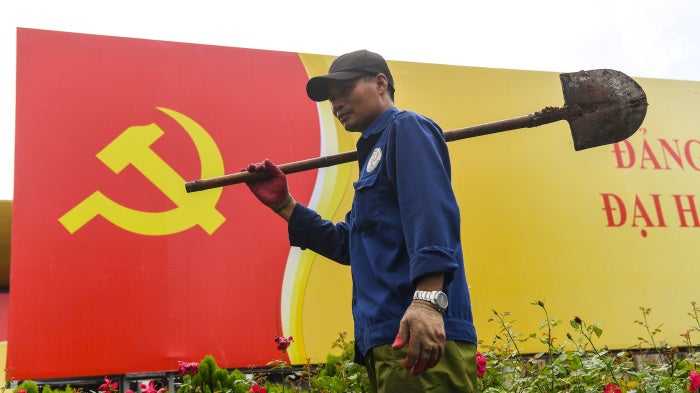
Under Vietnam’s constitution and laws, the VGCL and its “trade unions” explicitly fall under the control of Vietnam’s ruling party, the Communist Party of Vietnam, and the party’s Fatherland Front, the overarching leadership body of the party’s apparatuses.
The VGCL’s leaders at every level are chosen or approved by party officials and its budget is provided by the government and mandatory fees paid by employers and workers. The VGCL and its enterprise-level trade unions at times engage in activities ostensibly addressing labor rights issues, but only on a limited basis and not as genuine representatives responsive to workers’ needs. When VGCL unions engage in negotiations with company management about workers’ wages or working conditions, they ultimately do so in the interests of the government and the Communist Party, not on behalf of workers, and not in a representative capacity. VGCL unions do not engage in collective bargaining specifically on workers’ behalf. None have ever called for a strike or led any confrontational activities against employers.
* * * * *
The workers, labor activists, experts, and lawyers interviewed for this report made several similar points about the situation of labor unions in Vietnam: workers are legally and practically barred from organizing independent unions, and ostensible legal reforms—particularly the 2021 Labor Law—only exist on paper and have not been implemented. As many told us, to allow independent unions under Vietnam’s Labor Law (or what the law calls “worker representative organizations”), the government would have to issue implementing regulations and pass additional laws to create an administrative framework in which these organizations could come into existence and operate legally. These regulations would need to include provisions for organizations to register, engage in collective bargaining, seek protection from employers, and resolve disputes, among other needs. The Vietnamese government has not created any such institutions.
Those interviewed also said that even if procedures were adopted to allow organizations to form under the Labor Law, any exhibition of independence by these organizations would result in the authorities using penal code provisions to target their leaders or organizers.
Vietnamese authorities enjoy free rein to prosecute labor organizers. Vietnam’s penal code criminalizes free speech activities and organizing protests, strikes, or activities whether against the government or private companies, as acts “undermining the unity policy,” acts “propagandizing” or “disseminating” information or materials to “oppose the State of the Socialist Republic of Vietnam,” or acts “abusing the rights to democracy and freedoms to infringe upon the interests of the State.”
The government of Vietnam has a long record of using these vague and overbroad provisions to prosecute labor organizers and human rights defenders. The police routinely suppress the creation of any independent organizations outside of the government’s control. In the last 10 years, authorities have detained and imprisoned numerous prominent independent journalists, bloggers, and activists, including Pham Doan Trang, Pham Chi Dung, Nguyen Tuong Thuy, Nguyen Lan Thang, Can Thi Theu, and Hoang Thi Hong Thai. Several of these advocates were also prominent advocates for labor rights issues.
At any given time in the last decade, Vietnam has held approximately 150 to 180 political prisoners, either awaiting trial or imprisoned after unfair convictions. This repression has increased in more recent years: in 2025 and 2026, authorities have jailed over 50 dissidents.
The Vietnamese government’s animosity toward independent unions, and any entities independent of the VGCL, has remained nearly constant for decades. The government continues to repress all nascent efforts to organize unions and any activities deemed as a threat to the government. This is among the reasons why many labor organizers and workers do not even attempt to organize independent unions.
“A union has to have its own freedom, and freedom to grow,” said exiled labor organizer Nguyen Thi Thuy, among those interviewed for the report. “But the party remains the leadership of all things in Vietnam.”
Government statements and articles from government-controlled media outlets and websites demonstrate authorities’ hostility toward independent unions. These include reports and “Crime Warnings” in which officials portray independent trade unions as “reactionary” forces opposed to the government and the Communist Party and describe how labor organizers and civil society groups seeking their creation are engaged in “subversive” and “sinister” plots to undermine and sabotage the government. As one state-controlled media report stated:
Their objective is to mobilize forces and gradually form opposition political organizations under the guise of groups styling themselves as “independent trade unions.” This constitutes dangerous conduct; while ostensibly cloaked in the name of protecting workers’ interests, its true objective is to undermine the role of the Vietnam Trade Union [the VGCL], confront the State, and sow social instability.
Beyond the repressive and intolerant atmosphere, an additional obstacle facing labor organizers is that Vietnam’s touted reforms, even if implemented, would be inadequate to protect labor rights and meet international standards. As several organizers noted, even if permitted, such organizations would have extremely limited powers under Vietnamese law, far beneath what is demanded by international standards on independent trade unions. The Labor Law contains several excessive restrictions on union organizing and calling for strikes. And, as many of those interviewed said, if any actual unions came into existence, the authorities would likely force them to become part of the VGCL and not remain independent.
The Vietnamese government’s intolerance for independent trade unions has also harmed other labor rights of Vietnamese workers. By systematically undermining a fundamental right of workers—their right to form and join unions of their choosing—the government on an ongoing basis is suppressing a vital mechanism that could enable workers to realize other labor rights to which they are entitled under international human rights law. Without the freedom to form independent unions, workers in Vietnam are less able to meaningfully bargain or be represented to seek higher wages, better working conditions, or remedies or redress for individual and collective work-related grievances.
* * * * *
Over the past 10 years, the Vietnamese government has made numerous false, misleading, or disingenuous claims about its supposed labor reforms, including at the United Nations Human Rights Council and other UN institutions, and to trading partners seeking to forge or implement trade agreements with Hanoi. In trade negotiations and ongoing diplomatic dialogues with trading partners—in particular with the European Union for a European Union-Vietnam Free Trade Agreement (EVFTA), the United States, and countries in the Comprehensive and Progressive Agreement for Trans-Pacific Partnership (CPTPP), including Canada, Australia, Japan, and Mexico—the Vietnamese government has attempted to present Vietnam as an increasingly open society with a government meaningfully engaged in labor rights reforms.
More specifically, the government has attempted to portray recent reforms to Vietnam’s Labor Law (2021) and Trade Union Law (2025) as though they have created avenues for workers to form and join independent trade unions. At the same time, Vietnamese officials have repeatedly claimed—pointing to VGCL enterprise-level trade unions—that trade unions already exist, freely operate, and represent workers.
Many of Vietnam’s trading partners have accepted Hanoi’s claims about reform without adequate scrutiny of them, some even claiming that their negotiations compelled the supposed reforms and that the trade agreements will continue to compel Vietnam to improve its labor record.
Several multinational law firms and policy analysts have issued guidance documents accepting that reforms have been implemented as described by the government, and many companies operating or investing in Vietnam appear to believe that independent unions can exist in Vietnam or that the VGCL unions are independent trade unions.
Human Rights Watch’s findings demonstrate that this is not the case and that almost all of Vietnam’s recent supposed labor reforms are cosmetic or illusionary. The government has taken no meaningful steps to implement international labor treaties on the right to organize or implement purported reforms in its own legislation, nor created any working administrative architecture to facilitate the creation of independent unions. Ultimately, Hanoi has taken no steps to foster an environment in which independent unions could legally emerge.
These findings, beyond documenting Vietnam’s patterns of labor rights abuses, highlight the government’s duplicitous conduct and the unwillingness of its trading partners to hold the Vietnamese government to account for its inactions and unmet pledges.
Human Rights Watch is setting out below recommendations outlining actions the Vietnamese government should take to demonstrate a genuine commitment to respect the right to form independent unions, and actions Vietnam’s trading partners should take to pressure them to do so.
Recommendations
To meet its obligations under international human rights law and fulfill labor provisions in its trade agreements with other countries, the Vietnamese government needs to implement meaningful legal reforms and adopt more rights-respecting laws and policies.
Trade partners, businesses, and international institutions with influence in Hanoi should urge the Vietnamese government to reform. The European Union and other governments that have entered into free-trade agreements with Vietnam should be citing those agreements in pressing Vietnam to make and implement real reforms.
If necessary, trading partners should impose measures provided for in those agreements to withhold or restrict future tariff reductions to Vietnam that are scheduled in trade agreements and utilize other economic incentives to encourage Hanoi to adopt reforms.
Recommendations to the Government of Vietnam
- Repeal or amend provisions in the Labor Law that impose overly strict restrictions on the formation and powers of worker representative organizations. New provisions should clarify that worker representative organizations can be formed without affiliation with the Vietnam General Confederation of Labor (VGCL) and allow organizations to set their own internal rules, form regional and sectoral federations, and seek remedies with effective dispute resolution mechanisms.
- Repeal or amend—and in the meantime halt—the use of vague and overbroad provisions of Vietnam’s penal code that make labor organizing or advocating for workers’ rights a criminal offense. Problematic provisions include those criminalizing “undermining the unity policy” (article 116), “making, storing, disseminating or propagandizing information, materials and products that aim to oppose the State of the Socialist Republic of Vietnam” (article 117), and “abusing the rights to democracy and freedoms to infringe upon the interests of the State, the legitimate rights and interests of organizations, individuals” (article 331).
- Unconditionally release all labor activists imprisoned or detained for their labor organizing activities and permit exiled labor activists to return to Vietnam if they choose to, without facing prosecution or harassment. Allow civil society groups and union organizers to provide support to workers in establishing independent trade unions and enterprise-level worker organizations.
- Repeal or amend provisions in the Labor Law that disqualify worker organization leaders with criminal convictions, given that many labor organizers in Vietnam have previously been charged under vague and overbroad provisions of the penal code criminalizing free speech.
- Issue implementing regulations to the Labor Law to establish an entity to register worker organizations and independent (non-VGCL-run) trade unions, and an independent arbitration board to implement provisions of the Labor Law on worker organizations. These mechanisms should register worker organizations and resolve disagreements between the government and worker organizations, for instance, regarding their registration, permission to operate, and other legal issues. Such mechanisms should not be part of the existing judicial system, which is not independent of the Communist Party of Vietnam. For these mechanisms to have credibility as independent bodies, their staff will need to be appointed through a nomination process involving workers organizations, the VGCL, and the International Labour Organization (ILO).
- Reform the Labor Law and Trade Union Law by creating a level playing field for unions and enterprise-level worker organizations or worker representative organizations in relation to the VGCL, which has greater authority than worker organizations under the Labor Law. These organizations— whether called trade unions or worker organizations—should be able to function in accordance with ILO Convention No. 87 and No. 96.
- Strengthen provisions in the Labor Law prohibiting interference by employers in labor organizing activities and discriminating against workers who are members of the organizations. Implementing regulations should provide effective enforcement mechanisms for these provisions, preferably by the independent labor board described above, and define more precisely what activities constitute interference and discrimination.
- Remove excessive restrictions on strikes in the Labor Law consistent with international law, expand the rights of worker organizations to organize strikes and form federations and call for solidarity strikes, and until these changes are achieved in law and practice, refrain from treating private sector “wildcat” strikes as illegal.
Recommendations to Vietnam’s Trading Partners
- Consistently raise concerns about violations of labor rights in Vietnam at the highest levels of diplomatic engagement and negotiations, including in the context of economic and trade talks, and call upon the Vietnamese authorities to cease the harassment and arbitrary arrest, detention, and imprisonment of labor organizers and activists, and release those who are currently in detention.
- Call on the Vietnamese government take significant and meaningful steps, including those outlined above, to fully protect labor rights in law and in practice, including the right to freedom of association and the right to organize and bargain collectively, including the right to strike.
- Countries and institutions that are members of free trade agreements with Vietnam or similar economic agreements, should conclude or initiate, as appropriate, reviews of Vietnam’s compliance with its human rights and labor rights obligations under those agreements and adopt measures, including punitive measures as necessary, to remedy Vietnam’s serious violations and provide incentives for reform.
Recommendations to the European Union
- In addition to the recommendations above, the EU should also communicate to the government of Vietnam that their actions, including abuses documented in a February 2025 Complaint filed with the EU’s Single Entry Point by FIDH and other human rights groups (detailed below), amount to breaches to the EVFTA’s Trade and Sustainable Development chapter. EU governments should formally and publicly inform the Vietnamese government that unless concrete and measurable progress is made to address their violations, the EU will implement articles 17.18 and 17.22 of EVFTA, allowing parties to take the necessary “appropriate measures” in case of breach of the agreement, which can include suspension of benefits Vietnam enjoys under the agreement, such as reductions on tariffs on goods from Vietnam.
- Negotiate with Vietnam to create a dispute settlement mechanism under Chapter 15 of the EVFTA to address complaints of violations of the agreement.
- Issue business guidance, drawn from Vietnamese government labor rights law and practices, outlining risks of legal liability for businesses operating in Vietnam and possible complicity in labor rights violations.
- Consistently and publicly raise human rights and labor rights concerns, expectations and consequences at the highest levels of engagement, including summits and other high-level visits, and through the delegation in Hanoi, and stop relegating concerns to yearly and largely unproductive “human rights dialogues.”
Specific Recommendations to Australia, Canada, Mexico, the United Kingdom, New Zealand, Japan, and Other Members of the Comprehensive and Progressive Agreement for Trans-Pacific Partnership
Communicate to the government of Vietnam that its actions and abuses constitute breaches to the CPTPP’s article 19 on labor rights. Governments should formally and publicly inform the government of Vietnam that unless concrete and measurable progress is made to address their violations, they will utilize processes and adopt measures under the agreement to remedy breaches of its provisions, which can include the suspension of tariff reduction benefits under the agreement.
Methodology
From June 2025 through August 2026, Human Rights Watch conducted remote and in-person interviews with over 30 labor rights advocates, workers, political dissidents, lawyers, academics, foreign diplomats, and civil society and other independent observers familiar with labor rights in Vietnam.
Most of those interviewed for this report were provided anonymity due to the high risks of arrest and prosecution in Vietnam for speaking critically of the government, or speaking with a human rights organization. Vietnamese living in exile face transnational repression—cross-border harassment and threats from the Vietnamese government.
While Human Rights Watch was conducting research for this report, the Vietnamese authorities criminally charged and later convicted in absentia one of the people we interviewed, a former political prisoner exiled in the European Union, ostensibly for violating Vietnam’s penal code provision criminalizing criticism of the government or the Communist Party of Vietnam. The charges stem from articles the individual published on social media criticizing the government.
Most of the interviews were conducted in Vietnamese. A small number were conducted in English or in English with a Vietnamese interpreter. Those interviewed in Vietnam were mostly located in the country’s north and central provinces. Human Rights Watch obtained oral consent for each interview and informed interviewees of the purpose of the interview, its voluntary nature, and how information would be used. Those interviewed did not receive any compensation, benefit, or other incentives for speaking with us.
All interviews were cross-checked with publicly available information and other available secondary literature on labor rights in Vietnam. Human Rights Watch also undertook extensive searches of Vietnamese language articles about labor issues in state-run media and online posts to social media by government entities and writers and critics of the government. We also obtained feedback on our findings from labor rights experts at other nongovernmental organizations.
Background
Vietnam’s Record
Vietnam is a one-party, authoritarian state. Its ruling party, the Communist Party of Vietnam, is fully integrated into the organs of governance, with a presence at every level of society, from commune level up. Governance is tightly controlled by the top leadership of the Communist Party’s central politburo Vietnam’s elections are tightly controlled and scripted in which the Communist Party and the party’s Fatherland Front approve all candidates to serve on the National Assembly, which in turn carries out the instructions of the party’s leadership.
The Communist Party likewise appoints and oversees the judiciary. The authorities routinely use vague and overbroad penal code provisions to target critics and dissidents. The Ministry of Public Security, a domestic police and intelligence force, oversees a vast network to surveil and control the population. The party’s apparatuses have been used by the party leaders to reward loyalty or alternatively punish criticism and dissent.
Suppression of Efforts to Organize Unions
The Vietnamese government has a long history of animosity towards independent labor organizers. A 2009 Human Rights Watch report documented how authorities dismantled several nascent independent unions that formed in 2006-2007 and prosecuted their organizers and members.[1]
As recently exiled lawyer Dang Dinh Manh said: “In the past, there were a few independent trade unions established, but they were all suppressed by the Communist regime through the arrest of their founders.”[2] Nguyen Tien Trung, another exiled human rights defender, said that labor organizers and many workers were familiar with those past efforts, which were “severely suppressed.”[3]
During a wave of wildcat strikes in 2006, activists and striking workers issued calls to the government for the dissolution of all state-controlled labor unions and the release of workers arrested for participating in strikes. They also sought assistance from the International Labour Organization (ILO) to organize independent labor unions.[4] In October 2006, workers and activists then attempted to form two independent unions, the United Worker-Farmers Organization of Vietnam (UWFO) and the Independent Worker’s Union of Vietnam (IWU).[5]
Vietnamese authorities promptly arrested UWFO’s leaders and members, placed IWU’s leaders under house arrest, and later charged them and several of the union members with penal code provisions outlawing propaganda against the state and disturbing social order. All were ultimately sentenced to prison for terms of one to four years.[6] An activist and leader in a separate dissident group, Huynh Nguyen Dao (also known as Huynh Viet Lang), who earlier that year had issued a lengthy critique of Vietnam’s violations of labor rights, was also arrested in August 2006, convicted and sentenced to a two-and-a-half year term. Another human rights lawyer and advocate, Le Thi Cong Nhan, who supported the budding labor union movement, was arrested and convicted in 2007 under the same charge and sentenced to three years in prison.[7]
In 2008, the labor and human rights advocate Hoang Binh launched a new organization, the Viet Labor Movement, meant to advocate for labor rights and creation of independent trade unions.[8] But his efforts were likewise suppressed, and Vietnamese authorities harassed Hoang Binh for his work then and several times thereafter.
In December 2015, police detained Hoang Binh for distributing leaflets advocating for the formation of independent labor unions. The leaflets stated that the government had recently promised that workers would be able to form independent unions under a proposed economic agreement then under negotiation with the United States—the Trans-Pacific Partnership. He was released—possibly to placate officials in the Obama administration who raised his case. But in 2017, after the Trans-Pacific Partnership negotiations collapsed, authorities again arrested Hoang Binh and charged him under article 258 of Vietnam’s penal code, which prohibits “abusing freedom and democracy to infringe upon the interests of the State.”[9] He was tried and sentenced to 14 years in prison. As of October 2026, he remains imprisoned.
Vietnam has prosecuted and imprisoned several other labor rights organizers in the past decade, including other leaders and members of the Viet Labor Movement. These include Do Thi Minh Hanh, sentenced in 2010 to seven years, and Trong Minh Duc, sentenced in 2017 to 12 years, among others.[10]
Beyond the labor rights sphere, the government has prosecuted and imprisoned many other dissidents using one or more of the penal code’s vaguely worded and loosely interpreted provisions, which essentially make all protest and criticism of the government a criminal offense.[11] In the last 10 years, authorities have imprisoned prominent independent journalists, bloggers, and activists including Pham Doan Trang, Pham Chi Dung, Nguyen Tuong Thuy, Nguyen Lan Thang, and Can Thi Theu. Some of these advocates—such as Pham Doan Trang—have also advocated on labor rights issues. Nguyen Tien Trung, the exiled human rights defender, is personally familiar with Vietnam’s broad use of its penal code’s overbroad provisions to suppress dissent: he was charged and convicted in 2010 for anti-state propaganda, essentially for engaging in human rights advocacy and pro-democracy protests and sentenced to seven years in prison.[12]
At any given time in the last decade, Vietnam has held in detention 150 to 200 dissidents and critics, either facing charges or imprisoned under these provisions.[13] In recent years, the authorities have increasingly used these provisions to silence critics. In 2025 and 2026, authorities have detained over 50 dissidents.[14] For instance, in June and July 2026, police arrested and charged five people under penal code article 117 for their roles in publishing a book about Ho Chi Minh, the founder of Vietnamese communism, that appear to have angered the government. In July 2026, a court convicted the dissident Hoang Thi Hong Thai and sentenced her to six years in prison based on comments on social media criticizing the government’s abuses of the penal code.
As several lawyers and labor organizers interviewed noted, these penal code provisions continue to give the government an easy means to silence or crush any independent unions or labor organizers, simply by arresting and charging them under one or more of the code’s vague and overbroad provisions.[15]
The VGCL’s Status as a Governmental Entity
As noted by many of those interviewed for this report, the Vietnam General Confederation of Labor (VGCL)—discussed further below—is not an independent trade union.
On the contrary, the government has direct authority over the VGCL under Vietnam’s Trade Union Law, which legislates its mandate and powers.[16] Since 2013, the VGCL’s mandate and authority have also been outlined in article 9 of Vietnam’s constitution, and amendments in 2025 to both the constitution and the Trade Union Law clarify that all worker organizations in Vietnam come under VGCL control. 2025 amendments to the constitution specifically provide that the VGCL is a “socio-political organization” under the control of the Fatherland Front and serving as the sole representative of workers at the national level.[17] The amended constitution specifically states that the VGCL and several other labor-oriented entities (e.g., the Vietnam Farmers’ Association, the Ho Chi Minh Communist Youth Union, the Vietnam Women’s Union, and the Vietnam Veterans’ Association), which are ostensibly tasked with “representing and protecting the legitimate and legal rights and interests” of their members, are to be organized, coordinated, and led by the Vietnam Fatherland Front.[18]
Legal Terminology: Trade Unions, Worker Organizations, and the VGCL Under Vietnamese law, the term trade union (công đoàn) typically refers to organizations that are part of the Vietnam General Confederation of Labor (VGCL), organized under Vietnam’s Trade Union Law, which dictates the organization of the VGCL overall and both enterprise-level and sector-wide “trade unions” under its control. Separately, Vietnam’s 2021 Labor Law introduced the term enterprise-level worker organizations (tổ chức của người lao động tại doanh nghiệp) while also using the term grassroots worker representative organizations (tổ chức đại diện người lao động tại cơ sở), which is a term that also appears in the Trade Union Law to refer to VGCL trade unions at the factory or enterprise level. (The term in the law that translates as “grassroots,” cơ sở, does not connote the sense of growth from below or from roots but rather that the organization exists at the base level—at the workplace or factory level.) As provided by both laws, if enterprise-level worker organizations “choose” to affiliate to the VGCL, they become VGCL trade unions and then fall under the terms of Trade Union Law rather than provisions of the Labor Code relating to worker organizations. The Trade Union Law separately provides that if a workplace does not have an enterprise-level union or worker organization, higher-level VGCL trade unions are responsible for workers’ rights and interests. These terms are often conflated in media reports and online legal analysis about Vietnam’s labor rights situation. Complicating the terminology, the Vietnamese government—without explicitly using the words for “independent” (độc lập)—has since the adoption of the latest draft of the Labor Law in 2019, repeatedly sought to portray all of the above entities—both existing trade unions under the VGCL and any organizations that might be formed under the Labor Law—as if they were independent trade unions. But as Human Rights Watch found, any supposed trade unions in Vietnam are VGCL-led, and any worker organizations said to exist in Vietnam are under the authority of the VGCL, and thus not independent. As exiled lawyer Dang Dinh Manh told us: “In the current political context in the country, I can affirm that it is impossible for any independent trade union to be established and survive.” |
Since new provisions in the Labor Law took effect in January 2021, the only substantive implementation has been a June 2021 resolution by the Vietnam Communist Party’s politburo, “Vietnam Communist Party Politburo Resolution No. 02-NQ/TW,” not a legal or regulatory provision implementing the law but instead a set of instructions for the party.[19] The resolution aims to “enhance the leadership of the Party over the organizations and activities of all unions” to “guarantee the comprehensive and absolute leadership of the Party” over all unions—language which only reinforces that the government never intended to allow independent unions to form. The resolution provides for the party and government officials to manage and exercise control over any worker organizations created under the new law, essentially ordering officials to compel workers and employers to conduct surveillance on worker organizations and “identify” – and presumably report to authorities – any activity that “exploits” worker representative organizations “to infringe upon national security or disrupt public order.”[20]
Resolution 02-NQ/TW, and several subsequent official statements about it, are focused on strict party control of all labor issues in Vietnam, and propaganda reinforcing the Communist Party’s legitimacy and single-party control. Resolution 02-NQ/TW further states that independent worker organizations unaffiliated with the VGCL pose threats to national security and public order.
State control over all VGCL labor entities has been further demonstrated by an internal Communist Party directive that leaked to media in 2024. Directive 24, as it is called, ordered government and party officials to enhance scrutiny of labor groups, civil society, and foreign organizations, and more specifically those involved with or commenting on Vietnam’s implementation of new trade agreements with other countries and with the ILO.[21]
In recent years the government has carried out several arbitrary arrests and prosecutions of commentators on labor reforms, and even of labor officials within the government and VGCL, further reflecting its policies and attitudes about the VGCL and trade unions. Notably, in 2019, while the EVFTA was still being debated in Europe, the journalist Pham Chi Dung was arrested in 2019 after writing a message to the European Parliament critical of the agreement.[22] In 2021, two labor rights activists, Mai Phan Loi and Dang Dinh Bach, were arrested after they tried to join the Vietnam Domestic Advisory Group under the EVFTA, a body meant to be comprised of government and civil society representatives and tasked with monitoring implementation of the agreement.[23]
In April 2024, Vietnamese police arrested Nguyen Van Binh and Vu Minh Tien, senior officials in Vietnam’s then Ministry of Labor and the VGCL who had advocated for more meaningful labor reforms and some form of independence for trade unions.[24] At least one of the two likely would have been appointed to the EVFTA’s Vietnam Domestic Advisory Group. In a statement in November 2024, the EU Domestic Advisory Group (DAG), a civil society monitoring body established under the free trade agreement, strongly condemned the “arbitrary arrests” of Dang Dinh Bach, Nguyen Van Binh (“the EU’s and ILO’s main negotiation partner on labour reform”) and Vu Minh Tien, flagging their expectations that those arrested should have been members of the Vietnam DAG. “In these circumstances, [the EU DAG] restates its concerns regarding the ability of the Viet Nam DAG to work properly,” it said.[25]
In Their Own Words: Organizers, Workers, and Experts
“There are no independent trade unions in Vietnam,” said M.N.Q., a worker and member of an underground labor rights group. “This is because trade unions in Vietnam are controlled by the Communist Party of Vietnam.”[26] H.H., an exiled labor rights organizer, said almost the same. “Currently, there are no truly independent trade unions operating legally in Vietnam.” He explained:
The main reason there are no independent unions is because the Vietnamese government does not allow any labor organizations to operate outside of state control. Establishing an independent union is often considered an “anti-state” act and those who attempt to organize such an organization can be monitored, threatened, fired, or even imprisoned.[27]
H.K.N., a worker, said:
There are no independent trade unions in Vietnam. The reason is this: to maintain its dominant position, the Communist Party-controlled Vietnamese government, drawing lessons from the collapse of the Soviet Union and Eastern European bloc in the late 1980s and early 1990s, has not wanted and have consistently sought to delay or hinder the development of civil society, including independent trade unions.[28]
G.N.Y., a worker, said that even if workers on their own were somehow able to form some type of independent organization to represent them, it would result in its leaders either getting co-opted into the VGCL apparatus, or persecuted:
Vietnamese law does not allow them to be established. Anyone who has the idea of mobilizing a union will be immediately suppressed – beaten, arrested, imprisoned with many charges.
The nature of an independent trade union is to oppose the Communist Party of Vietnam and demand the rights of workers. This will affect the party’s interests, especially their power. So the party will use every method to prohibit the establishment of trade unions.[29]
Workers, labor organizers, lawyers, academics, and other observers interviewed for this report were consistent in saying that any all-existing trade unions or worker representative organizations in Vietnam were not independent and—as outlined in the Background section above—legally under the control of the government-controlled VGCL.
N.B., a worker in a city near Hanoi, said that VGCL-controlled trade unions were generally not responsive to workers’ needs: “In the various organizations where I have worked—including my current workplace—union activities exist merely as a formality. Whenever the union representative proposes or decides on a specific matter, they invariably have to gauge the boss’s reaction first [referring to management].”[30]
VGCL leaders at the factory level, N.B. said, typically hold a relatively high-ranking position within the company—such as managers—and “tend to prioritize safeguarding the interests of the institution itself rather than protecting the rights and welfare of the employees.” He added: “When it comes to advocating for issues such as increased lunch allowances, sick leave support, or assistance with life events (weddings, funerals, etc.), they [VGCL enterprise-level leaders] dismiss such requests immediately whenever possible, showing no regard for the collective opinion of the majority.”[31]
The VGCL as Quasi Mediator A 2024 ILO Working Paper on union organizing in the Asia region, noting that the VGCL is “the only trade union in the country” detailed how VGCL enterprise-level trade unions and “grassroots workers organizations” set up by the VGCL do not engage in most of the core activities of independent unions.[32] Workers do not elect the leaders, and these entities do not genuinely represent workers nor adequately communicate to employers workers’ complaints, requests or demands. Whatever enterprise-level “bargaining” or “negotiations” that takes place involving VGCL-affiliated unions or workers organizations typically only produces the minimum baseline protections that are already part of Vietnamese laws or policy.[33] Workers do not have the right to hold strikes, and the VGCL—with its primary duties under law to the party and government—does not organize strikes. A 2019 ILO discussion paper on the VGCL’s role in Vietnam described VGLC unions as engaging in “bridge negotiations,” in contrast with “representative negotiations.” The paper stated:
VGCL leaders, the paper adds, are typically drawn from management:
The paper also observes that bridge negotiations are ineffective compared to representative negotiations. In collective bargaining, trade unions “represent the workers [and] are on equal footing with the employee.”[36] The paper notes that in bridge negotiations, “[t]he workers hold a weak position.” Negotiations occur “only to resolve a conflict right after it happens. … Negotiation takes place only after a conflict/strike,” implying that outside of situations in which unauthorized and spontaneous strikes occur, VGCL trade unions are not involved in negotiations about workers’ rights. Entities engaged in bridge negotiations are “unable to function as a representative to protect employees in a market economy.” As a result, “[e]mployees cannot participate in decision-making related to them,” the paper noted. Another effect: “Low salaries, poor working conditions and the risk of exploitation.” |
L.L., a labor organizer, said that most workers in Vietnam, if they could form true independent unions, would want them to prioritize higher wages, fewer work hours, paid overtime, working conditions, the “spiritual well-being” of being treated with dignity, and benefits for their families, such as health care and educational opportunities for their children. But to turn any of these aspirations into reality, he said, “workers urgently need organizations that are truly politically independent—not merely peripheral bodies of a political party—to represent their legitimate interests.”
Nguyen Tien Trung, the exiled former political prisoner and human rights defender cited above, said that the end result of Vietnam’s suppression of independent unions was lower wages and poorer or more dangerous working conditions:
Vietnamese workers suffer a lot of abuses, such as a toxic environment, low wages, and with no right to form independent unions to represent them. So they suffer a lot of disadvantages compared to employers and the state. The need for workers’ organizations to have the right to form independent unions is very great.[37]
Q.D.A, a worker who had tried without success to organize factory workers, outlined the unresponsiveness of the VGCL. He said that “in theory” the VGCL is tasked by the party to represent workers, yet “in reality, many workers believe that the VGCL does not protect their rights, [for instance,] when they have conflicts with employers or when their rights are violated.”[38]
Recounting his experience with enterprise-level VGCL trade unions, he said:
Workers cannot choose the leaders of the VGCL [an enterprise level VGCL trade union]. The reason? The leaders of the trade union are not directly elected by all workers. The appointment of leaders is often done through the mechanism of “organizational assignment” or “recommendation-then-formal election” from top to bottom. [That is, party leaders choose a slate of representatives and then hold an “election” in which workers have no choices other than to select them.]
In many enterprises [factories, workplaces], union members are human resources officers or people recommended by the board of directors, not actually selected by the employees.
G.N.Y. said that workers “do not have a real right to choose the leaders.”
There may be a form of voting but the people they choose are pre-selected with many tricks to force workers to agree [to select them]. Fake freedom.
VGCL [at enterprise-level] is essentially a grassroots party organization. An extended arm of the ruling party. VGCL has the function of protecting the party to serve the ruling regime. There is no protection for workers. . . The Communist Party of Vietnam leads comprehensively and absolutely. They do not share power.[39]
As several people interviewed pointed out, the president of the VGCL, Nguyen Anh Tuan, is a senior leader in the Communist Party and Fatherland Front and he serves on the Communist Party’s Central Committee. For most of the last 20 years, he served as a Communist Youth League and Communist Party official and he was appointed to his current post by the Fatherland Front in March 2026.[40] Prior to becoming the president of the VGCL, he neither worked inside the VGCL nor had direct experience with labor issues.
ILO supervisory bodies over several years have established an international labor rights norm that unions are entitled to financial independence and the right to administer themselves without control or interference by the state.[41] But as noted in the 2019 ILO paper cited above—and as many labor organizers and experts told Human Rights Watch—VGCL trade unions receive most of their budget from employers and the government.
C.H.Q., a retired professor in Hanoi with extensive knowledge of Vietnam’s legal system and labor sector, said: “In essence, the Vietnam General Confederation of Labor does not operate as a labor union. It is an administrative unit of the employers operating according to the goals of the ruling party, aiming at political stability and social stability.” [42]
B.N., a lawyer familiar with labor issues, similarly said: “The VGCL is a union established by the state to control the social activities of workers, so it is not independent and does not represent workers.” When asked whether workers can choose leaders of VGCL-controlled enterprise-level trade unions, he responded, “Absolutely not.” [43]
T.N.G., another lawyer and labor activist, concurred. “Currently, there are entities referred to as ‘trade unions’ established and operating in Vietnam. However, they are all organized by the Vietnam General Confederation of Labor and operate under its direction.”[44]
They are by no means organizations representing workers at the grassroots level – independent trade unions – as stipulated by the 2019 Labor Code. The Vietnamese government’s assertion to other nations that independent trade unions are currently operational – this is untrue, as these organizations remain members of the VGCL.[45]
T.N.G. contested government claims that the VGCL is composed of trade unions set up in accordance with international law, and that VGCL essentially acts as a federation of independent trade unions.[46]
The fact that Vietnamese government considers VGCL trade unions to be the only entities authorized under Vietnamese law to be involved in labor disputes is also confirmed in articles in state-run media. Take, for instance, accounts in state-run media from July 2026 about a labor dispute at a shoe factory in Thanh Hóa Province, about 150 kilometers south of Hanoi.
During the dispute, according to the accounts, workers reportedly engaged in a work stoppage—a so-called wildcat strike. According to reports, local government officials and VGCL officials, working with the factory’s management, formed an interdisciplinary delegation made up of VGCL and government officials to “resolve” the situation, which ultimately involved some wage and benefit concessions, according to the accounts. Notably, reports stated that the strike occurred after three employees formed a collective of workers—effectively an independent union comprised of several hundred workers. But as part of the local government’s response to the resulting work stoppage, police launched an investigation, identified three organizers, and imposed “administrative violations” against them.[47] The reports implied the three organizers had used misinformation to organize the workers, including that the factory “did not have a trade union.” The reports stated that the factory already had a “trade union”—meaning the VGCL’s enterprise level trade union—and added that it had been responsive to the workers’ concerns in helping resolve the dispute.[48] The reports disregarded the likelihood that the resolution was in the first instance the result of the work stoppage organized by the workers—which the authorities were investigating—not the efforts of the VGCL trade union.
In practice, as those interviewed for this report noted, the Vietnamese government has consistently opposed worker-initiated engagement in independent labor rights advocacy. In another case outlined in state-run media in September 2026, it was reported that police in Hanoi had fined a person for publishing a social media post that called on drivers on Grab, a driving and delivery gig work app, to stop working on September 12 and 13 as a “labor strike” against the company, related to lower compensation. Police said the fine was for “disseminating disinformation and unverified information, negatively impacting organizations and individuals.”[49]
As several people interviewed for this report noted, when wildcat strikes occasionally take place in Vietnam, state-run media reports typically mention the VGCL as an entity that gets involved in mediation between employers and workers after workers have initiated the strike.[50] This further demonstrates that the government doesn’t consider the VGCL to be a representative body for workers, but at best a government-backed intermediary.
C.H.Q., the professor and labor expert, said that the government remains anxious about the existence of any and all independent entities: “They fear the emergence of a countervailing force to the Communist Party.” He added:
[B]oth independent trade unions and civil society organizations are completely neutralized. The trade union movement as well as the democratic movement are paralyzed. Even if there are regulations for the registration and operation of independent trade unions, they cannot be enforced because they [the government] will use administrative procedures and illegal tricks to prevent them from operating.
Regardless of the government’s position, organizers and workers repeatedly emphasized that the creation of independent labor unions outside of VGCL control remains completely impossible in practical terms. Q.K., a Vietnamese labor organizer in exile in Thailand, said:
I know that Vietnamese law [referring to 2019 amendments to Labor Law that came into force in 2021] states that workers have the right to form their own labor organizations. But in reality, no one can exercise this right because, first, there are no guidelines or methods for registration. Second, authorities would deliberately create difficulties and delays in registering any organizations. Third, anyone who tries would be monitored, threatened, and labeled as a reactionary or anti-state. This is why there are no unions.[51]
Even if such organizations could form, Q.K. said, they would have no real power to represent workers, engage in collective bargaining, or organize strikes: “The legal procedure for organizing a lawful strike is so complicated that it is nearly impossible to follow. It would involve a decision by the VGCL and the Communist Party itself.” Spontaneous strikes, carried out without permission, tend to be “immediately deemed ‘illegal’ and suppressed.”[52] M.N.Q., the worker quoted above, said: “Under the regime of the Communist Party of Vietnam, workers do not have the right to call for strikes.”
As noted, wildcat strikes occasionally occur and result in VGCL mediations that achieve modest results. But in most workplaces, said Q.K., the organizer, workers suffering significant labor rights abuses are unable to express their grievances: “When I was a factory worker, I witnessed countless injustices: workers toiling over 10 hours a day for low wages, lacking legal contracts, and being easily fired if they voiced concerns or demanded their rights.”
The ILO, in a 2019 report on labor issues across Asia, noted of Vietnam: “all strikes since 1995 have been wildcat strikes, initiated by the workers themselves, not by the trade unions. This reveals problems with the representational functions of trade unions and with the procedures for labour dispute settlement.”[53] (Vietnam’s Labor Law contains provisions, in articles 198-211, that provide a framework for enterprise-level worker representative organizations to facilitate strikes at an enterprise level, but the provisions are so extensive and restrictive that they would make a legal strike impossible in practical terms.[54]
“The process of calling for a strike is very complicated and tightly controlled,” said Nguyen Van Dai, an exiled human rights defender. He noted that even if an independent union were allowed to exist, the Labor Law’s provisions would make strikes impossible in practice. “There is no actual right to strike without the tacit approval of the government.”[55]
H.H. similarly said, “The process of organizing a legal strike in Vietnam is almost impossible due to many strict conditions.”[56] He added that strikes that do take place in Vietnam “are spontaneous and considered illegal.”
Workers have quit their jobs en masse, protesting poor working conditions, low wages, or oppression by management. They cannot, or do not dare, follow the purported legal process because it is too cumbersome and can easily lead to retaliation.
Everyone interviewed for this report expressed the view that it was not possible that any VGCL trade union could or would ever utilize provisions on strikes in either the Labor Law or the Trade Union Law. Nguyen Tien Trung, the former political prisoner and labor rights advocate who fled Vietnam, said: “Of all the demonstrations by Vietnamese workers that have taken place in Vietnam [i.e., wildcat strikes], there has never been a demonstration or strike led or organized by the Vietnam General Confederation of Labor.”[57]
* * * * *
Advocates, workers, and organizers interviewed for this report said that they did not believe that the Vietnamese government, in negotiating recent trade agreements with trading partners, was serious about carrying out meaningful labor reforms.
L.L., the labor organizer, said that “the Vietnamese government has, to date, taken virtually no steps to concretize the innovative provisions [in the 2021 Labor Law] or, in other words, to translate the law into practical reality.”[58] The reason, he said, was that the government considers unions to be a threat to their hold on power, a point made by other organizers and experts.
The Vietnamese government is acutely aware of the pressure exerted by its democratic Western partners regarding labor rights (and the right to independent trade unions) through new-generation trade agreements such as the EVFTA and CPTPP. However, due to excessive apprehension regarding the risks of “peaceful evolution” or “color revolutions” — and lessons from the collapse of communist regimes in Eastern Europe – the government continues to attempt to delay for as long as possible concrete steps aimed at bringing about genuine change.[59]
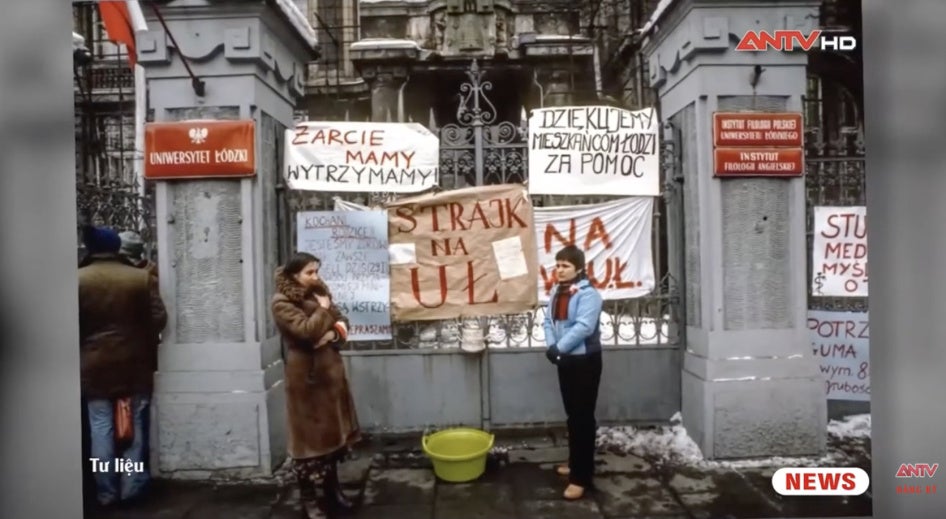
Government Anxiety Focused on Poland’s “Solidarity” Labor Movement in the 1980’s Evidence of the government’s anxieties about “color revolutions” and familiarity with the collapse of communism in Europe is often visible in state-run media articles about independent trade unions, which contain negative references and images of protests in Poland in late 1988 by the union Solidarność, or Solidarity, that led to the collapse of communist rule in Poland in 1989.[60] |
B.N., the lawyer in Hanoi, said that the labor law’s provisions on worker representative organizations (see Information Box on Vietnam’s labor laws above) appear to be written only to appease Vietnam’s trading partners on labor rights issues, “to deal with other countries and demonstrate to them that Vietnam has independent unions. In fact… there is no sign that the state is ready to allow the establishment of real workers’ organizations.”[61]
Referring to legal developments since 2021, L.L., the labor organizer, said: “It is evident that rather than liberalizing trade union freedoms in accordance with international commitments, the Communist Party of Vietnam appears to be trending in the opposite direction—namely, tightening controls and seeking to perpetuate its monopoly.”[62]
VGCL’s Focus on Control of Workers and “Patriotic Emulation”
People interviewed for this report said that Vietnamese authorities often represent VGCL trade unions and their actions as though the government genuinely supports unions and that the VGCL union activities are really meant to represent workers’ interests.[63] VGCL committees periodically hold meetings or conferences ostensibly to discuss labor rights issues including the creation of enterprise-level unions and implementation of the June 2021 party resolution meant to “implement” the labor law.[64] These conferences or events, however, do not resemble the types of meetings held by independent trade unions or federations elsewhere. Rather than providing a platform for workers to express themselves freely, these meetings give the floor to Communist Party officials who focus primarily on affirming existing VGCL priorities.
Q.D.A., the worker, said: “In Vietnam, such conferences and presentations take place frequently, yet the content invariably follows a stale, outdated format. The material is generic, offering nothing specific to comment on or evaluate.”
A major VGCL conference held in Hanoi on June 4, 2026, illustrates the extent to which the VGCL is a state and party-run institution. Vietnam’s leader, Communist Party General Secretary and State President To Lam delivered the keynote address. Prime Minister Le Minh Hung, National Assembly Chairman Tran Thanh Man, other politburo members, and other current and former party and state leaders also attended. According to state-run media, the conference lauded progress in promoting union membership, collective bargaining agreements, “workplace democracy,” and employee welfare.[65]
The state-run media reported that the president of the VGCL, Nguyen Anh Tuan, a senior Communist Party official, outlined in a speech how the VGCL had recently increased its focus on “patriotic emulation” to “encourage innovation and creativity among workers.”[66] He noted that “[t]he VGCL’s achievements reflect the close guidance of the Party, effective coordination among State agencies, local authorities, the Viet Nam Fatherland Front and socio-political organizations.”[67] The VGCL in coming years will “develop new productive forces, enhance labor productivity, and contribute to building a peaceful, independent, democratic, prosperous, civilized and happy Vietnam.”[68]
In Its Own Words: Government Statements Against Unions
The government’s actual views about independent trade unions are evident in Vietnamese-language articles in state-controlled or party-controlled media. Many of these portray efforts to create independent trade unions—and the civil society leaders and labor organizers seeking to organize them—as hostile and “reactionary” forces opposed to the government of Vietnam and the Communist Party and engaged in “subversive” and “sinister” plots to undermine and sabotage the government.[69]
In a November 2025 article on a local police department website under the heading “CRIME WARNING,” a Vietnamese police official warns that “hostile and reactionary forces—along with malicious elements—have aggressively intensified their propaganda activities and efforts to incite workers.”[70]
Their objective is to mobilize forces and gradually form opposition political organizations under the guise of groups styling themselves as “independent trade unions.” This constitutes dangerous conduct; while ostensibly cloaked in the name of protecting workers’ interests, its true objective is to undermine the role of the Vietnam Trade Union [the VGCL], confront the State, and sow social instability. . .
[T]he so-called independent trade unions in Vietnam are not legitimate organizations established by workers, nor do they represent the working class. The goal behind these organizations is to build a domestic political opposition force, preparing for color revolution-style riots and street disturbances aimed at overthrowing the Communist Party of Vietnam and eliminating the current political regime.[71]
A January 2026 article on the website of the local government and party in Hung Yen province likewise warns that “hostile and reactionary forces have intensified their propaganda of false and hostile viewpoints.”[72]
Their aim is to entice workers, consolidate their forces, and gradually form opposition political organizations under the guise of illegal groups styling themselves as “independent trade unions.”
This constitutes dangerous conduct that adopts the “guise” of representing workers’ interests, yet its actual objective is to dismantle the role of the Vietnam Trade Union organization [the VGCL], confront the State, and destabilize society.[73]
The article, mentioning the then-upcoming 14th National Congress of the Vietnam Trade Union in June 2026, describes how the “subversive activities” of these “reactionary” forces have “become increasingly sophisticated and insidious,” and warns of the dangers of enterprise level unions independent of government control. It refers to:
organizations lacking goodwill—and holding views opposed to our country … inciting workers to demand the establishment of independent representative organizations or independent trade unions directly within enterprises, with the ultimate goal of eliminating grassroots trade unions [i.e., worker’s organizations under the control of the VGCL] and negating the position and role of the Vietnam Trade Union organization [the VGCL].
This constitutes a dangerous political scheme that not only attacks the trade union system but also aims to undermine the leadership role of the Party and sow instability within society, following the script of a “color revolution.”
The so-called “independent trade unions” and “independent labor unions”—touted by organizations and individuals holding views hostile to Vietnam—can never genuinely represent the legitimate rights and interests of public servants and workers, nor do they possess any role in protecting the Vietnamese workforce. Outwardly, these organizations constantly preach that they “do not engage in politics,” proclaiming that their sole objective is to safeguard the legitimate rights and interests of workers and the working people. Yet, internally, they actively collude and coordinate with organizations dedicated to undermining the Vietnamese State. All these reactionary groups hide behind the guise of protecting workers’ rights, appropriating the mantle of worker representation to execute their sinister agenda—an agenda driven by reactionary motives aimed at sabotaging our Party and State. Their true objective is to exploit the State's policies—which permit the establishment of worker representative organizations outside the official Vietnam General Confederation of Labour—and to capitalize on the misconceptions held by certain workers. By doing so, they employ insidious, persistent propaganda tactics to entice workers and mobilize forces to oppose the Party and the State.[74]
An article in June 2025 in a Nghe An province Provincial Party Committee newspaper contains similar accusations and describes how the police work closely with the VGCL to ensure that all trade unions are firmly under the authority of the VGCL.[75]
An article in December 2025 in the state-controlled Vietnam News Agency, “Workers’ rights in the context of integration,” makes similar claims but in more muted tones, in a section entitled, “Refuting Distortions About ‘Independent Trade Unions’”:
Against the backdrop of Vietnam amending its laws to allow for the diversification of labor representative organizations at the grassroots level, certain ill-intentioned organizations and individuals have deliberately distorted the facts by claiming that “Vietnam bans independent trade unions,” or by demanding the acceptance of politically oppositional groups masquerading as “trade unions.”[76]
A March 2025 article in a media outlet of the National Assembly, another official stated that independent trade unions were essentially antithetical to the Communist Party’s core position that “[t]he Communist Party is the highest organization of the working class.” It notes that in the context of Marxist-Leninist theory, workers by definition were represented by the party, and that leaders from among the working class had to be part of the party and government, not independent of it.[77]
Vietnam’s International Legal Obligations
Relevant International Human Rights and Labor Law
Vietnam is a party to the International Covenant on Civil and Political Rights (ICCPR)[78] and the International Covenant on Economic, Social and Cultural Rights (ICESCR),[79] treaties Vietnam ratified in 1982. Vietnam ratified ILO Convention No. 98 on the Right to Organise and Collective Bargaining Convention in 2019.
The ICCPR protects the right to freedom of association. Both the ICCPR and the ICESCR, along with relevant ILO conventions, including ILO Convention 98, guarantee workers the right to form and join trade unions. These rights, and authoritative interpretations of them by the ILO Committee on Freedom of Association (CFA), unambiguously obligate governments not to thwart the formation of and participation in independent trade unions. Governments can prescribe legal formalities for establishing unions, but they cannot abuse this prerogative by prescribing regulations that impair (or “negate”) these fundamental labor rights guarantees.[80]
ILO Convention No. 87 on Freedom of Association and Protection of the Right to Organise Convention, which Vietnam has signed but not ratified, provides that workers have the right to join organizations “of their choosing without prior authorization” and that authorities should not engage in any interference that would restrict this right or impede its enjoyment.[81]
Vietnam’s Mischaracterizations of its Adherence to International Law
In seeking closer ties with trade partners, Vietnamese officials in recent years have repeatedly cited as evidence of their intention to reform the government’s ratification of several ILO labor rights treaties and its pledges to ratify others. They have also claimed that under the 2021 Labor Law, Vietnam now allows trade unions, which it refers to as “grassroots worker organizations” or “worker representative organizations.”
The government has also implied or stated without explanation that under Vietnam’s Trade Union Law and 2025 revisions, workers’ groups or trade unions operating within the government-controlled VGCL are in fact independent trade unions, even though as noted above Vietnam’s laws and constitution specifically provide that “trade unions” organized under the Trade Union law are controlled by the VGCL, which in turn is under the control of the Vietnamese government and Communist Party.
Notably, a review of statements by Vietnamese government officials on labor rights issues at the UN Human Rights Council and other public statements about unions to trade partners shows that they do not use the word “independent” in English or its equivalent in Vietnamese—độc lập—when speaking about trade unions in Vietnam.[82]
During Vietnam’s Universal Periodic Review in May 2024 at the UN Human Rights Council, Vietnamese officials stated that Vietnam upholds “freedom of association,” and that 125,000 “grassroots trade unions” exist in Vietnam, consisting of 11 million members and comprising 93 percent of all “eligible workers.”[83] In the same session, officials contended that Vietnam’s ratification of several ILO conventions was evidence of its commitment to labor rights, and that its amended Labor Law “was highly regarded by ILO and the international organizations as it was closely aligned with international labour standards, incorporating multiple provisions to ensure labour rights.”[84]
Also in May 2024 in the United States, Vietnamese officials made similar claims during a US Department of Commerce review of Vietnam’s status as a “non-market economy.”[85] An attorney for the Vietnamese government told US officials that Vietnam’s Labor Law “broadly adopts the international labor standards of the ILO and the labor commitments made under the CPTPP ensures core labor protections, such as the right to negotiate wages and working conditions through collective bargaining, freedom of association, and equality and non-discrimination.” The Vietnamese officials also stated, without providing evidence, that “[w]ages have risen in part because Vietnam has robust protections for collective bargaining. The right to join trade unions is provided by the amended law on trade unions.”[86]
Union membership in Vietnam has increased significantly in recent years, as nearly 5 million new trade union members have been admitted since 2018, and over 70 percent of enterprises have established grass roots unions.
Claims that Vietnam’s unions are not independent, and that only the state-controlled Vietnam General Confederation of Labor, the VGCL, has any authority, are not accurate. As Vietnam has explained, Vietnam has four levels of trade unions, from grass roots at the lowest, to VGL at the highest. Each level has the authority to elect the governing bodies of the higher levels, and thus all levels of unions interest are represented at the highest level.[87]
In earlier submissions to the US Commerce Department ahead of the hearing, Vietnam’s Ministry of Industry and Trade wrote that under Vietnam’s Labor Law, “the labor relationship” between employers and “employees’ organizations” is “established through discussion, negotiation, and agreement on the principles of voluntariness, goodwill, equality, cooperation and mutual respect for lawful rights and benefits.”[88]
The 2019 Labor Code approaches the progressive principles and international labor standards of the ILO and ensures the rights of workers in accordance with the international labor commitments that Viet Nam has made in line with Viet Nam’s process of implementing the Comprehensive and Progressive Agreement for Trans-Pacific Partnership (CPTPP) and European Union-Viet Nam Free Trade Agreement (EVFTA). … [T]he current [government] policies play an active role in promoting discussion and negotiation in order to create harmonious, stable and progressive labor relations.”[89]
The US Commerce Department rejected these arguments in a decision in August 2024, noting:
The Law on Trade Unions (2012) states that all trade unions must operate “in accordance with lines and policies of the Party.” Therefore, although trade unions are technically legal in Vietnam, trade unions that are fully independent from the GOVN [Government of Vietnam] and do not comply with the CPV’s [Communist Party of Vietnam’s] directives are illegal. …
[T]he government-run and -controlled VGCL remains the only legal labor union system in Vietnam, with which all trade unions must be affiliated, and is closely aligned with the CPV. According to the Law on Trade Unions (2012), the VGCL has the prerogative to “build the organizational structure and titles of trade union representatives,” as well as “perform the right and responsibility to own assets of trade unions.” This grants the VGCL undue discretionary power over the activities and management of any trade unions that may arise. Such authority provides the GOVN with the right to directly control trade unions and prevent them from operating independently.[90]
Vietnam’s Obligations and Pledges in Trade Agreements
In the context of trade negotiations, the Vietnamese government has broken several pledges about labor reforms made to trading partners, and it has made numerous false or misleading statements about steps toward such reforms.
In reaching trade agreements with the European Union in the EU-Vietnam Free Trade Agreement (EVFTA) and with other trading partners in the Comprehensive and Progressive Agreement for Trans-Pacific Partnership (CPTPP), including Canada, Australia, Japan, and others, the Vietnamese government specifically undertook joint obligations with parties to meet key labor standards and implement specific labor reforms. These include reforms of laws and regulations and carrying out activities to achieve those reforms in practice.
During and after negotiations for these agreements, Vietnamese government officials made several specific pledges about these reforms, both to trade partner governments and legislatures, as well as UN officials, including that it would achieve key benchmarks by specific dates.
In particular, the government did not fulfill pledges made to several trade partners that it would ratify by a specific date ILO Convention No. 87 on association and the right to organize.[91] Nor has the government promulgated implementing regulations for other ILO conventions that it has ratified, including ILO Convention No. 98 on the right to organize and collective bargaining, which it ratified in 2019.[92]
Under the European Union-Vietnam Free Trade Agreement (EVFTA), Vietnam is obligated to “make continued and sustained efforts towards ratifying ... the fundamental ILO conventions.” Ahead of the European Parliament’s vote on the trade agreement, the government pledged to ratify Convention No. 87 by the end of 2023. After it failed to do so, the government told EU officials and diplomats that it would ratify the agreement by October 2024. Ingrid Christensen, the ILO head in Vietnam, said on February 27, 2024: “We are confident Vietnam is committed to ratifying Convention 87 as early as possible.”[93]
The Vietnamese government also did not fulfill the pledges made to its partners in the CPTPP. Under the 2018 CPTPP’s Labor section, article 19.3, Vietnam agreed to “adopt and maintain in its statutes and regulations” rights outlined in the ILO Declaration, including the “freedom of association and the effective recognition of the right to collective bargaining.” In separate diplomatic communications with the ILO and CPTPP member Canada in 2023, it pledged to ratify ILO Convention No. 87 by the end of January 2024—another deadline that passed without action.[94]
Violations of Labor Provisions in Free Trade Agreements
In addition to the pledges above, Vietnam’s obligations under both the EVFTA and CPTPP include implementing already-ratified agreements and undertaking steps to meet other labor standards and implement its adopted reforms. Article 1 of the EU-Vietnam Partnership and Cooperation Agreement, the agreement under which the EVFTA was negotiated, identifies respect for international human rights laws and conventions as an “essential element” of the agreement.[95] Under the EVFTA specifically, parties undertake to “respect, promote and effectively implement” the ILO’s fundamental principles and rights at work, including “freedom of association and the effective recognition of the right to collective bargaining.”
EVFTA article 13.3 states that the “weakening the levels of protection in environmental or labour areas is detrimental to the objectives of [the trade and sustainable development] Chapter and that it is inappropriate to encourage trade and investment by weakening the levels of protection afforded in domestic environmental or labour law.” Paragraphs 2-4 of the article provide that each party “shall not waive or derogate from its… labour laws…. [S]hall not, through a sustained or recurring course of action or inaction, fail to effectively enforce its … labour laws,” and shall not apply labor laws “in a manner that would constitute … arbitrary or unjustifiable discrimination” between the EU and Vietnam “or a disguised restriction on trade” (for instance, by engaging or allowing the suppression of unions to keep national worker wages lower, thereby providing Vietnamese companies with an unfair trade advantage against the EU).
Beyond its disregard for these provisions, Vietnam has also failed to uphold its obligations to properly form a Domestic Advisory Group (DAG) under the trade agreement, including independent civil society representatives, to help monitor the agreement’s Chapter 13 provisions, make recommendations on compliance and implementation, and contribute to the resolution of disputes. Rather than facilitate or create a Vietnam DAG, as detailed above authorities in 2021 arrested and prosecuted two civil society representatives who tried to join the group. In November 2024, the EU DAG strongly criticized Vietnam for its actions and stated that the Vietnam DAG was not “working properly.”
Failures by Trading Partners to Hold Vietnam Accountable
In February 2025, the nongovernmental Federation for Human Rights (FIDH), the Vietnam Committee on Human Rights, and other civil society groups filed a formal complaint with EU trade authorities under the EU’s “Single Entry Point” complaints system, alleging “grave and persistent violations of Chapter 13 of the EVFTA… due to Viet Nam's systematic and widespread practice of arbitrary arrests and detentions of defenders documenting trade and sustainable development (TSD) issues, namely land rights defenders, environmental and climate rights defenders, and labour rights defenders.”[96] Noting the country’s failure to ratify ILO Convention 87 and its “deficient legislation,” the complaint detailed that the government “systematically arrests and arbitrarily detains civil society representatives who document Vietnam’s failures or shortcomings in meeting the objectives and obligations set out in the multinational conventions” and in Vietnam’s new labor law.[97]
The complaint also stated that Vietnam “is acting in bad faith against the object and purpose of the agreement, preventing cooperation between the parties in good faith and preventing the proper functioning of the participatory institutions and mechanisms” created by the agreement, i.e., the Domestic Advisory Groups.[98]
The EU communicated to FIDH in March 2026 that it was still assessing the merits of the complaint,[99] but as of September 2026, the EU had not issued any public findings relating to the complaint or taken meaningful action to address the complaint’s allegations.
Separately, in March 2023 in Canada, several Vietnamese exile civil society groups filed a petition with Canada’s National Administrative Office under provisions in the CPTPP similar to those in the EVFTA, making similar claims to those in the EU review about how Vietnam was violating the agreement’s labor chapter.[100] As of August 2026 the Canadian government has not issued any updates about the review.
Rather than acknowledge Vietnam’s failed pledges to uphold labor provisions in trade agreements, several trading partners have instead continued to herald trade agreements with Vietnam as catalysts for reform. For instance, an informational webpage about the CPTPP on New Zealand’s Ministry of Foreign Affairs states that the agreement is “raising labour standards”:
CPTPP’s labour outcomes are the most comprehensive New Zealand has achieved in a free trade agreement. They are designed to help protect and enforce labour rights, improve working conditions and living standards, strengthen cooperation on labour issues, and enhance labour capability of CPTPP Parties. They will help raise labour standards in the region and reduce the impact of unfair practices.…
Each Party has reaffirmed their obligations as members of the International Labour Organization (ILO). The Parties also agreed to adopt and maintain in their laws and practice the internationally recognised labour rights stated in the 1998 ILO Declaration on Fundamental Principles and Rights at Work, including freedom of association, the promotion of collective bargaining, non-discrimination in employment, and the elimination of forced labour and abolition of child labour.[101]
An Australian government information sheet on the CPTPP states that the agreement “will benefit workers in TPP [i.e. CPTPP] countries by promoting compliance with internationally-recognised labour rights and by promoting enforcement of labour laws.”[102] The Canadian government has made similar claims[103] and EU officials have said the same about EVFTA’s labor chapter.[104] (Several outside analysts and law firms have echoed these claims and stated without evidence that labor reforms in Vietnam have been implemented and that independent trade unions now exist in Vietnam.[105])
In short, Vietnam’s trading partners are continuing to insist that Vietnam has engaged in significant reforms and has taken meaningful steps to meet its pledges and obligations for labor reform.
As outlined in the recommendations section, Human Rights Watch is urging Vietnam’s trade partners to adopt a more critical and impact-oriented approach to Vietnam’s government and utilize provisions in free trade agreements to secure concrete labor rights improvements. Beyond trade agreement provisions, EU laws and regulations—particularly the 2024 Corporate Sustainability Due Diligence Directive[106] and the EU Forced Labour Regulation[107]—also create opportunities for pursuing reforms. To enforce key provisions in these laws, EU companies doing business in Vietnam should engage in meaningful consultations with workers—that is, with independent trade unions and other worker rights organizations and community-based organizations that represent workers—but which are not able to exist in Vietnam’s repressive atmosphere. Conducting robust due diligence is extremely difficult without such engagement. This provides an opening or opportunity for EU officials to raise concerns about the absence of independent labor rights advocates in Vietnam. EU officials and EU companies have good cause to raise concerns with the government of Vietnam about its intolerance of independent unions, and can credibly communicate that unless the government meaningfully reforms, EU companies importing from Vietnam may find it difficult to continue operations or investments in the country.
Acknowledgments
This report was written by John Sifton, Asia advocacy director. It is based on research conducted by him and Human Rights Watch staff. Specialist review was provided by Lena Simet, senior advisor on economic justice, and Aruna Kashyap, associate director in the Economic Justice and Rights Division. It was reviewed by Patricia Gossman, senior associate director of the Asia Division, and Eric Goldstein, program director. James Ross, legal and policy director, provided legal review.
Audrey Gregg, assisted by Anusha Prasad, provided production assistance and support. Layout and production were done by Travis Carr, publications manager, Fitzroy Hepkins, senior administrative manager, and Jose Martinez, administrative officer.
We are thankful for advice, comments, and other input of several labor rights and human rights experts, diplomats, and trade officials familiar with Vietnam’s record, none of whom wish to be named.
We are also deeply grateful for the financial support of donors to Human Rights Watch, which made this work possible. Human Rights Watch does not seek or accept any form of financial support from governments.