In the past year, Russian authorities have continued their harsh, retaliatory and arbitrary authoritarian practices. The government doubled down on its efforts to dismantle all forms of independent civic activity and sought to further suppress critical voices of Russian exiles. The government branded many more individuals and organizations “undesirable” or “foreign agents”—labels it uses as code for “enemies of the people”—to include many leading international human rights groups and expanded its use of “extremist” organization designations against Russian groups.
Courts have sentenced rising numbers of people, within Russia and in exile (following trials in absentia), to lengthy prison terms and other penalties, for peaceful activism, civic activity, independent reporting, and other expressions deemed dissent, including criticism of Russia’s full-scale invasion of Ukraine. As of July 2026, Memorial’s political prisoners project recorded 1,715 political prisoners in Russia, up from 997 a year ago. It also listed 2,777 people as other victims of political repression (compared to 1,044 in July 2025).
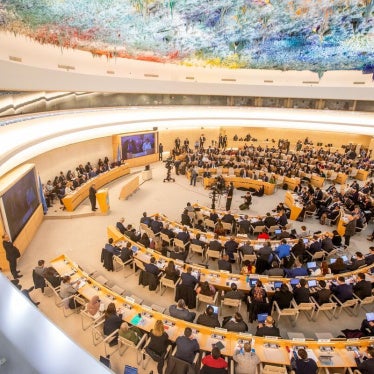
In October 2022, the Human Rights Council established the mandate of the Special Rapporteur on Russia, citing grave concern over “systematic crackdowns on civil society organizations,” “reported mass arbitrary arrests…the deterioration of the rule of law,” and “mass forced shutdowns of civil society organizations and independent media outlets.” These concerns remain equally relevant today.
Human Rights Situation in Russia – The Latest in a Worsening Crisis
Continued decimation of civil socieity
“Undesirable” organizations
- Russian authorities intensified their use of legislation on “undesirable” organizations to target dissent. They continue to prosecute people for working or otherwise engaging with “undesirable” organizations, such as by giving interviews, sharing content, or participating in their events.
- Between July 2025 and July 2026, authorities designated 124 organizations as “undesirable,” compared to 68 organizations in the same period a year earlier. In the past year alone, authorities added one third of the 367 organizations placed on the register since 2015.
- Authorities continued to outlaw international human rights organizations. In November 2025, the Prosecutor General designated Human Rights Watch as “undesirable.” Other rights groups designated in the past year include FIDH, Stichting Justice Initiative, ILGA, European Prison Litigation Network, International Commission of Jurists, Committee to Protect Journalists, and World Organisation Against Torture (OMCT).
- Prosecutors continued their crackdown on international education and research institutions, including by designating the Lemkin Institute for Genocide Prevention, University of California Berkeley, Stanford University, and Tufts University “undesirable.”
- Authorities also used “undesirable” designations to further restrict media freedoms. In the past year, they outlawed Chronicles.Media, a Russian outlet investigating corruption, Eurasianet, and Deutsche Welle.
“Foreign agents”
- The state can designate any individual or entity a “foreign agent” if authorities deem them to be “under foreign influence.” Authorities continued to use this legislation to further stigmatize and marginalize independent voices. Only 4 percent of organizations and individuals designated “foreign agents” in 2025 had received any foreign funding, according to the Justice Ministry.
- The October 2025 amendments to the foreign agents law further streamlined criminal prosecution for failure to comply with that law, allowing for criminal prosecution following just one misdemeanor offense. Prior to that, criminal charges generally required two prior misdemeanor convictions.
- Between July 2025 and July 2026, the authorities added 197 people, organizations, and groups to the registry of “foreign agents,” bringing the total to 1,227. The new designations included many prominent independent journalists and media outlets in Russia, as well as political, environmental, and Indigenous peoples’ activists. In the vast majority of cases, the Justice Ministry accuse them of sharing content and “false information” about Russia’s policies.
“Extremism” designations
- In April 2026, the Russian Supreme Court issued an “extremist” designation against what it termed “International Public Movement Memorial.” Memorial is one of Russia’s oldest and most respected rights groups, and various independent national, regional and foreign organizations operate under the brand. The ruling amounts to a ban on engaging in any activities of Memorial organizations, under the threat of a lengthy prison sentence. The court arbitrarily denied attorneys representing some of Memorial organizations permission to participate in the proceedings. According to the federal terrorist and extremist list updated in June, the court has branded as “extremist” independent Memorial-affiliated regional groups conducting historical research and providing education and legal aid to victims of rights violations, organizations based outside Russia operating under the Memorial brand, Memorial’s political prisoners project, and the Memorial Human Rights Defence Centre. The ban severely limits the ability of these organizations to continue historical research and education projects, collect data on repression, and provide legal aid to victims of rights violations.
- Among those designated as extremist as an alleged Memorial “branches” is OVD-Info, a leading rights group on freedom of assembly and expression. The designation forced OVD-Info to stop providing legal help.
Crackdown on dissent
- In recent months, authorities have adopted additional laws to target dissidents abroad.
- A law adopted in June stipulates that the property of individuals and legal entities charged with misdemeanor offenses while residing abroad should be frozen until any resulting fines are paid or the case is discontinued. It only applies to violations often used in crackdown on dissent, such as failure to fulfil the requirements of “foreign agent” legislation, participating in the activities of an “undesirable organization,” discrediting Russia’s army, or undermining Russia’s territorial integrity (which implies, among other things, references to the Russian occupation of Ukrainian territories), making clear that the intention is to put pressure on exiled dissidents and critics.
- Under a law adopted on August 4, 2026, exiles convicted of misdemeanor offenses involving violations of “foreign agent” laws, participation in the activities of an “undesirable organization,” discrediting the army, or any criminal charges, face sweeping restrictions of their rights. The head of a Duma committee explained that the purpose of the bill was to make the life of “traitors” abroad “not better than in prison.” Such restrictions include bans on registering property and consular support, such as passport renewal and notary services, which could render affected Russian passport holders who lack a second nationality effectively stateless. Exiles will not be able to access Russian government digital services, including requesting official documents or executing any actions or contracts through a power of attorney. Their bank accounts, assets, and property in Russia will be frozen, and online banking will be disabled.
- Following 2025 amendments that streamlined criminal prosecution on “foreign agent” charges and expandedin absentia prosecutions for many acts Russian authorities consider “anti-Russian” and “treacherous,” Russia has increasingly used in absentia trials against exiled dissidents.
- 741 people have faced criminal prosecution on bogus charges of “false information” or “discreditation” of the Russian armed forces since the start of the full-scale invasion of Ukraine. The number includes in person and in absentia prosecutions. In total, 1,306 have faced criminal prosecution for opposition to Russia’s war, and 372 people remain imprisoned on these charges, according to OVD-Info.
- Authorities continued to impose draconian sentences for criticizing Russia’s full-scale invasion of Ukraine. In June, a court in Moscow sentenced Maksim Kruglov, a deputy head of the opposition Yabloko party, to seven years in prison on charges of spreading “fake news” about Russia’s army based on two social media posts. One post cited UN data on civilian casualties in Mariupol; the other mentioned civilians killed in Bucha.
Freedom of expression and access to information online
- Since spring 2025, authorities continued to carry out internet shutdowns, with weeks-long mobile internet shutdowns affecting the entire country, including Moscow and Saint Petersburg. These shutdowns severely undermined access to information and online services, as well as people’s livelihoods. Authorities increasingly used “whitelists,” blocking all sites but the few approved by the state.
- More than 1,8 million websites are currently blocked in Russia, including information critical of the government, foreign social media platforms and messengers. Over the past year, authorities fully blocked WhatsApp, Telegram, FaceTime, and other communication apps.
- Authorities continued their fight against censorship circumvention tools, blocking around 469 Virtual Private Networks (VPNs) by late February 2026. They also issued fines for advertising VPNs, prohibited popular Russian websites from providing access to users connecting via VPNs, and continued to order foreign tech companies to take down apps used for censorship circumvention.
- The restrictions on popular messaging apps and VPNs are connected to efforts by the authorities to coerce users to switch to Russian platforms such as MAX, a state-backed national app that, according to numerous experts, has extensive surveillance capabilities to monitor communications.
Persecution of lesbian, gay, bisexual, and transgender (LGBT) people
- Russian authorities intensified their crackdown on LGBT people on the basis of Russia’s Supreme Court 2023 ruling that outlawed “the International LGBT Movement” as an “extremist organization,” a legal and factual mischaracterization of a diverse, decentralized global human rights cause.
- In 2026, Russian courts in seven regions banned ten groups that provide support to LGBT people as “extremist” organizations.
- In the past year, courts in Russia have convicted 16 people on criminal charges stemming from the Supreme Court ruling, bringing the total number of convictions to 21, according to Human Rights Watch monitoring. Three nightclub staff received prison sentences of 7 years; 6 years and 3 months; and 2 years and 3 months for managing a queer bar in Orenburg. Two nightclub staff in Voronezh and four people in Kirov were also found guilty of participating in or “organizing” the activities of the “LGBT movement.” In June 2026, a court in Chita increased the sentence of a local night club owner from 4 years in prison to 6 years and 2 months.
- Criminal cases against 15 more people on similar charges are pending, or their outcome is currently unknown.
Renewing the mandate of the UN Special Rapporteur on Russia
Renewing the mandate of the UN Special Rapporteur on Russia is essential to ensuring independent monitoring and reporting on the situation, in a context of persistent mis- and disinformation about human rights in Russia. This dedicated mandate on human rights in Russia is needed to respond robustly, consistently and promptly to the Russian government’s escalating human rights violations against people voicing peaceful criticism and defending civic space.
The Special Rapporteur mandate also provides a vital lifeline of engagement and support within the UN system for Russian human rights defenders, activists, and civil society organizations, who are increasingly isolated from international support as a result of restrictions imposed by the Russian state.
Other people facing criminal prosecution “which is likely to be politically motivated and involve serious violations of the law, but who have not been recognised by the Memorial Human Rights Centre or the ‘Support for Political Prisoners. Memorial’ project as political prisoners.”