Brussels, 10 November 2026
Dear HR/VP,
Dear Ministers,
We are writing ahead of the 16 November 2026 Foreign Affairs Council, during which you will address the situation in Syria, to encourage you to ensure that the EU will tie its future engagement with Syria to concrete and durable human rights progress.
Following the restoration of the EU-Syria Cooperation Agreement and the EU-Syria high-level political dialogue on 11 May 2026, European Commission President von der Leyen hinted at a possible future Association Agreement between the EU and Syria.
In this regard, we call upon your government to ensure that any steps towards re-opening negotiations or finalizing an association agreement with Syria be linked to Syria’s transitional authorities meeting key human rights benchmarks.
The EU has demonstrated – throughout Syria’s brutal conflict and since the collapse of the Assad government – continued commitment to the rights of all Syrians and to accountability for serious international crimes. We value the EU’s ongoing engagement with the Syrian authorities on these issues, as reflected in the June 2025 FAC conclusions. The EU’s engagement with Syria’s authorities and its support to Syria’s transition, reconstruction and recovery are and will remain central to ensuring and consolidating respect for human rights for all Syrians.
EU’s association agreements with third countries – including the proposed 2008 EU-Syria agreement – identify respect for democracy and human rights as an essential element. A credible and demonstrable record of respect for these fundamental principles should constitute a key political prerequisite for any decision to open or finalize negotiations on an association agreement. Not doing so would undermine the credibility of the agreement’s own provision, the leverage of the EU with its partners, and the potential for genuine human rights reform in the third country concerned.
However, despite Syrian transitional authorities’ commitment to turn the page on the atrocities and abuses of the Assad era, reforms remain selective and incomplete. Key issues include continued recourse to Assad-era repressive legislation, the lack of transparency around justice efforts for the March and July 2025 killings in the coastal region and Sweida, and ongoing fair trial concerns.
At this critical juncture of Syria’s transition and of EU-Syria relations, we call on your government and the EU as a whole to make sure that key human rights benchmarks are met before any steps are taken toward a possible future association agreement between the EU and Syria. These benchmarks should include:
Justice, Accountability and Guarantees of Non-Recurrence
- Impartial, independent, comprehensive and meaningful justice for victims and survivors of serious international crimes committed by all perpetrators during the Syrian conflict – while respecting guarantees of fair trial and due process for the accused;
- Transparency around investigations into atrocities in March and July 2025 in the coastal regions and in Sweida governorate as well as around any resulting prosecutions of those accused of crimes;
- Unhindered access to and cooperation with international investigative bodies, including the UN International, Impartial and Independent Mechanism (IIIM) and UN Independent International Commission of Inquiry (CoI), as well as to the Independent Institution on Missing Persons (IIMP) and steps toward accession to the Rome Statute of the International Criminal Court;
- Comprehensive reform of Syria’s justice system to enable the effective investigation and prosecution of serious international crimes and including an immediate moratorium on the death penalty with a view to its abolition;
- Security sector reform in line with international human rights standards.
Fundamental Rights Guarantees
- Removal of all legal and administrative barriers to civil society engagement and commitment to ensure independent civil society groups can monitor government activities, engage with institutions and participate in public debate, freely and without fear of reprisals;
- Time bound commitment to repeal Assad-era provisions on defamation, insult, and cybercrime provisions, used to silence peaceful criticism and online activism, and the suspension of their application pending reform, in consultation with independent civil society and relevant UN experts;
- Constitutional and legal protection of fundamental rights and freedoms for all, including freedom from discrimination, freedom of movement, assembly, and expression, freedom of religion and belief and an end to arbitrary arrests and other forms of repression;
- Demonstrated commitment for the participation of women in public life, including in government agencies and security forces at all levels and in transitional justice mechanisms.
Human Rights Framework for Reconstruction and Recovery
- Application of rights and freedoms guarantees under the March 2025 Constitutional Declaration to Syria’s reconstruction and recovery, without discrimination on grounds of ethnicity, religion, or political opinion;
- Incorporation of binding community participation requirements; establishing clear, fair compensation standards; and the creation of accessible, independent grievance mechanisms, for all reconstruction projects.
EU’s engagement with Syria should be matched by consistency across the region. In line with its repeated calls to all external actors to respect Syria’s territorial integrity, we call on your government and the EU as a whole to publicly condemn and act to end Israel's continued abuses in areas of southern Syria under its occupation, including forced displacement, home seizures and demolitions, denial of access to livelihoods, and unlawful transfer of Syrian detainees to Israel.
Finally, we urge the EU to refrain from downplaying Syria’s continued economic, security and human rights challenges to justify or prematurely promote or facilitate returns of Syrians. Instead, the EU and its member states should prioritize Syria’s economic, social, political and human rights challenges, by supporting and using its leverage with transitional authorities and working closely with civil society. Only the restoration of safe, dignified and sustainable living conditions in Syria could create incentives for Syrians who wish to do so based on informed individual decisions to voluntarily return.
We thank you for your attention and remain available should you require any additional information.
Cordially,
Balkees Jarrah, Middle East and North Africa Director, Human Rights Watch
Philippe Dam, EU Advocacy Director, Human Rights Watch
Annex
Background information
Accountability for Serious International Crimes
Syrian authorities signaled their intention to pursue accountability for serious crimes committed under the Assad government, including through arrests of former government figures and the first domestic trials of senior Assad-era officials. However, concerns remain over the fairness and transparency of the proceedings and the absence of laws criminalizing serious international crimes. Human Rights Watch opposes the death penalty in all circumstances.
The National Commission for Transitional Justice, together with other authorities, drafted a transitional justice law, but civil society groups criticized the process for insufficient public consultation and transparency, while underlining the need for a process that is inclusive, including of women, and for accountability for crimes by all perpetrators in the conflict.
The government cooperated with UN mechanisms, but their access and presence in the country remains uncertain.
Accountability for abuses involving government forces
Serious concerns have been raised about military court proceedings in Aleppo for defendants accused of involvement in the March 2025 coastal atrocities, and in Damascus for those accused of involvement in the July 2025 Sweida violence. Neither the Military Penal Code nor the ordinary penal code recognizes command responsibility as a basis for liability, increasing the risk that commanders and officials who ordered or allowed the killings may escape prosecution even as direct perpetrators face trial. Civilians should not be tried before military courts, and the legal basis for the courts' jurisdiction over these cases has not been published. Authorities have not made public their findings in either investigation.
The CoI on Syria found in March 2026 that violations during the July 2025 violence in Sweida, including widespread executions, torture, sexual and gender-based violence including rape, and the burning of homes by government forces, Bedouin armed groups, and Druze armed groups alike, may amount to war crimes or crimes against humanity. Human Rights Watch documented apparent war crimes by government forces and armed groups in Sweida and found that accountability was lacking.
Freedom of expression, association and assembly
Authorities continue to apply Assad-era defamation, insult, and cybercrime provisions against peaceful criticism and online activism.
Civil society organizations are seeking to re-establish and expand their activities, and authorities showed greater openness to engagement with them. But local groups remain subject to the restrictive 1958 Associations Law, with onerous registration requirements and approvals for nearly all activities.
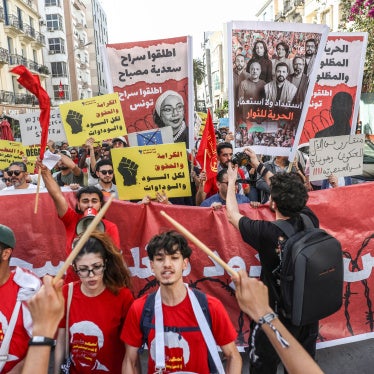
In May, the Interior Ministry issued Syria's first official framework recognizing peaceful assembly as a right. However, it requires organizers to obtain prior authorization, wait up to five days for a decision, and form an organizing committee, and it treats unauthorized assemblies as riotous gatherings subject to criminal penalties.
Economic crisis, reconstruction and humanitarian aid
Most Syrians live below the poverty line. In August, the World Food Programme said 13.3 million of Syria's estimated 24.4 million people were food insecure, including 7.1 million facing acute food insecurity, and that funding shortfalls had forced it to halve its emergency food assistance.
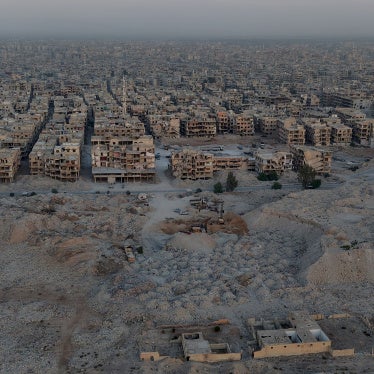
Authorities increasingly presented reconstruction as an investment-led process centered on large development projects. The Arab Reform Initiative found that these projects were developed within narrow official and business circles, without meaningful consultation of affected communities or resolution of concerns over property rights and displacement. The government resumed the Assad-era Marota City project in Damascus without providing alternative housing to thousands of displaced families, despite allegations of corruption and links to contractors tied to the former government.
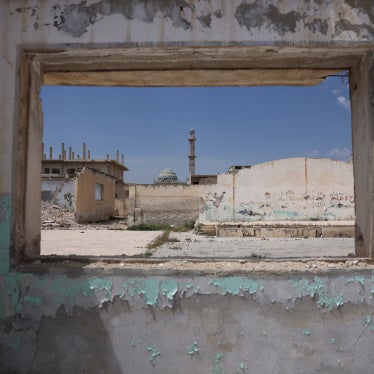
School buildings that were damaged or used as shelters, teacher absences, long travel distances, insecurity and conflict in the northeast, and lack of basic supplies all impair children’s access to education, including for returnee and displaced children.
Conditions for returnees remained difficult. In a survey, the International Rescue Committee found that 91 percent arrived to find essential services missing and 71 percent were living in damaged housing.
Women’s and girls’ rights
Women hold only 22 of the People's Assembly's 210 seats, about 10 percent, after it was formed in July: seven were chosen through indirect elections and 15 were appointed by President al-Sharaa.
Insecurity and economic hardship in Syria have had deeply gendered impacts, and exclusion of women from full participation in political processes risks undermining the country’s ability to achieve a just transition.
In October 2026, authorities imposed admissions rules barring women from most programs at two new state universities for defense and security, effectively denying them a path into the army.