(Beirut) – Syrian authorities have imposed admissions rules that bar women from most programs at two new state universities focused on defense and security, with applications closing on October 19, 2026, Human Rights Watch said today. The discriminatory rules clearly violate Syria’s international legal obligations and are part of a concerning pattern of actions by the transitional authorities that restrict women’s role in state institutions and reinforce gender stereotypes.
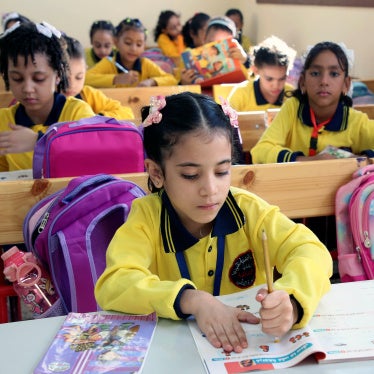
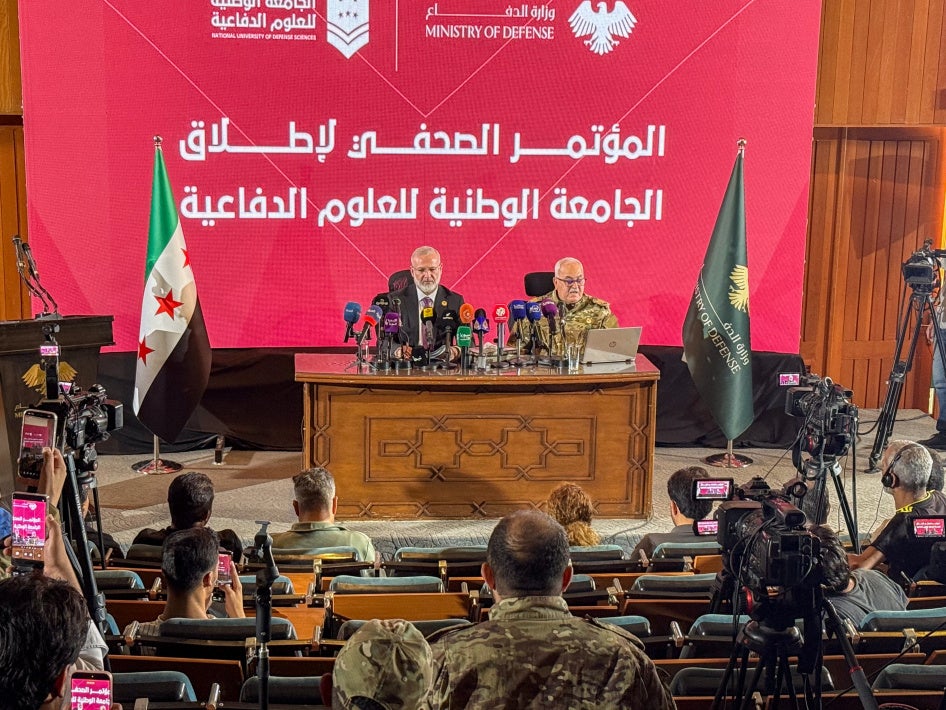
The Ministry of Higher Education and Scientific Research announced on September 30 that admission to programs in law, economics and management, and social sciences at the National University of Defense Sciences is reserved for men. At the Syrian University for Security Sciences, women can only apply to cybersecurity programs. Elsewhere, programs on kindergarten teaching at public universities, some midwifery programs, and the nursing schools in Damascus and Aleppo are reserved for women.
“Syria’s authorities are rebuilding the army and the security forces without women,” said Hiba Zayadin, senior Syria advisor at Human Rights Watch. “Women can’t train as officers, and they can’t even study to be the army’s lawyers or administrators. This is discrimination, plain and simple.”
A former higher education ministry official told Agence France-Presse in early October that some of the men-only rules predate the transition, and Damascus University, the country’s largest, still admits women to all programs. But the defense and security universities are admitting students through the general university admissions process for the first time this year and shutting women out of most tracks.
At the National University of Defense Sciences, at which a mandatory commitment to serve in the military is required, only men can enter the land, naval, and air force military colleges, which teach engineering, and the College of Humanities and Administrative Sciences. The only part of the university open to women, the Higher Institute for Applied Sciences and Technology, involves no commitment to military service.
The Syrian University for Security Sciences, the College of Security Sciences, and the Technical Institute of Security Sciences admit men only. Graduates of the university must serve with the Internal Security Forces or another competent body for 20 years after completing college or 10 years after completing an institute program.
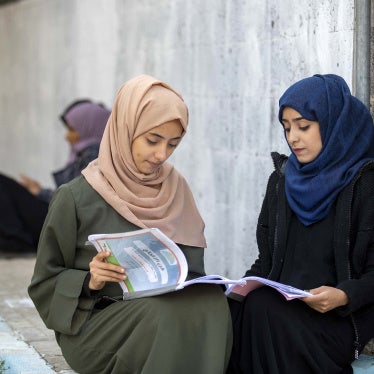
Women can study law, economics, and social sciences at other public and private universities and can join the police through a separate Women’s Police Institute, which graduated its first class in September 2026. But these new policies effectively deny women a path into the army and security forces. The exclusion is already playing out in northeast Syria, where the authorities refused in August to let the Women’s Protection Units, or YPJ, the all-female component of the Kurdish-led Syrian Democratic Forces, join the army alongside its male fighters.
Since December 2024, women have been sidelined across Syria’s public institutions. In the October 2025 indirect parliamentary elections, women won 6 of the 119 elected seats in the People’s Assembly, about 5 percent. The UN deputy special envoy for Syria said that women were consistently underrepresented throughout the process.
Senior Syrian officials have publicly questioned or openly disparaged women’s place in public office. In December 2024, the government spokesperson suggested women may be biologically unsuited for some political roles and said their ability to serve as judges “could be an area of study and research for specialists.”
Women working in some public sector roles face new rules about their physical appearance. In January 2026, the governor of Latakia, a central government appointee, issued a directive banning female public employees, including school staff, from wearing “excessive” makeup at work, under threat of “legal accountability.” The directive does not explicitly define what counts as excessive makeup or outline specific punishment details.
On the other hand, in December 2024, the education minister, Nazir al-Qadri, said the right to education is not limited to one gender. The authorities should honor that commitment, Human Rights Watch said.
The Ministry of Higher Education should open the security and defense university programs to women on equal terms before applications close on October 19, 2026, and rescind all other gender-based admissions restrictions. The transitional authorities should revoke the Latakia makeup ban and adopt concrete measures to ensure full, equal, safe, and meaningful participation by diverse women in all public institutions, including the People’s Assembly.
Governments and donors supporting Syria should prioritize ending all forms of discrimination, including in the security sector. All Syrian authorities should uphold the Constitutional Declaration and Syria’s international commitments and remove any provision or policy that discriminates against women.
“Women are underrepresented in parliament, the police, and some public offices, and are now shut out of the army, Zayadin said. “The authorities have promised to respect women’s rights, but their actions directly contradict those promises. Women’s full participation, in all roles and sectors, is essential to building a brighter future for Syria.”