The UK has significantly expanded its Global Human Rights Sanctions Regime, allowing the government, for the first time, to impose targeted sanctions on individuals and entities involved in war crimes. The new powers were approved by parliament yesterday.
The previous framework, adopted in 2020, did not allow for such sanctions, providing, instead, for targeted sanctions only for certain serious human rights violations of the right to life, freedom from torture, and freedom from slavery and forced labor. Under the new rules, the government can also target those responsible for serious violations of international humanitarian law, obstruction of humanitarian assistance, and violations of the right to liberty and security of person.
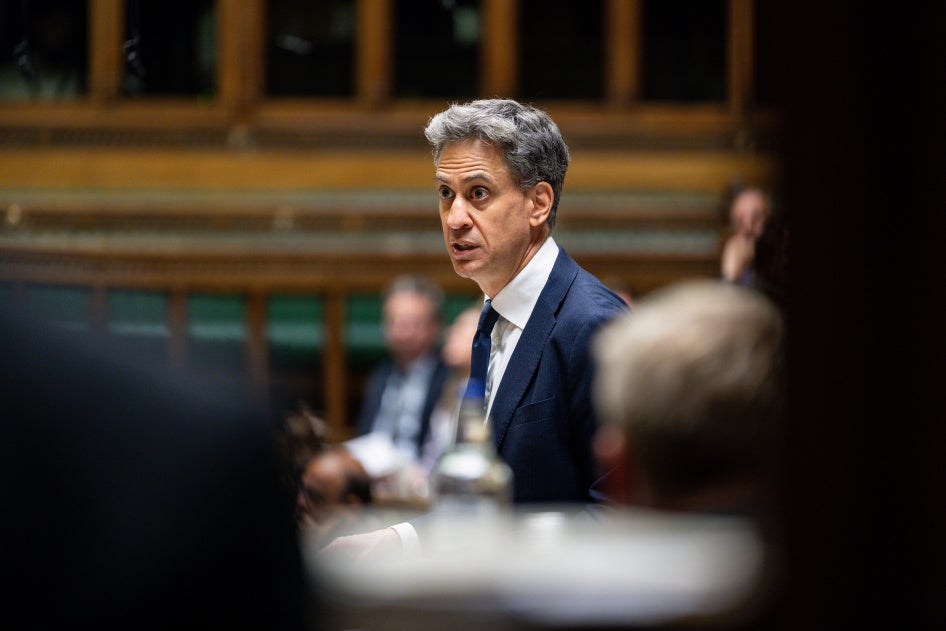
This is an important step that means the UK can impose consequences for atrocities committed around the world. Although Foreign Secretary, Ed Miliband, announced the change in September while laying out measures to address Israel’s unlawful settlement expansion in the West Bank, the powers can also be used against those responsible for war crimes anywhere.
Human Rights Watch has documented serious violations of international humanitarian law across the globe and called on governments to investigate individuals and entities with a view to imposing targeted sanctions.
It is important that such sanctions are treated distinctly from criminal accountability. Sanctions should be used on those responsible for ongoing atrocities with the aim of bringing abuses to an end, and the UK should ensure that all persons affected by sanctions have due process rights to challenge them. Additionally, accountability for international criminal acts, past or present, should be implemented through criminal justice, including fair trials.
In the West Bank, we documented the forced displacement of 32,000 Palestinians from three refugee camps in 2025, amounting to war crimes and crimes against humanity and called for targeted sanctions on officials including Defense Minister Israel Katz and Maj. Gen. Avi Bluth as well as criminal accountability.
In Sudan, we found that the Abu Dhabi-based Global Security Services Group (GSSG), owned and run by Mohamed Hamdan al-Zaabi, apparently hired Colombian military contractors deployed to fight alongside the Rapid Support Forces, including in El Fasher, where the RSF committed mass atrocities.
In the Democratic Republic of Congo, the M23 and Rwandan Forces forcibly recruited and detained thousands, including children, subjecting them to horrific abuse in “training” camps for which Rwanda Defense Force Special Force Commander Stanislas Gashugi and M23 commanders Léon Kanyamibwa and Bertin Masozera were responsible.
The new powers give the UK the tools to act against all the above individuals and entities. To ensure the credibility of its expanded regime, the UK should use it in a principled and consistent manner, imposing targeted sanctions where appropriate to help end atrocities. It should also ensure its criminal justice system can investigate and prosecute those responsible for war crimes, wherever they occur and whoever commits them.