When I woke up this morning to the news that Novaya Gazeta is closing its doors, it felt like a personal blow. To me, Novaya’s office in a small grey building in central Moscow always felt like home.
The newsroom moved to Moscow almost three decades ago. I got to know its every nook and cranny, as I went there, in my capacity of a Moscow-based Human Rights Watch researcher, for meetings, celebrations, commemorations, or simply to swap stories with a friendly journalist over coffee or wine.
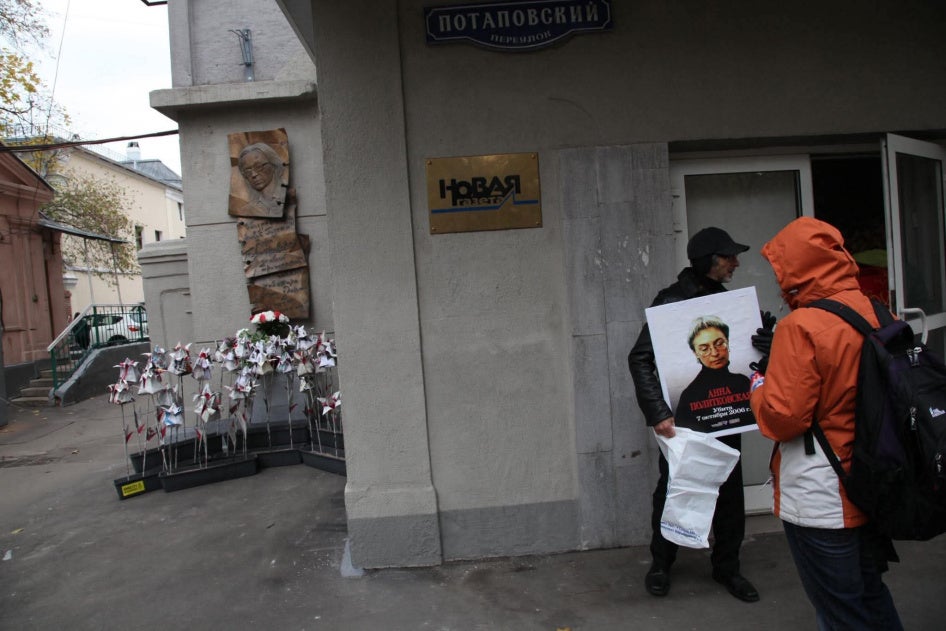
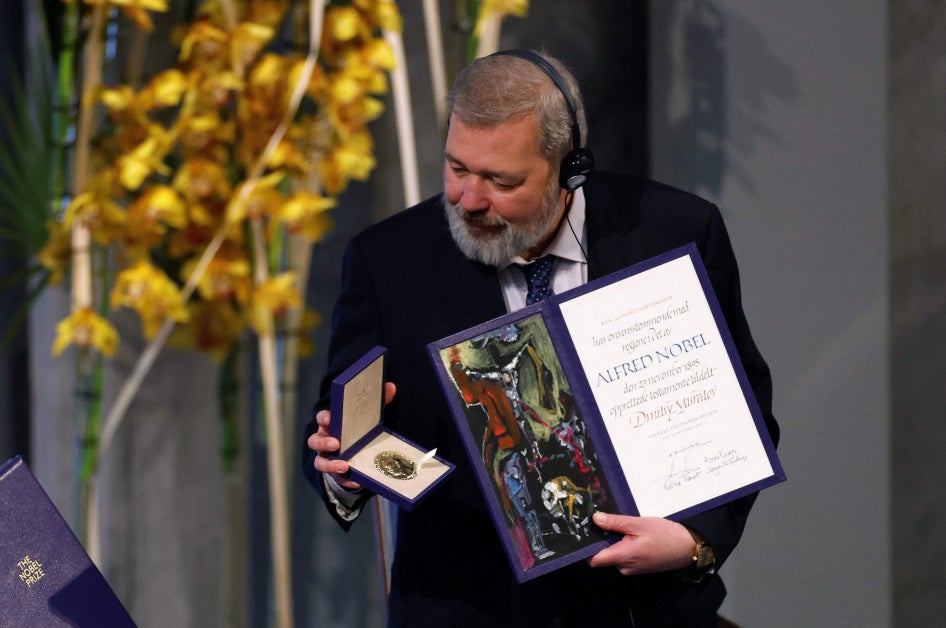
I was there on the night of Anna Politkovskaya’s murder in October 2006 and stood outside seven years later as her memorial plaque was affixed to the wall. I celebrated with the newsroom when editor-in-chief Dmitry Muratov won the Nobel Peace Prize in 2021. For years, I worked alongside Novaya journalists in conflict zones. Together, we travelled to Chechnya, remote mountain villages in Dagestan, South Ossetia (Georgia), and Ukraine. It was more than collaboration; it was a true partnership.
Following Russia’s full-scale invasion of Ukraine in February 2022, the authorities set out to stifle Novaya Gazeta. By the end of 2022, the newspaper had lost its print and online media registrations, and its website had been blocked.
Some journalists left Russia, launching Novaya Gazeta Europe and other projects in exile. Others stayed against all odds, continuing to publish investigations, interviews, and commentary online, accessible outside Russia and through circumvention tools inside the country. Despite mounting pressure, they persevered.
In April 2026, police searched the newsroom for 13 hours and arrested a journalist on criminal charges carrying up to six years in prison. In September, the authorities designated Novaya Gazeta a “foreign agent” and listed over 100 staff and contributors as “affiliated individuals.”
On October 29, the newspaper was told to vacate its offices. Its donation-processing system was also disabled, cutting off reader contributions.
Today, Novaya Gazeta announced it would cease operations on November 9. In a statement titled “They Killed Us,” the editors wrote: “This is not just our own story. It is the story of a country and a society that are being destroyed in exactly the same way.”
Novaya Gazeta’s story is also one of extraordinary courage and journalistic integrity. The authorities may silence a newspaper, but they cannot extinguish the voices of those who refuse to be silenced.