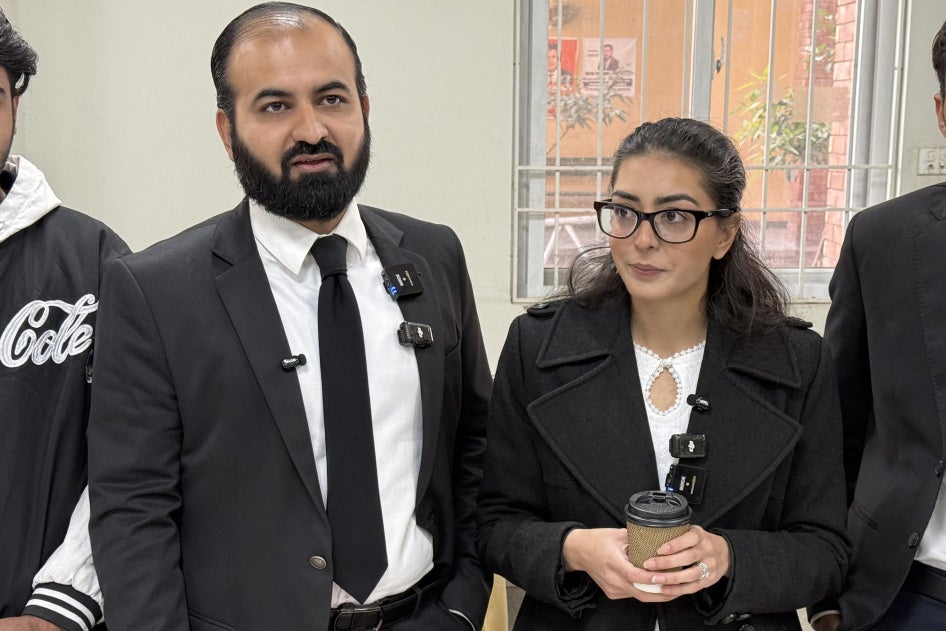
(New York) – An anti-terrorism court in Pakistan imposed 10-year prison sentences on two human rights lawyers on October 29, 2026, in an escalation of the government’s crackdown on civil society, Human Rights Watch said today. Pakistani authorities should immediately quash the convictions, release Imaan Mazari-Hazir and her husband Hadi Ali Chattha, and cease criminal proceedings aimed at punishing human rights advocates.
The sentences were handed down following a trial held inside Adiala prison in Rawalpindi. The lawyers were accused of obstructing police at a road closure in Islamabad in October 2024.
Instead of prosecuting them for a misdemeanor or common crime, the police charged them under Pakistan’s anti-terrorism act, which carries far greater penalties and a longer sentence. This was the second time in recent weeks that the two have been prosecuted in an apparent attempt to prevent them from carrying out their legal work.
“Prosecuting two human rights lawyers for terrorism sends a chilling message to everyone who speaks up for fundamental rights in Pakistan,” said Patricia Gossman, senior associate Asia director at Human Rights Watch. “The authorities should quash the outrageous 10-year sentences handed down to Imaan Mazari-Hazir and Hadi Ali Chattha.”
Mazari and Chattha have represented journalists as well as political and human rights activists. They have defended people facing blasphemy charges, victims of sexual violence and enforced disappearances, and prisoners facing the death penalty.
In addition, the court sentenced both lawyers to three years in prison for “obstructing and assaulting public servants,” to run concurrently. Family members allege that during the trial, Mazari and Chattha were denied legal representation of their choice and access to key legal documents, raising serious concerns about the fairness of the trial, due process, and the right to prepare and present an effective defense.
On September 17, the Supreme Court had suspended their sentences in a separate case involving social media posts and ordered their release on bail, but police rearrested them hours later. On September 30, United Nations human rights experts called for their immediate release and said that successive proceedings appeared intended to punish them for their views and their human rights advocacy.
Pakistani authorities have used vague and overbroad anti-terrorism legislation to sentence and imprison those protesting government policies. The authorities should prosecute alleged violence under appropriate criminal laws while protecting the rights to freedom of expression and peaceful assembly. Allegations of obstructing officials or disrupting public order should not be treated as terrorism, Human Rights Watch said. The authorities should ensure that counterterrorism laws are narrowly drawn and applied and are not used to punish dissent or circumvent fair-trial protections.
The UN Basic Principles on the Role of Lawyers provide that governments should protect lawyers from intimidation, harassment, and improper interference, as well as from prosecution for carrying out recognized professional duties.
“Punishing lawyers and human rights activists for defending rights leaves those they represent without protection,” Gossman said. “Concerned governments should press Pakistan to end its crackdown on human rights advocacy.”