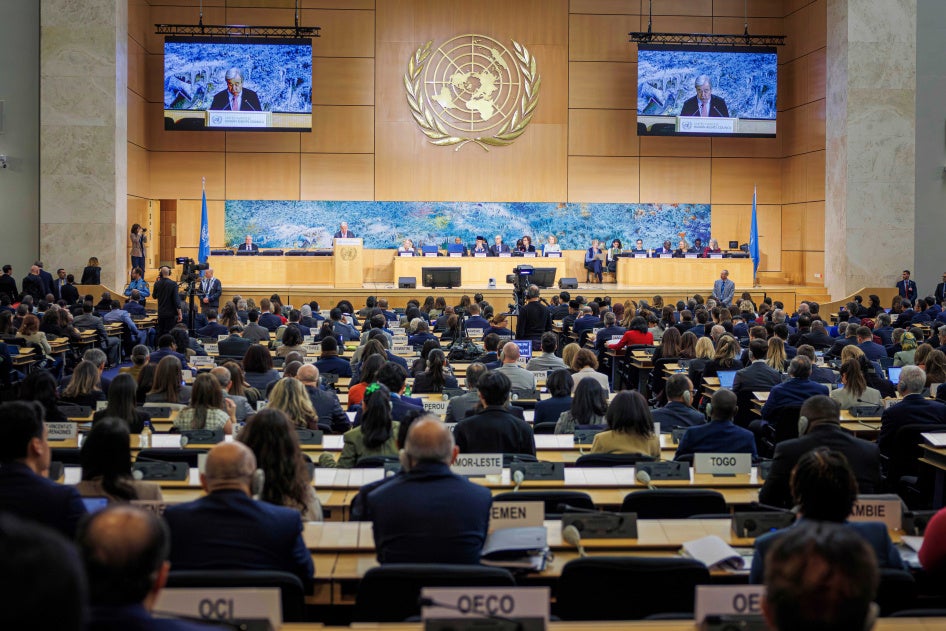
This joint statement was delivered by the International Commission of Jurists (ICJ) at the 63rd regular session of the UN Human Rights Council during an interactive dialogue with the Working Group of Experts on People of African Descent held on September 30, 2026.
Mr. Vice-President,
The International Commission of Jurists (ICJ) and Human Rights Watch (HRW) welcome this opportunity to address the Working Group on the situation of Black African migrants, refugees and asylum seekers in Tunisia and Libya.
Since 2023, in the wake of an agreement with the EU to stem the flow of "irregular" arrivals, the Tunisian authorities have subjected Black African migrants and refugees to arbitrary detention, ill-treatment, sexual violence, and collective expulsion.
Concurrently, the authorities have targeted associations supporting migrants and refugees and fighting racism, through abusive prosecutions and arbitrary detention of their members. This includes Mnemty, whose President, Saadia Mosbah, was sentenced to eight years' imprisonment on appeal in June on charges concerning her human rights work.
In Libya, the EU and its Member States are furthering support to western and eastern authorities despite their practice of widespread abuse, enabling interceptions at sea and forcible returns of migrants and refugees, who face arbitrary detention, torture and ill-treatment including sexual violence, enslavement, refoulement, and unlawful killings. In July, the International Criminal Court confirmed charges against Khaled El Hishri for crimes perpetrated at Mitiga Prison, finding that “Black migrants” were specifically targeted for enslavement and persecution because of their race, ethnicity and nationality.
In both countries, European policies of border control externalization have exacerbated hate speech and racist attacks on Black persons.
We call on this Council and Member States to act to prompt Tunisia and Libya to uphold the rights of Black African migrants, refugees and asylum seekers, and to urge European States to stop outsourcing migration control to authorities committing abuses in Tunisia and Libya.
Thank you.