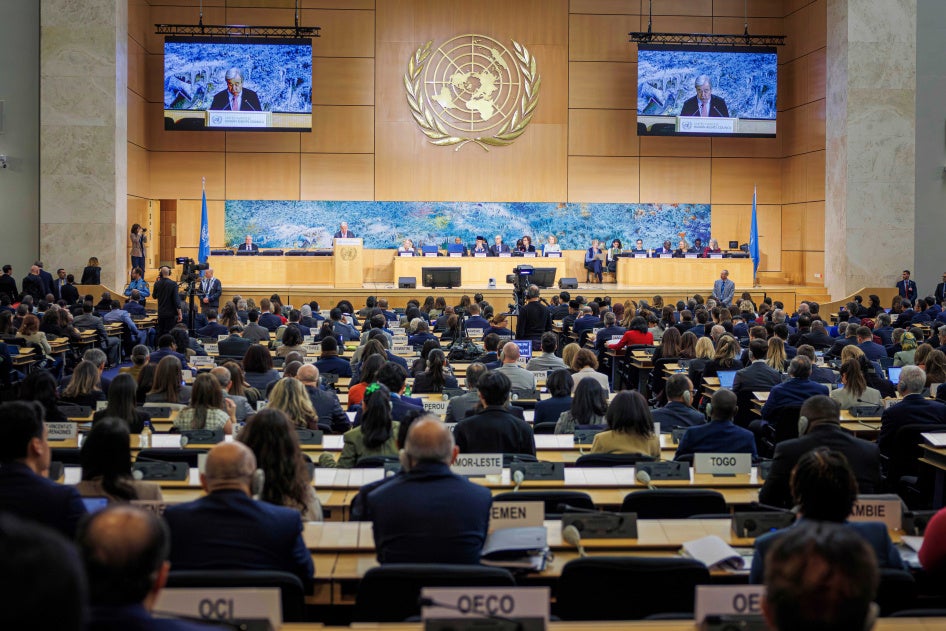
This statement was delivered by Human Rights Watch at the 63rd regular session of the UN Human Rights Council during an interactive dialogue with the Special Rapporteur on the situation of human rights in Russia held on September 21, 2026.
Mr. President,
We thank the Special Rapporteur for her report and share her assessment regarding the escalating human rights crisis in Russia.
In the past year, Russian authorities have continued their harsh, retaliatory authoritarian practices. The government branded many more individuals and organizations “undesirable” or “foreign agents”—labels it uses as code for “enemies of the people”—to target many leading international rights groups, including Human Rights Watch, and expanded its use of “extremist” organization designations against Russian civil society groups and LGBT people and their supporters.
The government seeks to intimidate into silence its critics, including independent reporters and writers, human rights defenders, political opposition supporters, and especially those who criticize its war in Ukraine. As of September 2026, Memorial, a leading Russian rights association banned as “extremist” by the government in April this year, recorded 1,806 political prisoners in Russia, up from just over 1,100 a year ago. It also listed 5,600 people as other victims of political repression.
By increasingly cracking down on digital freedoms, the authorities strive to isolate Russians from information that is critical of the government and prevent them having any access to online services and information authorities perceive as “hostile.”
The government is also increasingly engaging in transnational repression to target exiled critics. In August, Russia adopted new repressive legislation providing for a wide range of restrictions against Russian exiles convicted of offenses predominantly used for politically motivated prosecutions. These include a prohibition on providing consular support, such as renewal of passports and notary services, denial of access to Russian governmental digital services, and freezing bank accounts and other assets in Russia.
The Special Rapporteur’s mandate needs to be renewed as it is an essential independent voice to report on the Russian government’s escalating human rights violations and as a lifeline for besieged Russian civil society.
Thank you.