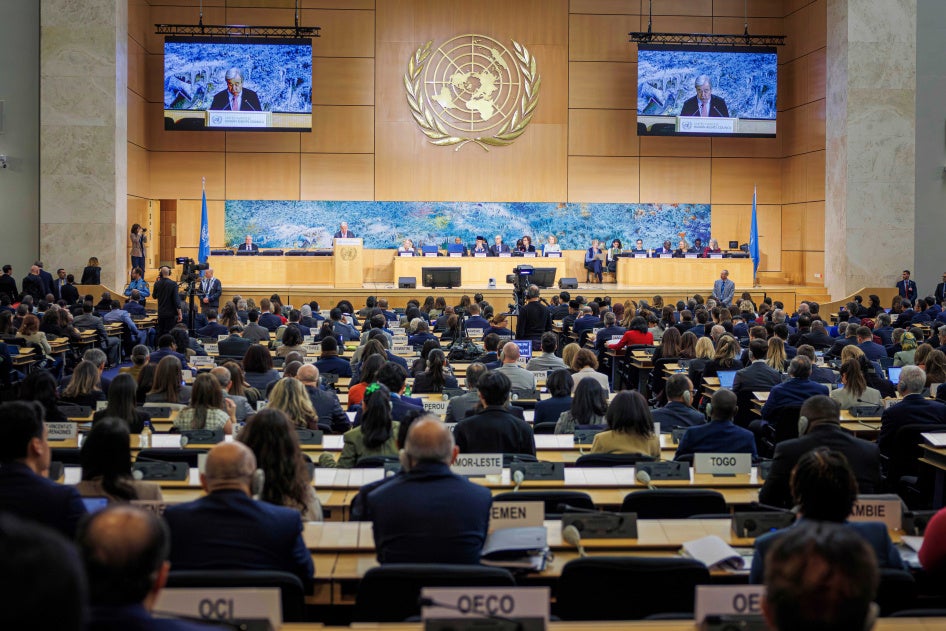
At its 63rd regular session, the UN Human Rights Council held an interactive dialogue on the report of the High Commissioner on the situation of human rights in Nicaragua on September 21, 2026.
Under co-presidents Daniel Ortega and Rosario Murillo, Nicaragua has become deeply authoritarian, and those who oppose the government risk imprisonment, exile, or arbitrary deprivation of their nationality.
On September 1, the National Assembly gave first approval to a constitutional amendment that extends the presidential term from six to seven years and bars from public office anyone the authorities designate a “traitor.” Co-president Ortega had already announced there would be no further elections.
The government’s record includes years of documented abuse including arbitrary detention and enforced disappearance of critics, torture and ill-treatment in custody, arbitrary deprivation of nationality leaving hundreds stateless, confiscation of property, and the closure of thousands of civil society organizations. Repression extends beyond Nicaragua's borders, through surveillance, threats and attacks against exiles.
Nicaragua has expelled international monitors, disengaged from the Human Rights Council and from the Organization of American States, and rejects every accountability mechanism.
The international response to Nicaragua has not matched the scale of the crisis. States should work together, across regions, to press for the release of political prisoners and for free and fair elections.
Given the absence of an independent judiciary in Nicaragua and the government’s withdrawal from key human rights bodies, states should explore all avenues for accountability and holding individuals responsible for gross human rights violations and other violations of international law to account, including exerting domestic criminal jurisdiction under the principle of universal jurisdiction, or considering actions before the International Court of Justice under the Convention against Torture and the 1961 Convention on the Reduction of Statelessness.
Strong and sustained international scrutiny is needed to curb these violations and restore Nicaraguans’ fundamental rights.