This document provides more detail, as well as answers to key questions, in relation to the call for an additional, complementary, comprehensive accountability mechanism on Afghanistan.
1. Growing momentum for an independent investigative mechanism for Afghanistan. 2
2. What mandate should this mechanism have?. 4
4. What impact could such a mechanism have?. 8
5. What should the scope of the mandate be?. 11
Why is a comprehensive approach so important?. 11
Are there precedents for such a comprehensive scope?. 12
1. Growing momentum for an independent investigative mechanism for Afghanistan
Since 2021, a growing number of civil society organizations, including this broad-based group of Afghan and international human rights organizations, have called on the UN Human Rights Council (HRC) to establish an independent international accountability mechanism for Afghanistan, with a mandate to investigate and collect, preserve and analyze evidence of grave violations and abuses in Afghanistan.
Such a mechanism would be a key tool in addressing the entrenched impunity at the heart of the current crisis in the country, advancing accountability, and supporting access to justice, truth and reparation for victims and survivors. It would be distinct and complementary to the vital mandate of the UN Special Rapporteur on the situation of human rights in Afghanistan, and would also complement and support ongoing or possible future efforts at the International Criminal Court (ICC), the International Court of Justice (ICJ), and at the national level, including through the use of universal or other forms of jurisdiction in the courts of third countries.
Since the civil society coalition led by HRD+ renewed its appeal in September 2024, there has been growing international momentum for the creation of such a mechanism.
A stocktaking report on accountability options and processes for human rights violations and abuses in Afghanistan was presented to the 57th regular session of the HRC by the UN Office of the High Commissioner for Human Rights (OHCHR) in September 2024. It noted that addressing long-standing and entrenched impunity for past and ongoing human rights violations and abuses in the country is essential to ensure the rights of victims and survivors to justice, truth and reparation, as well as for long-term sustainable peace, development and reconciliation, establishing the rule of law, preventing recurrence, and rebuilding trust among the full range of members of Afghan society. The report identified principles that should guide such efforts – namely, that they be comprehensive, multi-dimensional, broad-based, victim-centered and gender responsive – and noted the importance of strengthening existing mechanisms, and ensuring the collection, preservation and analysis of evidence of crimes in a way that could be “used to facilitate future accountability and transitional justice processes.”
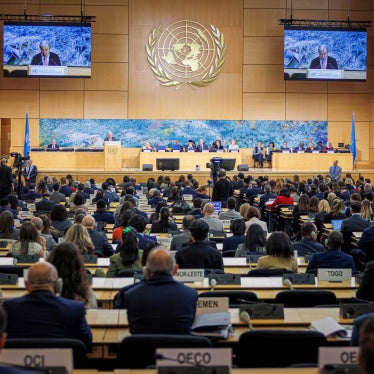
In a resolution adopted by consensus at the end of its 57th regular session (57/3), the HRC itself acknowledged the “urgent and imperative need to ensure accountability, by bringing perpetrators of crimes involving violations and abuses of human rights and violations of international humanitarian law to justice through a comprehensive, multidimensional, survivor- and victim-centered, gender-responsive approach to accountability efforts, applying a comprehensive approach to transitional justice, and to prevent and redress human rights violations and abuses.” Moreover, it specifically recognized the need to “strengthen existing mechanisms and to give consideration to ensuring the capacity for collecting, preserving and analyzing evidence of the most serious international crimes and violations of international law in a way that could be used to facilitate future accountability and transitional justice processes.”
At the 58th regular session of the HRC, a cross-regional group of countries “[noted] with alarm the Special Rapporteur’s conclusion that the international community’s failure to hold the Taliban accountable has emboldened them in their increasing oppression of women and girls, and the broader rights crackdown,” and the recommendation in his report for the creation of an additional and complementary independent investigation mechanism, with a comprehensive mandate and broad scope, to support efforts towards criminal accountability. The group of countries moved to “call on [the Human Rights] Council to take action on the Special Rapporteur’s recommendation for the creation of an additional independent investigation mechanism, with a comprehensive mandate and broad scope, to support efforts towards criminal accountability.”
In his latest report to the HRC, presented at its 59th regular session, the Special Rapporteur on Afghanistan again recommended that states “establish an independent accountability mechanism with a comprehensive mandate to investigate and establish the facts and root causes of past and ongoing violations and abuses of international human rights and humanitarian law, collect and preserve evidence, identify alleged perpetrators, and prepare casefiles to support future prosecutions and other forms of accountability, including truth, justice, and full and effective reparation.”
A group of 25 Special Procedures reiterated the appeal for a “the establishment of an additional, complementary investigation mechanism with a comprehensive mandate” as part of an “all-tools” approach in a joint statement issued on 14 August 2025.
2. What mandate should this mechanism have?
An Independent, Investigative Mechanism for Afghanistan should be designed according to precedents set by the Independent Investigative Mechanism for Myanmar (IIMM) and the International, Impartial and Independent Mechanism on Syria (IIIM). It would work to advance justice, accountability and reparations for past and ongoing serious human rights violations and abuses of international human rights law and international humanitarian law, some of which amount to crimes against humanity and war crimes, including the ongoing serious violations and abuses against women and girls.
Specifically, the mechanism should have a mandate to:
- Investigate and establish the facts, circumstances and root causes of past and ongoing alleged serious violations and abuses of international human rights law and violations of international humanitarian law, including those amounting to crimes under international law, by all actors in Afghanistan; it should include a focus on the gendered dimensions of such violations and abuses;
- Collect, consolidate, preserve and analyze evidence of such violations and abuses, including those affecting women and girls, and systematically record and preserve all information, documentation and evidence, including interviews, witness testimony and forensic material, and prepare files in order to facilitate and expedite fair and independent criminal proceedings, consistent with the international standards and best practices, in view of any future legal proceedings;
- Identify, where possible, those individuals and entities allegedly responsible for serious violations and abuses of international human rights law and violations of international humanitarian law, including those amounting to crimes under international law, with a view to ensuring that they are held accountable in proceedings that fully respect the right to a fair trial, without recourse to the death penalty;
- Make recommendations on, among others, accountability options, with a view to ending impunity for violations and abuses, and addressing their root causes, and ensuring the right to an effective remedy and to justice, truth and reparations for victims, survivors and their families;
- Support relevant judicial and other proceedings, including in national courts through the use of universal and other forms of jurisdiction, and through international judicial institutions, including ongoing and possible future proceedings at the International Criminal Court (ICC) and the International Court of Justice (ICJ).
In carrying out its mandate, the mechanism should be requested to:
- Integrate a gender perspective, a child’s rights perspective, and a survivor-centered approach;
- Report on an annual basis to the UN HRC and the UN General Assembly, including with regard to the progress of its investigations, while fully respecting the need for confidentiality, and recommendations for advancing accountability for past and ongoing crimes under international law;
- Coordinate with the UN Special Rapporteur on the situation of human rights in Afghanistan and other relevant UN human rights mechanisms in order to ensure the use of all relevant information, analysis and reporting of the Special Rapporteur, with due consideration to their respective and distinct mandates;
- Ensure that its efforts are complementary and accessible to other relevant actors, in particular the UN Secretary-General (UNSG) and his Special Representative and Head of the United Nations Assistance Mission in Afghanistan (UNAMA), the Office of the High Commissioner for Human Rights (OHCHR), and the ICC.
The Independent, Investigative Mechanism for Afghanistan should be provided with necessary resources and expertise to carry out its mandate, including to:
- Collect, analyze, consolidate and preserve the integrity of evidence to a standard that may ultimately become admissible in judicial proceedings;
- Ensure a gender-responsive approach, and effectively investigate the gendered dimensions of violations and abuses; and
- Carry out robust remote investigations, including with digital and forensic investigative expertise.
In the event of lack of access, the mandate of the mechanism can be fulfilled from outside the country, as the other two independent mechanisms (the IIMM and IIIM) have shown.
3. How would this mechanism complement the work of the UN Special Rapporteur on Afghanistan? What is the difference?
The UN Special Rapporteur on the situation of human rights in Afghanistan has a mandate to: monitor, document and report on violations and abuses; make recommendations to improve the situation; and support and advise civil society, particularly women human rights defenders. He can respond quickly to policy developments and engage on individual cases, issuing public statements or sending direct communications to the Taliban. He raises awareness about and presses for a coordinated response to the specific situation facing women and girls, which he and other UN human rights mechanisms have described as “gender apartheid,” and offers guidance for addressing and improving the situation.
The mandate of an Independent Investigative Mechanism for Afghanistan would be distinct, but complementary, to that of the Special Rapporteur. Its work would be clearly distinct from other human rights documentation and monitoring efforts on Afghanistan – including by the Special Rapporteur, OHCHR and UNAMA.
With regards to Myanmar, the IIMM explained the difference between its work and that of human rights monitoring and documentation, as for instance conducted by the Special Rapporteur on Myanmar, as follows:
“The Mechanism conducts criminal investigations, not human rights documentation. Human rights documentation typically has broad purposes, such as advocating for the end of armed conflict and the promotion of transitional justice. […] Human rights documentation is generally based on “reasonable grounds” to believe that violations were committed. The standard of proof in criminal cases in most jurisdictions is considerably higher, requiring the establishment of facts “beyond a reasonable doubt”. The methodologies used in human rights documentation and criminal investigations also differ significantly, with criminal investigations requiring the establishment of specific elements of crimes based on legal principles such as the “chain of custody” of evidence.”
The Afghanistan mechanism would focus on the collection, analysis, consolidation and preservation of evidence of violations and abuses of international human rights law and violations of international humanitarian law committed in Afghanistan, the identification of potential perpetrators for investigation by judicial authorities (at national and international levels), and recommendations and guidance on steps to advance accountability and deliver justice, truth and reparations to victims, survivors and their families.
As with the IIIM, the work of the Afghanistan mechanism would fall squarely within a criminal accountability framework. As the IIIM explains in an online FAQ, “in addition to applying rigorous criminal law evidentiary frameworks for establishing the occurrence of crimes (referred to in the international criminal law context as “crime-base” evidence), [its] work focuses on identifying evidence that links these crimes to specific individuals.”
Table 1: Differences between the mandates of the Special Rapporteur and an Independent Investigative Mechanism for Afghanistan
| Special Rapporteur | Independent Investigative Mechanism for Afghanistan |
|
|
|
|
4. What impact could such a mechanism have?
Like the IIMM and the IIIM, an Independent Investigative Mechanism for Afghanistan would not be able to make arrests, prosecute or issue indictments. Rather, it would support accountability efforts through the collection, preservation, analysis and consolidation of evidence, and support competent international and national jurisdictions in the investigation and prosecution of suspected perpetrators of grave rights abuses and violations, some of which amount to international crimes committed in Afghanistan. It could play an important role preventing rights abuses, both in the short- and long- term, including in terms of deterrence.
The success of ongoing and future criminal proceedings and effective transitional justice initiatives depends in part on collecting and preserving evidence now before it is lost or destroyed and recording witness testimonies while the information is fresh.At present, apart from the ICC there is currently no other international mechanism collecting or preserving information that could be used as evidence of crimes under international law in Afghanistan in ongoing and future accountability efforts – evidence is being lost every day, significantly affecting the possibility of future prosecution. The IIMM’s (Myanmar) Proposed Programme Budget for 2025 identified that it was able to provide “tailored, comprehensive and timely analytical products and underlying evidence in diverse formats” to support authorities to “[establish] specific crimes and [identify] perpetrators of the most serious international crimes.”An Independent Investigative Mechanism for Afghanistan could perform a similar role and fill existing gaps.
The identification of alleged perpetrators would be an important tool to support and advance criminal prosecutions against suspected perpetrators of crimes under international law. For example, it could help to examine the possible criminal responsibility of specific individuals within the Taliban for the serious human rights violations against women and girls, some of which amount to the crime against humanity of gender persecution. It may also identify individuals suspected of committing war crimes or crimes against humanity that may have fled Afghanistan to countries that could exercise universal jurisdiction – e.g. former warlords (including ISKP) and former government officials.
The work of the mechanism could provide significant support to the following accountability avenues:
- International Criminal Court (ICC): Information collected could be made available to the ICC for its review in light of its ongoing or future investigations into war crimes and crimes against humanity in Afghanistan.
- International Court of Justice (ICJ): In the case of The Gambia vs. Myanmar at the ICJ, information gathered by the HRC-mandated Fact-Finding Mission on Myanmar and the IIMM have been made available to parties to the litigation. In June 2020, HRC resolution 43/26 specifically called on the IIMM to cooperate with the ICJ. The IIIM has also submitted a report on torture to in an ongoing case against Syria brought by Canada and the Netherlands under the UN Convention against Torture and Other Cruel, Inhuman or Degrading Treatment or Punishment (CAT). Information and evidence gathered by a similar mechanism for Afghanistan could be used by parties in any possible future proceedings at the ICJ, including for example the potential case against the Taliban authorities under the Convention on the Elimination of All Forms of Discrimination against Women (CEDAW).
- Domestic courts: Evidence or other information collected could also be made available to national judicial authorities exercising universal and other forms of jurisdiction for crimes under international law committed by all relevant actors in Afghanistan, including national military personnel who served in NATO-led missions. It should be able to mirror the work of the IIIM, to which national prosecution and judicial authorities are able to submit requests for assistance (RFAs) to receive information and evidence or analytical work products that it has developed. It should also be able to share material proactively with competent national jurisdictions. For example, it could assist by identifying individuals suspected of committing crimes under international law that may have fled Afghanistan to countries that could exercise universal jurisdiction – e.g. former warlords (including ISKP) and former government officials.
- Transitional justice: The mechanism’s mandate would allow it also to contribute to any future criminal and non-criminal transitional justice processes within Afghanistan. This could include domestic prosecution of crimes under international law committed by the Taliban, provided such prosecutions would respect international human rights law and standards, including the right to a fair trial, and provided the death penalty would not apply for the offences under consideration. It could also include non-criminal transitional justice measures.”
- The mechanism’s work could also contribute, for example, to the adoption by the UN Security Council of travel restrictions and other targeted sanctions against specific individuals, under the condition that these be applied in a manner consistent with international human rights law.
The mechanism’s work could also contribute to the prevention of human rights abuses and violations in Afghanistan.
In the short term, its establishment would send a deterrence message to possible perpetrators that serious rights abuses and violations are being thoroughly documented and investigated, and that one day the perpetrators may be brought to justice. In this regard, its creation and work (including public appeals for information) could have a deterrent effect on individual behavior.
In the long term, as recognized by the OHCHR, addressing long-standing and entrenched impunity for past and ongoing human rights violations and abuses in the country is essential not only to ensure victims’ rights to justice, truth and reparations, but also for long-term sustainable peace, development and establishing the rule of law, and preventing recurrence.
5. What should the scope of the mandate be?
The mandate should be “comprehensive” – meaning that it should be able to address past and ongoing human rights abuses and violations, and “all the different periods of the conflict and responsibilities of all parties and perpetrators.”
The OHCHR, the Special Rapporteur on Afghanistan and this civil society coalition have consistently emphasized the importance of such a comprehensive approach to advancing accountability for grave past and ongoing human rights violations and abuses in Afghanistan.
As noted in the OHCHR stocktaking report presented at the 57th session of the UN HRC, “following four decades of conflict and widespread human rights violations and abuses and violations of international humanitarian law committed by multiple perpetrators, generations of Afghans have been denied truth, justice, reparation and guarantees of non-recurrence for gross violations of international human rights and serious violations of international humanitarian law.” Recognizing the complexity of the situation, the need for “rebuilding trust among the full range of members of Afghan society,” and the right to justice of all victims of crimes under international law, the report set out a series of principles that should guide international efforts to advance accountability. Notably, the report affirmed the need for a “comprehensive approach,” which “should encompass all the different periods of the conflict and responsibilities of all parties and perpetrators.”
The HRC itself subsequently acknowledged, by consensus in October 2024, the need for this comprehensive approach, “guided by” the principles elaborated by the OHCHR in its stocktaking report.
A growing cross-regional group of countries have also explicitly expressed support for such an approach, notably in the recent joint statement at the HRC, supported by Iceland, South Africa, Chile, Costa Rica, Liechtenstein, Switzerland, Luxembourg, Colombia, Slovenia, Spain, Czechia, Mexico, France and Afghanistan – which urged the HRC to move on “the creation of an additional independent investigation mechanism, with a comprehensive mandate and broad scope, to support efforts towards criminal accountability” (emphasis added).
Why is a comprehensive approach so important?
Genuine justice for the victims of human rights violations and abuses in Afghanistan would be seriously undermined by double standards or cherry-picking in investigations and prosecutions. All victims and survivors should have equal access to justice, without a hierarchy of victims. The credibility of the international response to Afghanistan requires a holistic and non-selective approach to justice and accountability, including for women and girls, who have faced crimes under international law and other serious human rights violations and abuses both now and in the past. It is crucial that impartial and independent justice is delivered to victims of crimes under international law, regardless of where and when in Afghanistan they were committed, and by whom.
Taliban crimes predate August 2021, and a failure to address the crimes of the pre-2021 period also risks marginalizing the victims and sidelining certain kinds of crimes, including the many attacks committed by the Taliban and other armed groups against civilians.
Moreover, Afghans across the board have pointed to the failure to hold to account warlords and others implicated in serious human rights violations and abuses in Afghanistan as another example of entrenched impunity that has undermined peace and stability in the country.
Prosecuting, or at least collecting a list of possible perpetrators/individuals credibly implicated in crimes under international law would also be important to ensure such individuals are not allowed to play a role in governance or the military or security services in a future Afghanistan.
The OHCHR stocktaking report also underlines the responsibility of states involved in past international military interventions in Afghanistan “to ensure accountability, justice, remedy and reparations for violations committed by their personnel in Afghanistan.” There has yet to be meaningful justice anywhere for alleged crimes under international law committed by members of the armed forces of such states. Victims of these crimes – which include extrajudicial executions, enforced disappearances and torture and other ill-treatment – should have equal access to justice; states of origin of any suspected perpetrator of crimes under international law should hold such individuals accountable. The mechanism could provide support such efforts.
Would the limitation of resources negatively impact the mechanism’s ability to fulfil such a broad mandate?
With the significant number of crimes under international law that have been committed over decades in Afghanistan, the worsening abuses being committed by the Taliban on a daily basis, and the significant amount of time needed to investigate each incident, the mechanism would clearly have to prioritize. For example, the IIMM has developed a policy that guides the selection of which incidents to investigate – which includes looking “at the nature, gravity and scale of each crime, how it was committed and its impact on victims.” It also prioritizes “incidents that include sexual and gender-based crimes and crimes against and affecting children.”
Are there precedents for such a comprehensive scope?
At the 58th session of the HRC, the scope of mandate of the Independent International Fact-Finding Mission on the Islamic Republic of Iran was widened, to allow it to focus on all “recent and ongoing serious human rights violations in the Islamic Republic of Iran.” The breadth of the mandate and terms such as “recent” and “serious violations” grant the FFMI the discretion to interpret both the temporal and material scope of its investigations as deemed appropriate for the fulfillment of its mandate. This initiative was led by Iceland, Germany, North Macedonia, Republic of Moldova, and the United Kingdom of Great Britain and Northern Ireland.
- OHCHR, The human rights situation in Afghanistan, Report of the Office of the United Nations High Commissioner for Human Rights, 3 September 2024, UN Doc. A/HRC/57/22, Para 61, available at: https://docs.un.org/en/A/HRC/57/22.
- Ibid (UN Doc. A/HRC/57/22), Para 59.
- UN Human Rights Council resolution 57/3, Situation of human rights in Afghanistan, adopted without a vote, 46th meeting, 9 October 2024, PP8.
- HRC resolution 57/3, OP21.
- Iceland, South Africa, Chile, Costa Rica, Liechtenstein, Switzerland, Luxembourg, Colombia, Slovenia, Spain, Czechia, Mexico, France, Afghanistan.
- Report of the Special Rapporteur on the Situation of Human Rights in Afghanistan, UN Doc. A/HRC/58/80, 20 February 2025, para 128c.
- Human Rights Council – 58th session, Item 4: General Debate, Joint Statement on Accountability in Afghanistan, Statement delivered by Iceland on behalf of a group of countries, 20 March 2025, https://www.government.is/diplomatic-missions/permanent-mission-and-embassy-of-iceland-in-geneva/statements/statement/2025/03/20/HRC58-Joint-Statement-by-Iceland-Accountability-in-Afghanistan/.
- Access to justice and protection for women and girls and the impact of multiple and intersecting forms of discrimination : report of the Special Rapporteur on the Situation of Human Rights in Afghanistan, Richard Bennett, UN Doc. A/HRC/59/25, 16 June 2025, Para 113.
Afghanistan: International community must reject Taliban’s violent and authoritarian rule, say UN experts
- IIMM, FAQ: What is the difference between human rights documentation and a criminal investigation?, https://iimm.un.org/en/faq, as at 4 July 2025.
- IIIM, FAQ: What is the difference between the IIIM and other UN bodies documenting crimes committed in Syria?, https://iiim.un.org/who-we-are/faqs/, as at 6 August 2025.
- UNGA, Proposed programme budget for 2025, Part III International justice and law, Section 8 Legal affairs, Programme 6 Legal affairs, UN Doc. A/79/6 (Sect. 8) Para 8.142; https://docs.un.org/en/A/79/6(Sect.8).
- IIMM, ICJ – The Gambia v. Myanmar, https://iimm.un.org/en/icj-gambia-v-myanmar as at 6 August 2025.
- The dispute settlement process under article 30 (1) of the UN Convention against Torture and Other Cruel, Inhuman or Degrading Treatment of Punishment (CAT) includes three stages: negotiation, arbitration, and adjudication before the International Court of Justice. On 12 June, Canada and the Netherlands announced that they would bring the dispute regarding Syria’s compliance with the CAT before the court, as no solution was reached during the negotiation and arbitration stages. (See, Joint Statement by Canada and the Kingdom of Netherlands on institution proceeding at the International Court of Justice to hold Syria to account for torture. See Joint statement by Canada and the Kingdom of the Netherlands on instituting proceedings at International Court of Justice to hold Syria to account for torture, issued 12 June 2023, https://www.canada.ca/en/global-affairs/news/2023/06/joint-statement-by-canada-and-the-kingdom-of-the-netherlands-on-instituting-proceedings-at-international-court-of-justice-to-hold-syria-to-account-.html (as at 6 August 2025).
- The Guardian, Taliban To Be Taken to International Court Over Gender Discrimination, Patrick Wintour, 25 September 2024, https://www.theguardian.com/world/2024/sep/25/taliban-to-be-taken-to-international-court-over-gender-discrimination.
- IIIM, FAQ: Can the IIIM assist national jurisdictions in the context of ongoing investigations or trials?, https://iiim.un.org/who-we-are/faqs/ as at 27 June 2025.
- IIIM, FAQ: Can the information collected by the IIIM be used in other non-criminal transitional justice processes such as truth, justice and reconciliation commissions, the restoration of family links, etc.?, https://iiim.un.org/who-we-are/faqs/ as at 27 June 2025.
- Such a “comprehensive” approach was identified as a key guiding principle for all accountability efforts for Afghanistan in the OHCHR stocktaking report on accountability options and processes (UN Doc. A/HRC/57/22), para 59.
- Ibid, Para 58.
- Ibid, Para 59.
- HRC resolution 57/3, OP10.
- Cross regional joint statement delivered at the 58th session of the UN HRC, Item 4: General Debate, Joint Statement on Accountability in Afghanistan, Statement delivered by Iceland on behalf of a group of countries, 20 March 2025, https://www.government.is/diplomatic-missions/permanent-mission-and-embassy-of-iceland-in-geneva/statements/statement/2025/03/20/HRC58-Joint-Statement-by-Iceland-Accountability-in-Afghanistan/.
- Amnesty International, Afghanistan: No impunity for war criminals, 8 February 2010, https://www.amnesty.org/en/latest/press-release/2010/02/afghanistan-no-impunity-war-criminals-20100208/; Just Security, The Failure of Transitional Justice in Afghanistan: Impunity Turned Into Law, Huma Saeed, September 16, 2021, https://www.justsecurity.org/78252/the-failure-of-transitional-justice-in-afghanistan-impunity-turned-into-law/.
- OHCHR stocktaking report on accountability options and processes (UN Doc. A/HRC/57/22), Para 58.
- IIMM, FAQ: How does the Mechanism prioritize which incidents to investigate?, https://iimm.un.org/faq as at 6 August 2025.