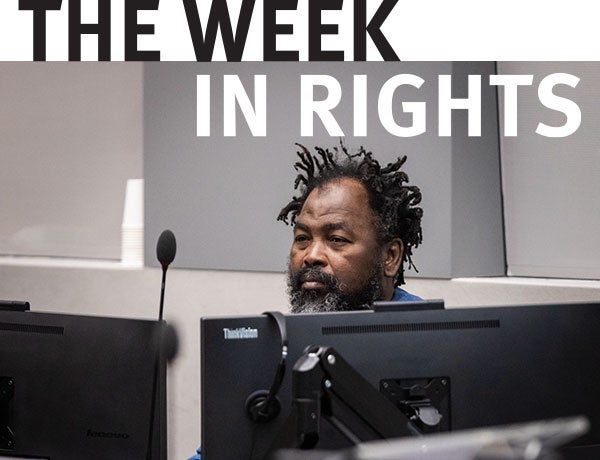
Last week, the International Criminal Court convicted Mahamat Said Abdel Kani, a senior Seleka commander, of crimes against humanity committed in the Central African Republic’s capital of Bangui in 2013.
For victims who have waited far too long, it was finally a measure of justice.
During and after the conflict in the Central African Republic, Human Rights Watch documented a pattern of serious crimes by Seleka forces and others in the country. Many of those responsible have yet to face justice.
In a new article, HRW’s Executive Director Philippe Bolopion discusses his trip to Bangui in 2013, where he met with the country’s then interim president in a military camp and presented him with a copy of our latest report at the time. The research documented the killing of civilians and the destruction of more than 1,000 homes by Seleka forces.
When confronted with the findings, however, the “president” deflected. “What struck me was not simply the denial,” Bolopion writes. “It was the chaos of the military camp, the lawlessness in the country, the collapse of the justice system and the complete absence of accountability.”
With last week’s ICC conviction, justice is finally catching up.
Yet as the ICC makes strides to bring perpetrators to justice around the world, the Court is under attack by the United States. Offended by the ICC’s attempts to advance justice for Palestinians, the Trump administration has imposed crippling sanctions on its officials and others supporting its work.
HRW recently joined partners to sue the Trump administration in US courts and get rid of these sanctions.
At stake is the idea that there should be no impunity for the most serious crimes.
“It matters to the victims in the Central African Republic,” writes Bolopion, “and to all civilians caught in the wars tearing our world apart.”