Violence Against Protesters and Unaccountable Perpetrators in Iraq
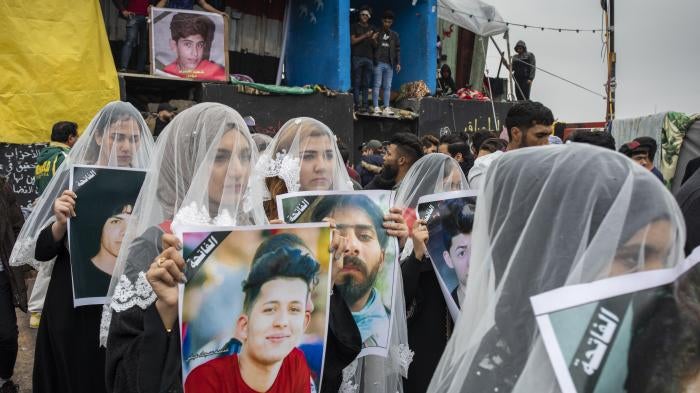
The 40-page report, “To Sleep the Law: Violence Against Protesters and Unaccountable Perpetrators in Iraq,” details specific cases of killing, injury, and disappearance of protesters during and after the 2019-2020 popular uprising in central and southern Iraq. Al-Kadhimi took power in May 2020 promising justice for the murders and disappearances, but when he left office in October 2022, his government had made no concrete progress on holding those responsible to account.
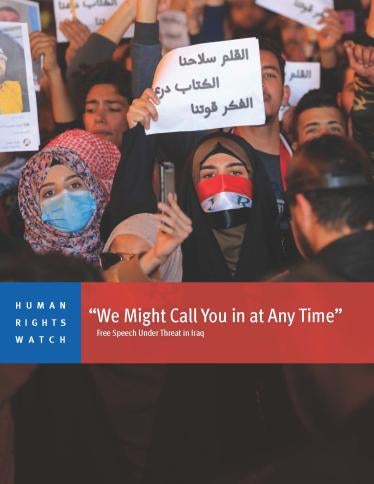
The 42-page report, “‘We Might Call You in at Any Time’: Free Speech Under Threat in Iraq,” examines a range of defamation and incitement legal provisions that authorities have used against critics, including journalists, activists, and other dissenting voices. The Iraqi and Kurdistan Region parliaments should replace criminal defamation articles in the Penal Code with civil defamation penalties and amend laws that limit free speech to comply with international law. Given Mustafa Al-Kadhimi’s new role as prime minister and his stated willingness since taking office to address some of Iraq’s most serious human rights challenges, the government has a unique opportunity to tackle over a decade of free speech restrictions.
Abuses against Children Suspected of ISIS Affiliation in Iraq
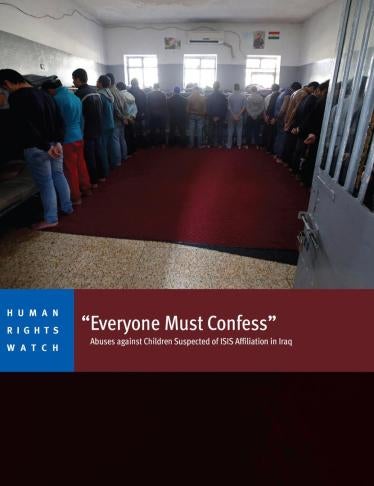
This report shows that Iraqi and KRG authorities often arrest and prosecute children with any perceived connection to ISIS, use torture to coerce confessions, and sentence them to prison in hasty and unfair trials. International law recognizes children recruited by armed groups primarily as victims who should be rehabilitated and reintegrated into society.
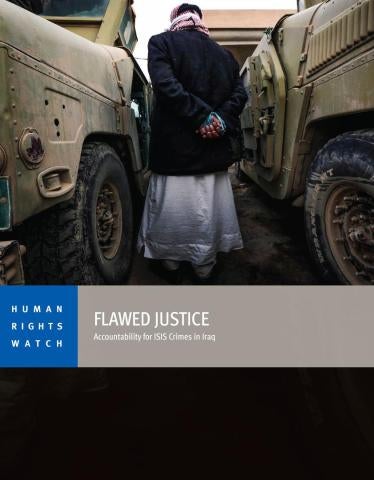
The 76-page report, “Flawed Justice: Accountability for ISIS Crimes in Iraq,” examines the screening, detention, investigation, and prosecution of some of the thousands of Islamic State (also known as ISIS) suspects in Iraq. Human Rights Watch found serious legal shortcomings that undermine the efforts to bring ISIS suspects to justice. Most significantly, there is no national strategy to ensure the credible prosecution of those responsible for the most serious crimes. The broad prosecution under terrorism law of all those affiliated with ISIS in any way, no matter how minimal, could impede future community reconciliation and reintegration, and clog up Iraqi courts and prisons for decades.
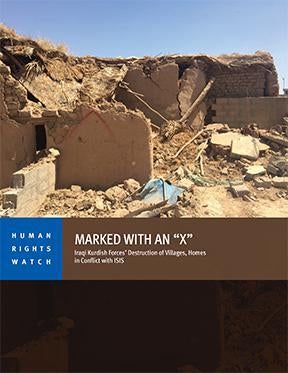
Iraqi Kurdish Forces' Destruction of Villages, Homes in Conflict with ISIS
This report looked at destruction of homes between September 2014 and May 2016 in disputed areas of Kirkuk and Nineveh governorates, areas nominally under Iraqi government jurisdiction but under Kurdistan Regional Government (KRG) control. The destruction, which took place after KRG Peshmerga forces routed Islamic State (also known as ISIS) fighters, targeted Arab homes while leaving Kurdish homes intact. KRG leaders have maintained that these are historically Kurdish areas that they intend to incorporate into the Kurdistan region.
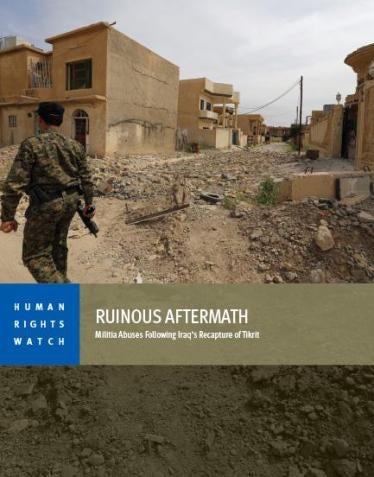
Militias Abuses Following Iraq’s Recapture of Tikrit
This 60-page report uses satellite imagery to corroborate accounts of witnesses that the damage to homes and shops in Tikrit, and the towns of al-Bu ‘Ajil, al-Alam, and al-Dur covered entire neighborhoods. After ISIS fled, Hizbollah Battalions and League of Righteous forces, two of the largely Shia pro-government militias, abducted more than 200 Sunni residents, including children, near al-Dur, south of Tikrit. At least 160 of those abducted remain unaccounted for.
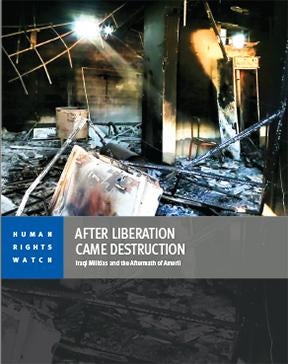
This <a href="http://features.hrw.org/features/HRW_2015_reports/Iraq_Amerli/index.htm… report</a> documents, through field visits, analysis of satellite imagery, interviews with victims and witnesses, and review of photo and video evidence, that militias looted property of Sunni civilians who had fled fighting, burned their homes and businesses, and destroyed at least two entire villages.
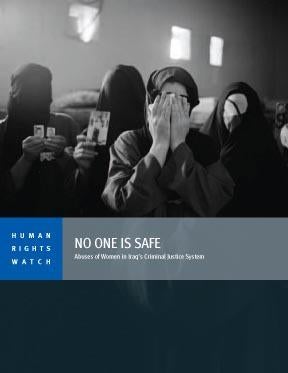
The Abuse of Women in Iraq’s Criminal Justice System
This 105-page report documents abuses of women in detention based on interviews with women and girls, Sunni and Shia, in prison; their families and lawyers; and medical service providers in the prisons at a time of escalating violence involving security forces and armed groups.
This 42-page report documents how thousands of defendants in Iraq wait months or even years before facing a judge and hearing charges against them in the Central Criminal Court (CCCI), and cannot pursue a meaningful defense or challenge evidence against them.
Torture and other abuses against detainees in U.S. custody in Iraq were authorized and routine, even after the 2004 Abu Ghraib scandal, according to accounts from soldiers in this 53-page report. Soldiers describe how detainees were routinely subjected to severe beatings, painful stress positions, severe sleep deprivation, and exposure to extreme cold and hot temperatures.
Findings of the Detainee Abuse and Accountability Project
This 27-page report presents findings of the Detainee Abuse and Accountability Project, a joint project of New York University’s Center for Human Rights and Global Justice, Human Rights Watch and Human Rights First. The project is the first comprehensive accounting of credible allegations of torture and abuse in U.S. custody in Iraq, Afghanistan and Guantánamo.
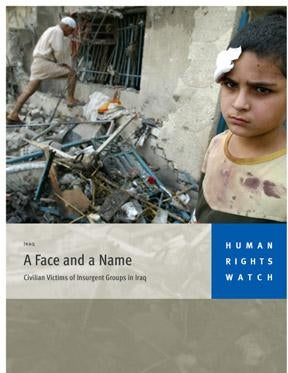
This report is the most detailed study to date of abuses by insurgent groups. It systematically presents and debunks the arguments that some insurgent groups and their supporters use to justify unlawful attacks on civilians.
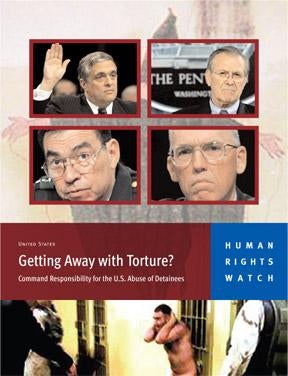
Command Responsibility for the U.S. Abuse of Detainees
This 95-page report, issued on the eve of the first anniversary of the publication of the Abu Ghraib photos, presents substantial evidence warranting criminal investigations of Rumsfeld and Tenet, as well as Lt. Gen. Ricardo Sanchez, formerly the top U.S. commander in Iraq, and Gen. Geoffrey Miller the former commander of the prison camp at Guantánamo Bay, Cuba.
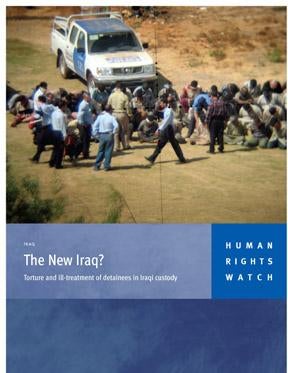
Torture and ill-treatment of detainees in Iraqi custody
This 94-page report documents how unlawful arrest, long-term incommunicado detention, torture and other ill-treatment of detainees (including children) by Iraqi authorities have become routine and commonplace. Human Rights Watch conducted interviews in Iraq with 90 detainees, 72 of whom alleged having been tortured or ill-treated, particularly under interrogation.
This 41-page report details what happened to some of the key archival and forensic evidence that the U.S.-led coalition and, more recently, the Iraqi interim government failed to secure.
This 38-page report examines how the Bush administration adopted a deliberate policy of permitting illegal interrogation techniques – and then spent two years covering up or ignoring reports of torture and other abuse by U.S. troops.