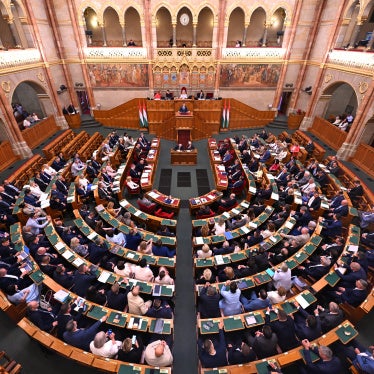
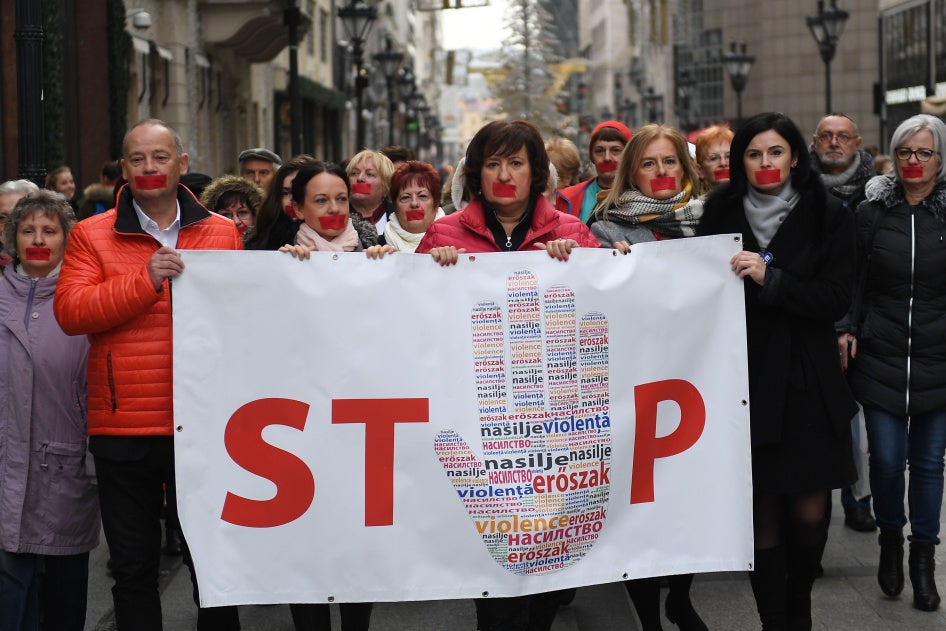
On November 12, Hungary's Prime Minister Péter Magyar announced that his government intends to ratify the Council of Europe Convention on preventing and combatting violence against women and domestic violence, also known as “Istanbul Convention,” as part of a comprehensive package of measures seeking to strengthen protection and dignity of women and girls. It is a welcome and timely step.
In 2013, I interviewed 37-year-old Lívia from Budapest for Human Rights Watch’s report Unless Blood Flows which documented domestic violence in Hungary. She told me she had repeatedly called the police about her husband’s abuse and that the police even witnessed him beating her. Officers told her they could do nothing “unless blood flows.” Other women described similar responses, some telling me they had stopped calling for help.
The new government package would strengthen enforcement of restraining orders, make misuse of intimate images a distinct criminal offense, and provide special protections for victims and survivors of intimate partner violence in criminal proceedings.
The government also plans to end the prescription requirement for emergency contraception and the requirement under the so-called “heartbeat decree” that forces women seeking abortions to listen to any embryonic or fetal cardiac activity. It also aims to help women and girls in need to access menstrual products. These measures are urgently needed and very welcome.
Parliament, then controlled by a two-thirds majority from the Fidesz/KDNP ruling coalition, blocked an earlier ratification effort in 2020. Ratification commits Hungary to binding standards on preventing violence, protecting victims and survivors including those without secure immigration status, and holding perpetrators accountable.
Alongside ratifying the convention, authorities should develop an implementation plan in consultation with victims, survivors and women’s rights organizations; Police should receive specialized training on intimate partner violence, how to assess risks and to act on credible threats, and how to work with the courts to enforce protection orders. And the government should adequately fund sufficient numbers of shelter spaces, legal aid, and counseling services nationwide. To ensure reforms are effective, authorities should collect and publish data on police responses and breaches of protection orders to facilitate assessment.
The real test of these reforms will be when a survivor like Lívia next calls the police for help. No one should have to bleed before police and authorities act.