- Malian armed forces and their allies have since July 2026 responded to mounting attacks by Islamist and separatist armed groups with abusive counterinsurgency operations in central and northern Mali.
- The Malian military, armed groups, and insurgent forces are committing grave laws-of-war violations while international organizations and governments largely stand by.
- The AU Peace and Security Council should undertake sustained scrutiny of all parties to Mali’s conflict by convening a dedicated session on civilian protection and accountability and pressing them to halt abuses.
(Nairobi) – Malian armed forces and their allies have since July 2026 responded to mounting attacks by Islamist and separatist armed groups with abusive counterinsurgency operations in central and northern Mali, Human Rights Watch said today.
Mali’s military and the allied Russia-controlled Africa Corps (formally the Wagner Group) have killed and wounded scores of civilians in attacks and in custody in violation of international humanitarian law. Islamist and separatist fighters have also violated the laws-of-war, including torturing and executing captured Malian soldiers. The African Union Peace and Security Council should urgently take action to prevent further atrocities in Mali.
“The Malian military, armed groups, and insurgent forces are committing grave laws-of-war violations while international organizations and governments largely stand by,” said Ilaria Allegrozzi, senior Sahel researcher at Human Rights Watch. “The AU Peace and Security Council should undertake sustained scrutiny of all parties to Mali’s conflict by convening a dedicated session on civilian protection and accountability and pressing them to halt abuses.”
Between July 30 and September 20, 2026, Human Rights Watch remotely interviewed 30 people, including 16 witnesses to abuses, human rights defenders, community leaders, journalists, and a Malian soldier. Human Rights Watch verified and geolocated two videosposted online showing the aftermath of an apparent drone strike and analyzed 12 photographs of the drone’s debris. Human Rights Watch also reviewed photographs and videos of casualties from other incidents documented. Human Rights Watch sent a letter to Mali’s defense minister on August 5 with findings and questions but received no response.
Human Rights Watch documented two apparently indiscriminate Malian military drone attacks: a strike on July 29 in Talahandak village, in the northern Kidal region, that partially destroyed a health facility; and another one on August 19 at a market in Tombonkore village, in the central Bandiagara region, that killed six civilians and injured at least 20 others. Human Rights Watch also documented that on July 12 Malian soldiers shot and killed five girls during a counterinsurgency operation in the central Ségou region, and that on July 27 and 28, allied Dozo militia killed three civilians in the central Mopti region, all with impunity.
The Al-Qaeda-linked Group for the Support of Islam and Muslims (Jama’at Nusrat al-Islam wal-Muslimin, or JNIM) and allied separatist fighters of the Azawad Liberation Front (Front de libération de l’Azawad, or FLA) attacked a military convoy on July 18 in Gao region and then tortured and executed at least 19 Malian troops taken prisoner.
These incidents occurred amid renewed fighting in Mali. On April 25, JNIM carried out coordinated attacks across the country alongside FLA fighters seeking to overthrow the military junta led by Gen. Assimi Goïta and backed by the Africa Corps. Malian armed forces and their allies responded with airstrikes that killed civilians and with reprisals against ethnic communities accused of collaborating with the insurgents.
“I found myself on the ground, propelled by the blast, stuck between a cart and a tree more than 15 meters from where I had been,” said a 24-year-old man who survived the August 19 attack. “Everyone started running. I tried to get up and saw that my right leg was completely shredded. Blood was dripping from my pants.”
Since their coordinated attacks in April, JNIM and the FLA have captured and detained increasing numbers of Malian security personnel. Concerns over their treatment intensified after the two armed groups claimed responsibility for a July 18 attack against a Malian military and Africa Corps convoy in Tabrichat, Gao region, in which at least 19 Malian troops who had surrendered were tortured and executed.
Human Rights Watch reviewed videos posted online, also previously analyzed by Amnesty International, showing armed men beating and shooting surrendering soldiers. Human Rights Watch could not determine whether the armed men were JNIM or FLA fighters. However, in one of the videos, credible sources and international media identified one of the men as the son of JNIM’s leader, Iyad Ag Ghali. In at least two videos, as Amnesty International highlighted, a white flag with black writing, characteristic of JNIM, is visible on the front of the attackers’ vehicles.
“Once [we made it to] Gao, over 50 military personnel were missing,” a soldier who survived the attack said. “At least 19 were executed – we saw them in the videos. The others? Dead? Captured? We don’t know. We can’t ask questions and we have been prohibited from watching the videos in the camp.”
JNIM’s Sharia Committee, in a September 30 response (English, Arabic) to Human Rights Watch, wrote that “although the killing of captives in Tabrichat … did in fact take place, we did not give the order for it, not because it is not permitted in our religion, but because we considered it a matter of interest to leave this alone.” JNIM added that Islam “grants Muslim leaders four choices with respect to captives: release, ransom, enslavement, and execution … even though we did not
order our troops to commit that incident and it is not our policy to do such things, what they did does not violate our Sharia such that we see it necessary to hold them accountable or punish them.”
In a September 20 response to Human Rights Watch, Mohamed Elmaouloud Ramadane, FLA’s spokesperson, wrote that “[t]he FLA acknowledges that armed clashes took place between its forces and those of the Malian army and its Russian allies of the Africa Corps in Tabrichat on July 18, … However, the FLA categorically rejects any allegation that its forces carried out the execution” of Malian soldiers. He added that “the FLA has carried out and will continue to carry out … internal checks about any … violations of international humanitarian law by some of its members … especially those from Tabrichat.”
All parties to Mali’s armed conflict are bound by international humanitarian law, notably Common Article 3, Protocol Additional of 1977 to the 1949 Geneva Conventions relating to the Protection of Victims of Non-International Armed Conflicts (Protocol II), and customary laws-of-war. Deliberate or indiscriminate attacks on civilians or civilian property, including medical facilities, are prohibited. Indiscriminate attacks include those that do not target a specific military objective. Common Article 3 and Protocol II also provide that anyone deprived of their liberty must be treated humanely in all circumstances. In particular, they are protected against murder, torture, and cruel, humiliating, and degrading treatment. Individuals who commit serious violations of the laws-of-war with criminal intent or are responsible as a matter of command responsibility may be prosecuted for war crimes.
At its April 28 session on Mali, the AU Peace and Security Council called for protecting civilians and regular briefings and requested increased AU support for Mali’s security sector in compliance with international human rights and humanitarian law. The council should follow through by adopting a communiqué condemning abuses by all parties to the conflict and requesting an urgent report on civilian protection measures and investigations, Human Rights Watch said.
“The AU Peace and Security Council should follow up its commitments to protect civilians in Mali with concrete measures and regular public reporting,” Allegrozzi said. “It should press the Malian authorities to conduct independent investigations into abuses by the Malian military and its allies as well as opposition forces, and offer support in such investigations from AU human rights experts.”
Abuses by Malian Armed Forces and Allied Militias
Armed Conflict Location & Event Data (ACLED), a nongovernmental organization that monitors, collects, and analyzes conflict-related data globally, reported that between April and August 2026, Malian forces and the Africa Corps carried out 49 airstrikes, killing 89 civilians, more than double the 22 strikes and 44 civilian deaths reported during the same period in 2025. ACLED data also show that between April and August, the Malian armed forces killed 268 civilians. JNIM forces killed 134 civilians over the same period.
Following military coups in 2020 and 2021, Mali’s junta has increasingly used airstrikes in its operations against armed groups. Mali has acquired and used Turkish-made Bayraktar TB2 drones since 2022 and Turkish-made Akinci drones since 2024. Russia has since 2022 also provided drones and fighter jets to Africa Corps personnel in Mali. Human Rights Watch, as well as other human rights groups and several media and investigative organizations, have repeatedly documented unlawfully indiscriminate or disproportionate airstrikes that caused civilian casualties.
Apparent Indiscriminate Drone Strikes
Tombonkore, Bandiagara Region, August 19
On the morning of August 19, an apparent military drone released munition on civilians gathered at the cattle market in the village of Tombonkore, Kilimpo area, Bandiagara region, killing six men and injuring at least 20 others. The strike also killed several animals and destroyed market stalls and motorbikes.
Five witnesses, including three injured in the strike, said that JNIM forces controlled the Tombonkore vicinity, but that no JNIM fighters were at the market or in the village at the time of the strike. They said the drone flew over the village for an extended period before releasing its munition, suggesting that the area was being surveilled.
“It [the drone] was gray and slowly flew above us from east to west and back for about 30 minutes before it bombed us,” said a cattle trader, 48, who was at the market.
Human Rights Watch could not identify the specific drone or munition used. However, the Malian military and allied Africa Corps are the only known forces in Mali to possess the large drones described by witnesses.
A 43-year-old witness said:
When the drone dropped the bomb on the market, I was thrown to the ground, blood gushing from my body. I saw my right arm was almost severed, held together only by a tiny piece of flesh. The blood was flowing profusely. A man … dragged me toward a small house nearby. I felt excruciating pain, and lay in a pool of blood. I saw people running, I heard screams. I got up after 40 minutes like that, and … looked for help. A man I didn’t know rescued me, took my turban and tied it around my arm securely to stop the bleeding.
The man’s arm was later amputated at the hospital in Sévaré.
A 24-year-old man injured in the strike was interviewed hours before doctors amputated his right leg at the Sévaré hospital. He said he saw the drone repeatedly fly over the village, first eastward and later westward at increasingly lower altitude, until it approached the village more directly and dropped its munition. He said:
I saw people lying down, screaming and asking for help. It was at least an hour later that the villagers came to rescue us. I was rescued by a [ethnic] Dogon [man] who took me to his home next to the market, where I found my wife and other wounded people.… The motorcycle that my friend and I had come with to the market had caught fire. We had no means of transportation.… My foot was wrapped with a big cloth, and the pain was so severe. I spent the night with this Dogon family.… The next day, my foot looked like an elephant’s leg…. They took me to the hospital, and I am waiting for doctors to amputate my leg.
A 29-year-old butcher said he was at the market when the drone dropped its munition:
I fell and tried to get up, but I couldn’t. I saw blood running from my clothes, but I didn’t feel any pain. I then crawled to take cover under a cart to avoid a second strike. I looked at my leg; it was red with blood and twisted. From there, I saw several people on the ground, some screaming and others not moving. People were running everywhere. Motorcycles parked near my butcher shop caught fire. I was screaming for help, but people were running around, and no one was listening to me. After an hour and a half like that, calm returned, the market was empty, and villagers came to help the injured. I had lost a lot of blood. Friends and a cousin … tied my leg with a cloth before lifting me. I couldn’t breathe; I felt nauseated.
The man said that his cousin took him to the hospital in Bandiagara and then to the Sévaré hospital, where his right leg was treated for a fracture.
The 48-year-old man said he helped evacuate the injured by putting them on carts and motorcycles and buried the bodies of those killed. He said five civilian men died on the spot, while a sixth died of his injuries at the Sévaré hospital:
Around 3 p.m. we buried the dead at the village cemetery, each in his grave.... There were no JNIM fighters among the dead. The bodies of those killed … had deep wounds in the abdomen and back.… The bodies were almost all at the same place, at the market, a few meters one from the other. Fourteen were seriously injured and were taken to either Bandiagara or Sévaré hospitals. Others, with less serious wounds, were treated in the village – they did not want to go to the hospital because they feared reprisals from the FAMA [Malian armed forces]. Among the injured, I saw one who had almost lost an arm, another had both legs in tatters, and others had open wounds on their abdomen, back, and head.
Witnesses shared with Human Rights Watch a video showing the aftermath of the strike. Although Human Rights Watch was not able to independently geolocate it, the footage includes an on-screen narration identifying the location and date of the attack consistent with witness accounts. The video shows the bodies of at least two men and blood on the ground.
Human Rights Watch also reviewed 10 photographs from witnesses showing one of the bodies visible in the video, another dead man, dead animals, and other people that witnesses said were injured in the strike. One of the photographs shows a man whose right arm is severely damaged; a forensic expert who reviewed the image said that injuries to the arm were highly consistent with a blast injury. Three other photographs show three injured men, with wounds to their legs and arms, including one who sustained a traumatic amputation.
The chief of staff of the Malian armed forces issued a statement on August 20 that on the previous day Malian forces and their partners successfully struck a “terrorist hideout” in the Kilimpo area after long monitoring it. He added that about 20 “terrorists” were “neutralized,” and military equipment destroyed.
Human Rights Watch reviewed a list provided by witnesses with the names of the six men, ages 21 to 54, killed in the strike.
“They [JNIM fighters] weren’t there that day, and still they are often around the village and also visit it,” said the 24-year-old man. “They preach and, above all, they make a lot of purchases at the market, buying fuel, pasta, spices, cereals, especially on Fridays. They also come during the week to make sure everyone follows the rules.”
Talahandak, Kidal Region, July 29
On July 29 at about 4 a.m., an apparent one-way (“kamikaze”) attack drone hit and partially destroyed a health center in Talahandak, a village in a JNIM and FLA-controlled area near the Algerian border.
Two men, including a 45-year-old health worker who witnessed the explosion, said that no JNIM or FLA fighters were in or around the health facility at the time of the strike and that the health center did not store anything other than medicines and medical equipment.
The health worker said:
At the health center, we took care of men, women, children, and elderly people suffering from, among other things, malaria. Under no circumstances was this facility used by armed groups.… Only civilians received care here. Today, the center is destroyed.… Women and children, already deprived of basic health services, are going to suffer from this situation, not the armed groups. There were never any munitions or armed vehicles on site, even in the days before the attack. The fighters never came here. No terrorist or armed man was ever treated here; we don’t even have the medical means to treat war injuries.
The witnesses said they recovered the drone’s debris. They provided 12 photographs they said were taken at the site after the strike. The photographs analyzed by Human Rights Watch show components and remnants consistent with a Shahed-type delta wing drone, including control surfaces, brackets, bolt patterns, and internal construction. In a July 24 report, Bellingcat and Jeune Afrique geolocated footage showing Shahed-136 type one-way attack drones in operation in Mali. They verified two strikes, including one in Talahandak on July 17 that destroyed a truck carrying cooking oil and killed one civilian.
A 35-year-old resident of Talahandak said:
The health center was hit. The pharmacy and the room where the patients used to get treated were destroyed, as well as the patients’ beds, the lab equipment, and the pharmaceutical products. It’s completely in ruins and can’t be used for anything anymore. I can’t accurately describe the drone because it was dark. But I heard it and saw the strike, the explosion, the flames, and the fire coming from the health center. The drone sounded like a motorcycle, came at full speed, and crashed straight into its target. The next day, we went to see the ruins of the health center. We saw the drone’s engine as well as its propeller, which were not too damaged.
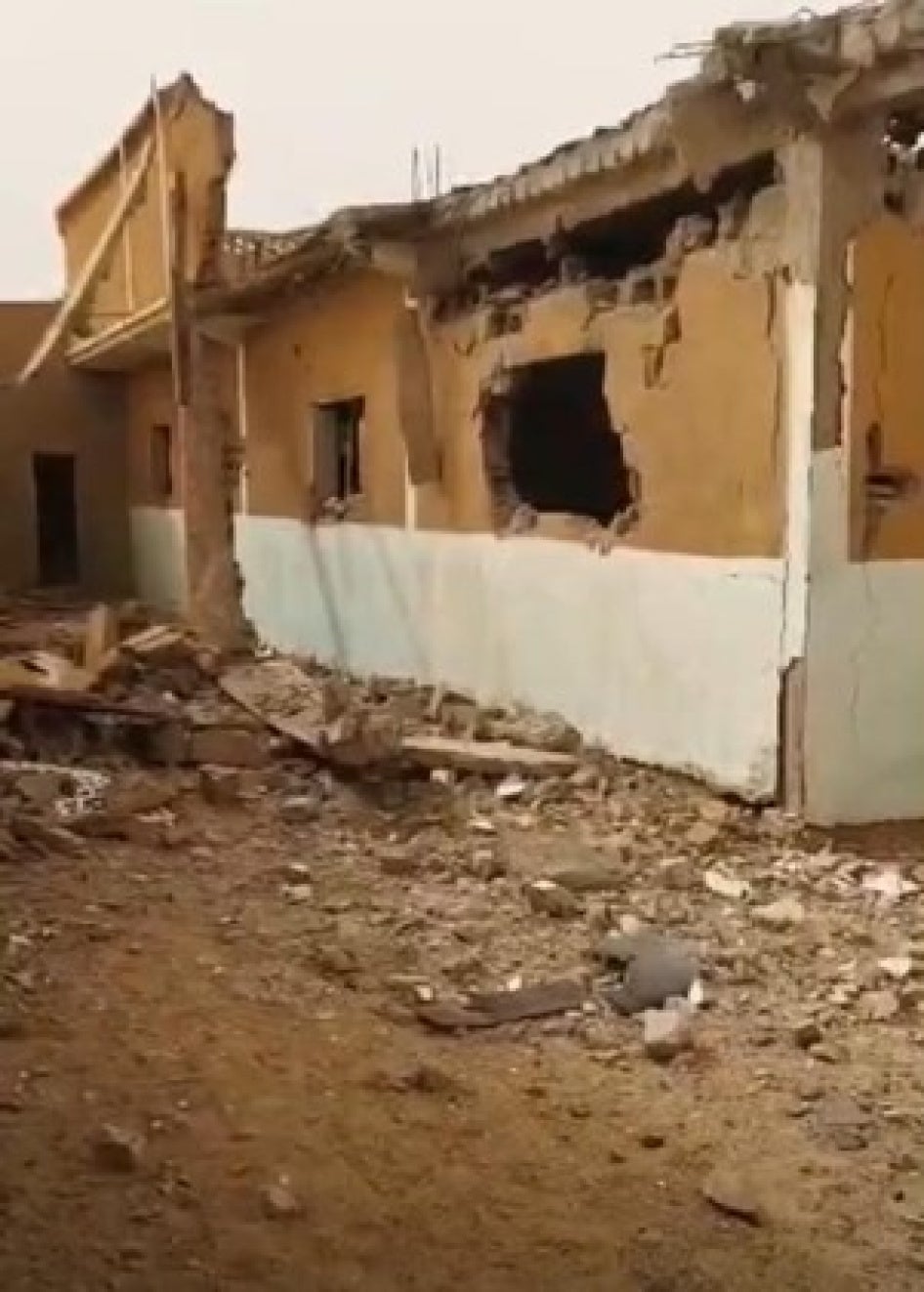
Human Rights Watch also verified and geolocated two videos posted to X on July 29 showing the interior and exterior of the Talahandak health center. The footage shows extensive damage to several rooms identified as the men’s and women’s treatment rooms, the laboratory, the pharmacy, and a consultation and ultrasound room. Damaged medical equipment and supplies are visible throughout the facility.
The room marked as the men’s treatment room appears to be the most damaged, with a large hole in its exterior wall where a window had been. Debris is scattered through the room, and numerous fragmentation impacts are visible on the walls, along with signs of fire damage, and a charred stretcher. The videos also show structural damage to at least two of the building’s facades and its roof. Human Rights Watch also analyzed satellite imagery from August 6 that showed severe damage to the roof’s northwestern corner.
Under international humanitarian law, all medical facilities are protected from attack, including facilities that treat members of belligerent armed forces or armed groups. This protection ceases only when medical facilities are used to commit hostile acts outside their humanitarian function, and then only after a warning that goes unheeded.
Abuses During Counterinsurgency Operations
Djenné, Mopti Region, July 27 and 28
On July 27 around noon, a militia member from a group of dozens of Dozo militiamen wearing traditional clothing and armed with Kalashnikov-style assault rifles shot and killed a 50-year-old ethnic Fulani man near the main mosque in Djenné. Minutes later, the militiamen fatally shot another Fulani man, 43, at the same location.
A 45-year-old resident said:
During the attack, I was with my friend [the 43-year-old man]. We were together when we heard a gunshot. I immediately told him, ‘Let’s take cover, it’s right next to us.’ He hesitated while I ran without waiting. The Dozo then shot him. In fact, the very first gunshot we heard was aimed at another friend of mine [the 50-year-old man]. The Dozo killed him, and we saw him collapse. When I turned my head, I saw a large group of Dozo, armed with Kalashnikovs, heading toward us. I personally know them because we all live in Djenné. To save myself, I had to run and leave my friend behind. That’s when they shot him.
Another witness provided a similar description of the incident.
On July 28, four Dozo militiamen, believed to be members of the same group who entered Djenné the previous day, forced their way into a house in Sankore neighborhood. They dragged out a 42-year-old Fulani man, tied his hands behind his back, blindfolded him, and drove away with him. His relatives found his body the next day, about two kilometers away, with three gunshot wounds to the head and chest.
Human Rights Watch spoke to two witnesses to the abduction, including the victim’s 32-year-old wife. She said that on the day the Dozo shot and killed the two men near the mosque, fear spread throughout Djenné’s Fulani community, prompting many to flee. She said she urged her husband to flee, but he refused, saying that he had spoken with the military based in town to report the incident and seek protection.
The wife said:
The next day, on July 28, around 10 a.m., four Dozo armed with Kalashnikovs, dressed in their traditional outfits and horned hats, surrounded our house.... Two of them broke inside the house and forcibly took him [the husband] out. They grabbed his turban to blindfold him, tied his hands behind his back, put him on a motorcycle, and drove off with him. That’s the last time I saw him alive.
The other witness, a 39-year-old man, was among the people who found the victim’s body, “under a tree [with] a bullet wound in the head and two in his chest.”
Residents said that there were no JNIM fighters in Djenné on the days of the killings and the abduction. They said the victims were targeted because they were Fulani. Islamist armed groups, including JNIM, have long recruited from Fulani communities in the area. Malian authorities and allied ethnic militias have repeatedly equated Fulani civilians with Islamist fighters to justify killings and other serious abuses.
Niono, Ségou Region, July 12
On July 12 at about 3 p.m., Malian soldiers shot and killed five girls, ages 10 to 13, who were harvesting rice in a field about three kilometers from Niono town.
The soldiers took the victims’ bodies to the morgue at Niono hospital and later apologized to their families, acknowledging that they had made a mistake. They said that earlier that day, around midday, they had come under attack approximately nine kilometers away. When they later saw heads emerging from the rice fields, they mistakenly believed they were the attackers and opened fire.
The father of three of the victims, a 46-year-old Fulani man, said:
When I arrived, the hospital was cordoned off by soldiers. I went inside and a nurse told me, ‘The soldiers brought the children’s bodies here.’ … The nurse confirmed the children had been shot by the army […] and then he led me to the morgue. That’s where I found my three children lying, their bodies riddled with bullets. Devastated, I asked the nurse, “What happened to them? They were just kids going to work in the fields, they weren’t fighting in any war! Why are they coming back like this?”
“An army captain came all the way to our home in person to apologize to us,” said the father of the two other victims, a 59-year-old ethnic Dogon man. “He told us that they were completely sorry and that their intention was never to kill children.” The other father said he received a similar explanation from the soldiers.
It is evident that the soldiers did not do everything feasible to verify that the targets of the attack were combatants, resulting in the killing of civilians in violation of the laws-of-war.
As of mid-September, the government had not, to Human Rights Watch’s knowledge, opened an investigation into this incident, nor had the families been offered any reparations.
Abuses by JNIM and FLA Armed Groups
Tabrichat, Gao Region, July 18
On July 18, JNIM and FLA fighters attacked a Malian military and Africa Corps convoy traveling from Anefis to the city of Gao near Tabrichat village in the Gao region. Both armed groups claimed responsibility for the attack, with JNIM noting “heavy casualties and significant material damage to the enemy,” and the FLA stating there were “heavy losses on the enemy side, several dead left on the battlefield, dozens of injured as well as prisoners.”
International media and human rights organizations reported that the armed groups captured dozens of Malian soldiers, tortured several, and then executed many. Radio France Internationale reported that JNIM and FLA fighters “summarily executed Malian soldiers who had surrendered.” Amnesty International documented the beating and abuse of the captured soldiers by alleged JNIM and FLA fighters and the execution of at least 19.
Human Rights Watch spoke to a Malian soldier who was in the convoy and with two victims’ relatives and reviewed videos posted on social media previously analyzed by Amnesty International. The videos show surrendering soldiers with their hands in the air or clasped behind their heads walking in the desert surrounded by armed men and their vehicles. Armed men can be seen beating and shooting at the captured soldiers.
On July 23, the Office of the United Nations High Commissioner for Human Rights condemned the torture and killing of surrendered soldiers in Tabrichat and called for accountability.
The Malian soldier said the convoy left Anefis at about 10 p.m. on July 17, bound for Gao. Africa Corps fighters, he said, led the convoy, followed by soldiers from the Aguelhokcamp. Soldiers from the Anefis base were at the rear. He said that right from the convoy’s departure, he was worried by “the huge lack of coordination between the Africa Corps, the Anefis units, and the few units that came from Aguelhok.”
The soldier said:
Breakdowns and flat tires were too frequent, while FLA and JNIM fighters were following us since we left the camp. We were intercepting their communications. They clearly intended to attack the convoy before the morning. The terrorists had surveillance drones and launched rockets at the convoy…. Near Tabrichat, everyone understood that the convoy would be attacked and that when the attack happened, nobody would be able to counter it because we were slowed down by the breakdowns and flat tires and lacked any real coordination. We didn’t know who was where, who was doing what, who was on defense, and who was dealing with the broken-down and stuck vehicles.
He said that JNIM and FLA fighters attacked the convoy at about 7 a.m. in Tabrichat, in a sandy area where vehicles could easily get stuck. The insurgents began surrounding the convoy and split it into two groups. He said Africa Corps fighters in front did not turn back to help, escaping instead. Malian soldiers at the middle and rear of the convoy were overwhelmed despite returning fire. “Some managed to escape, others were captured and executed,” he said. “The number of soldiers we counted as missing after the ambush is over 50. Among these 50 soldiers, 19 were executed.”
A 32-year-old woman said she learned that her husband, an army sergeant who had been deployed to Anefis since 2023, was killed in the ambush by watching videos that circulated online soon after the attack.
She said:
I began struggling to breathe. I immediately left the hairdresser—who had shown me the images—to go to the military camp [in Gao].… I asked a soldier if he knew about the ambush and he replied: ‘Yes, but the situation is under control.’ … I told him I identified my husband in the videos … but he told me not to pay attention to fake videos produced by the JNIM and FLA’s propaganda [outlets], which are ‘aimed at discouraging and demoralizing the military.’ He told me to go back home and wait for an official military communication.
The woman said the following day she spoke to her husband’s brother who told her he had also gone to see the military in Gao but had received the same answers. They then decided to seek more information from an FLA commander.
She said:
We wrote him the following message: ‘Was our military relative among the soldiers who were attacked in Tabrichat? Can you verify if he’s still alive?’ The rebel commander immediately responded that the FLA did not execute any soldiers but only took them prisoner and brought them to a safe place [but] a military drone bombed the place and all prisoners died. He added that if our relative was among those taken prisoner, we should not assume that he would come back home.… It was at this moment that I began mourning.
In response to Human Rights Watch’s query, the FLA’s spokesperson, Mohamed Elmaouloud Ramadane, also suggested that drone strikes had killed the soldiers in the custody of the rebel groups: “[S]everal military personnel under the control of or near FLA forces were killed following drone strikes carried out by the Malian armed forces and their Russian Africa Corps allies after the clashes.”
In a July 18 statement, the chief of staff of the Malian armed forces said that “alongside the air and ground response launched to support the convoy attacked in Tabrichat by the JNIM/FLA terrorist coalition, the Malian armed forces are continuing their operations ... across the country.”
The media reported that the public prosecutor at the judicial unit specializing in terrorism cases and organized transnational crime announced on August 1 the opening of an investigation into the summary executions at Tabrichat.
As of mid-September, the Malian army had not contacted the families of the soldiers killed or missing to provide information or support.
A carpenter whose brother, a 37-year-old soldier, has been missing since the Tabrichat attack, said that he had identified him in one of the videos that circulated online:
The day after the ambush, we watched the videos and we identified him. He and his comrades can be seen with their hands up, one after the other, surrounded by the armed groups.… Any attempt to get more information from the army was in vain. His surviving comrades refused to tell us more about what happened that day. So, we have to mourn and leave it in God’s hands.
He added that no authorities contacted him or his family to provide information about Tabrichat:
I learned that the government has opened an investigation, but ... no government official has come to ask us anything.... The government has never reached out to us. Neither to offer condolences nor to talk to us about the investigation.… Authorities have shut themselves off in silence about this incident, and in this specific situation where soldiers are captured, executed, and filmed, relatives deserve answers.
Human Rights Watch reviewed a list, shared by the soldier and victims’ relatives, with the names of five soldiers believed killed in the attack, ages 37 to 52.