Thank you.
I am pleased to deliver this statement on behalf of 40 civil society organizations.
After years of reports about the horrific human cost of incendiary weapons, it is long past time for states to take action to address them. States should both raise the issue at this month’s First Committee and agree at the November Review Conference of the Convention on Conventional Weapons (CCW) to initiate dedicated discussions to assess the status of existing law and find ways to strengthen civilian protection.
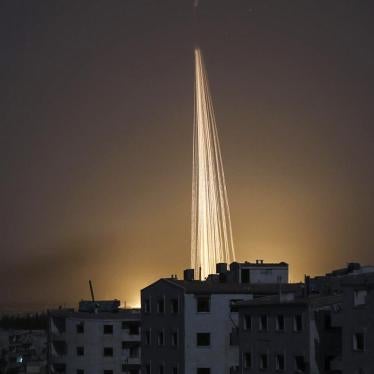
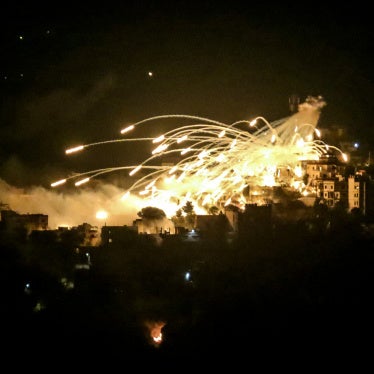
Incendiary weapons cause excruciating burns, lifelong physical and psychological pain, socioeconomic exclusion, and damage to homes, farms, and the environment. CCW Protocol III on Incendiary Weapons has failed to adequately address this harm due to two key loopholes. Its definition excludes multipurpose munitions, notably those containing white phosphorus munitions, and its regulations are weaker for ground-launched incendiary weapons than for air-dropped ones.
In 2026, white phosphorus munitions have attracted particular attention. Human Rights Watch verified 23 incidents of the use of white phosphorus munitions by Israeli forces in southern Lebanon between March and May 2026. At least some of those incidents involved airbursting white phosphorus munitions over populated areas, which is indiscriminate and violates international humanitarian law.
In a recently released report titled Uncontrolled Burn, Human Rights Watch and the Harvard Law School International Human Rights Clinic assessed white phosphorus munitions under the Martens Clause, a provision of international humanitarian law that sets out that, when there is no specific treaty on a topic, civilians and combatants are protected by the principles of humanity and dictates of public conscience.
The inhumane and hard-to-treat injuries caused by white phosphorus munitions are incompatible with the principles of humanity. Objections and concerns raised by countries, international organizations, civil society groups, medical professionals, and financial institutions provide evidence that the munitions run contrary to the dictates of public conscience.
Stronger and more specific international law is urgently needed to address the problems of white phosphorus munitions and the consequences of incendiary weapons more broadly.
While work at CCW meetings should continue, the forum’s consensus-based decision-making process has impeded progress. States should therefore take up the topic more seriously in other forums, including the First Committee.
We urge states at this month’s meeting to:
- Cease and condemn the use of incendiary weapons and white phosphorus munitions due their unacceptable human cost.
- Call for discussions of options for responding to the humanitarian consequences of incendiary weapons and white phosphorus munitions.
- Work to strengthen international standards to close the loopholes in Protocol III, further stigmatize the use of incendiary weapons, and better protect civilians. A complete ban on incendiary weapons and white phosphorus munitions would have the greatest humanitarian impact.
For more information, see the recent report Uncontrolled Burn: The Inhumane Effects of White Phosphorus Munitions and the Need for Stronger Law, co-published by Human Rights Watch and Harvard Law School’s International Human Rights Clinic.
Thank you.
The following organizations have endorsed this statement:
- Action on Armed Violence (AOAV)
- ACTORS RWANDA
- Aotearoa New Zealand Campaign on Military Spending
- Aotearoa New Zealand Network on Explosive Weapons
- Campaña Colombiana Contra Minas (CCCM)
- Campaign Against Arms Trade
- Center for Civilians in Conflict (CIVIC)
- Center for International Policy
- Christians for a Free Palestine, Catholic Caucus
- Conflict and Environment Observatory (CEOBS)
- DAWN
- Deutsche Friedensgesellschaft – Vereinigte KriegsdienstgegnerInnen e.V. (DFG-VK)
- Development and Ability Organization
- Dhesarme – Brazilian Action for Humanitarian Disarmament
- Disability Rights and Disarmament Initiative (DRDI)
- Explosive Weapons Trauma Care Collective (EXTRACCT)
- ForUM
- Human Rights Watch
- Humanity & Inclusion
- International Human Rights Clinic at Harvard Law School
- International Network on Explosive Weapons
- Legacies of War
- Maat for Peace, Development and Human Rights
- Mines Action Canada
- Nonviolence International
- Nonviolence International Canada
- Norwegian People's Aid
- Nuclear Age Peace Foundation
- Pax Christi USA
- PAX
- Peace Movement Aotearoa
- PROTECTION
- Réseau d'Action Sur les Armes Légères en Afrique de l'Ouest (RASALAO)
- Réseau d'Action Sur les Armes Légères en Afrique de l'Ouest, section Côte d'Ivoire
- Saferworld
- SANE Policy Institute
- Seguridad Humana para América Latina y el Caribe (SEHLAC)
- West Virginia Campaign to Ban Landmines and Cluster Munitions
- Women, Peace and Security Network Aotearoa New Zealand
- Women's International League for Peace and Freedom (WILPF)