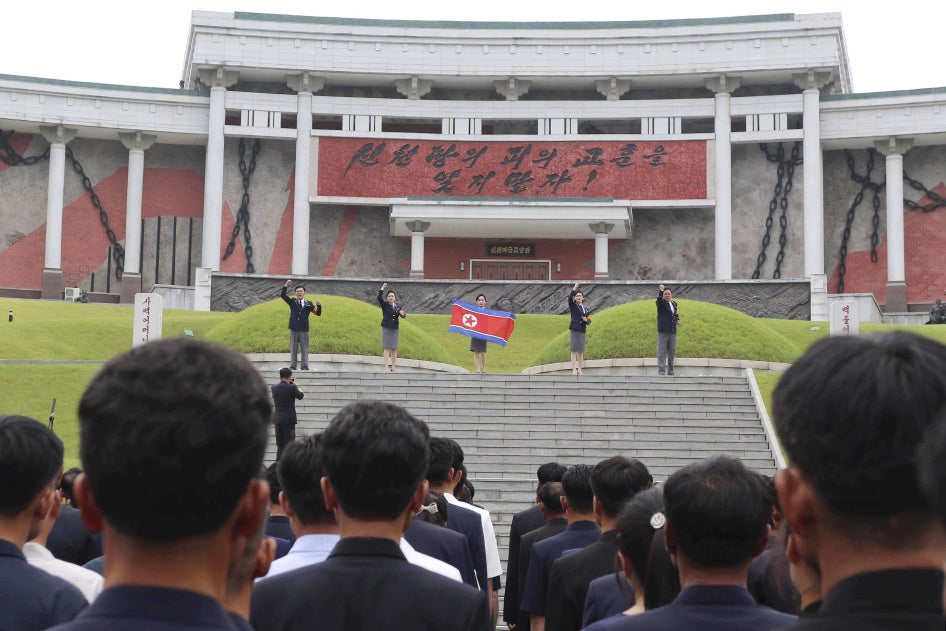
(Bangkok) –In 2025, the North Korean government increased surveillance, information controls, and restrictions on market activity despite deepening food insecurity and inequality, Human Rights Watch said today in its World Report 2026.
North Korean leader Kim Jong Un’s totalitarian government, among the world’s most repressive, was implicated in human rights abuses abroad, including abductions, enforced disappearances, and overseas deployment of North Korean workers under abusive conditions.
“Over the past year, while ordinary North Koreans struggled to obtain food and other necessities, Pyongyang expanded censorship and surveillance, cracked down on border crossings, and limited market activity,” said Lina Yoon, senior Koreas researcher at Human Rights Watch. “Governments engaged with North Korea should focus on human rights, including with regard to international security, food shortages, and support for groups abroad defending North Koreans’ rights.”
In the 529-page World Report 2026, its 36th edition, Human Rights Watch reviews human rights practices in more than 100 countries. In his introductory essay, Executive Director Philippe Bolopion writes that breaking the authoritarian wave sweeping the world is the challenge of a generation. With the human rights system under unprecedented threat from the Trump administration and other global powers, Bolopion calls on rights-respecting democracies and civil society to build a strategic alliance to defend fundamental freedoms.
- Food insecurity worsened with official trade remaining below pre-Covid-19 levels, increased restrictions on market activity, and rising prices. Some people had to cut back on food while the government prioritized weapons development.
- In September, the United Nations Office of the High Commissioner for Human Rights reported that Kim Jong Un had increased the use of surveillance, forced labor, and severe punishments over the past decade to maintain “total control” over the population. The UN General Assembly in December 2024 and the Human Rights Council in April 2025 again adopted resolutions condemning North Korea’s grave human rights violations.
- Reports from Ukrainian special forces and South Korean intelligence revealed that injured North Korean soldiers who were sent to fight in Russia’s war against Ukraine were sometimes executed by their own units. Soldiers are instructed to commit suicide rather than risk capture, which North Korean state media glorifies as heroic sacrifice.
- Chinese authorities forcibly returned at least 26 North Koreans in 2025, bringing the total number since 2020 to at least 1,076, unlawfully putting returnees at high risk of torture, forced labor, sexual violence, wrongful imprisonment, and possible execution.
- Funding cuts by the United States to independent broadcasting into North Korea, together with the South Korean government’s decision to scale back programming aimed at North Koreans, shut out vital sources of uncensored information, leaving North Koreans increasingly isolated.
The North Korean government should end collective punishment, forced labor, and “unconditional” shoot on sight orders at the border; ensure that people have adequate access to food, health care, and employment; and allow independent monitoring, including by UN human rights mechanisms, Human Rights Watch said.