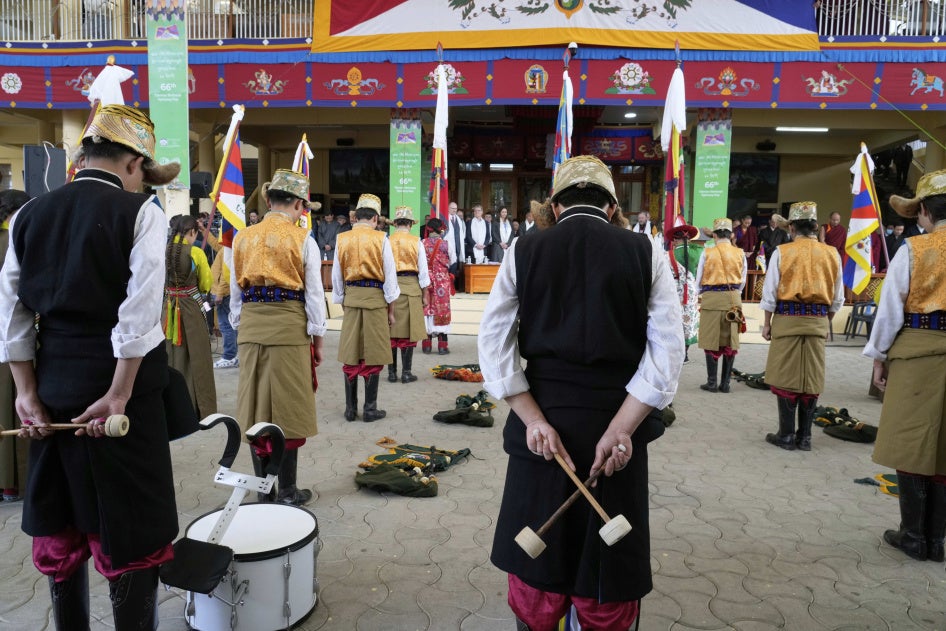
Nearly seven decades since the 1959 uprising in Lhasa, the capital of Tibet, the Chinese government still treats March 10 with vigilance. On that date, popular anger against eight years of control by the People’s Republic of China boiled over into protest, triggering the Chinese government’s bloody imposition of direct rule and the flight into exile of the Dalai Lama, Tibet’s spiritual and political leader. Few Tibetans now dare to publicly commemorate the day as the risks are too high.
The repression of Tibet remains unrelenting. Apart from the torrent of state propaganda—well-funded and amplified in recent years by state-controlled social media—almost no independent news escapes Tibet. But a handful of exile-run platforms provide a rare window into life in this highly oppressed region. In 2024-25, they reported 45 politically motivated detentions—few about public protests—but mostly for what people did on their phones.
Nineteen Tibetans were punished for sending information abroad (many Tibetans have relatives in the diaspora), sharing “illegal” content about the Dalai Lama, or simply having such material stored on their devices. The authorities detained a waitress in Shigatse city after a random phone search—a surveillance tactic—before releasing her without charge after a year in detention.
At least 15 cases amount to enforced disappearances as the authorities have not revealed the whereabouts of the detainees, including three popular singers.
Among those 45 arbitrary detentions, two died in custody and two shortly after release.
Four senior religious figures have been detained, including Choktrul Dorje Ten and Khenpo Tenpa Dargye, both of whom ran government-approved vocational schools, highlighting the government crackdown on educational institutions that promote Tibetan language study.
Some reported detentions did stem from public protests. Five Tibetans remain in custody after the authorities arrested and mistreated hundreds for peacefully protesting the construction of a dam in Sichuan province in 2024. In March 2024, a lone Kirti monk was arrested after briefly protesting for freedom and the Dalai Lama’s return: his sentence remains unknown. And mass arrests reportedly followed large-scale protests against renewed gold mining in November 2025.
World leaders should use this moment to challenge China’s enforced silence surrounding Tibet, by pressing for information about the 45 known detention cases, accountability for deaths in custody, and genuine international access to the region.