Chinese authorities systematically deny the rights to freedom of expression, association, assembly, and religion, and persecute government critics. Tightened Chinese Communist Party (“Party”) ideological control has been accompanied by harsh forced assimilation of Tibetans and Uyghurs and by imposition of a repressive national security regime in Hong Kong. There has been no accountability for crimes against humanity in Xinjiang where several hundred thousand Uyghurs remain unjustly imprisoned.
Activists have proved willing to take enormous risks to publicly criticize the government and Party. In August 2025, an activist who had left China remotely projected a pro-democracy message from a hotel room onto a high-rise building in Chongqing ahead of Beijing’s annual military parade.
Freedom of Expression
The Chinese government controls all major channels of information and implements one of the world’s most stringent surveillance and censorship regimes. It uses the Party-controlled legal system to punish, forcibly disappear, and imprison critics.
Notable cases in 2025 include the three-and-a-half-year sentence imposed on filmmaker Chen Pinlin, convicted of “picking quarrels and provoking trouble” in January for making a film about the 2022 White Paper protests.
Another was the conviction of Fu Cha, a Taiwanese citizen and editor-in-chief of Gūsa Publishing, which published translated works critical of the Chinese government in Taiwan. Fu was visiting China when he was arrested and was sentenced to three years for “inciting secession” in February.
In April, authorities forcibly disappeared Mei Shilin for hanging three anti-government banners, one of them reading “the people do not need a political party with unrestrained power,” on an overpass outside Chadianzi metro station in Chengdu, Sichuan.
In July, a court reportedly sentenced “Bridge Man” Peng Lifa to nine years in prison for hanging pro-democracy banners on a Beijing bridge in 2022. Peng’s banners inspired thousands and sparked the White Paper protests of 2022.
Authorities continue to suppress public commemorations of the 1989 Tiananmen Massacre in both Hong Kong and mainland China. However, diaspora groups held 77 events in 40 cities in 10 countries.
In August, the bullying of a 14-year-old girl in Jiangyou, Sichuan province, sparked a widespread protest in the city and led to national outrage. The Chinese government censored the incident and used police with batons and electric prods to subdue protesters.
Also in August, days before the Chinese government celebrated the 80th anniversary of China’s victory in World War II with military pageantry in Beijing, an activist projected large slogans on a building in Chongqing calling on the Chinese people to “rise up against fascism” and “take back your rights.” The activist left China after putting the projector in place and operated it remotely from abroad, but the police harassed his family and friends in China.
In September, the Chinese government released a draft law on Promoting Ethnic Unity and Progress, which seeks to justify existing repression of minorities and facilitate intensifying ideological controls both at home and abroad.
China’s censorship continues to have global impact. In September, foreign-based researchers released leaked documents showing that a major Chinese company had exported some of China’s “Great Firewall” internet censorship and surveillance technologies to other countries, including Pakistan and Myanmar. In August, Chinese and Thai officials pressured an arts center in Bangkok to remove the works of Tibetan, Uyghur, and Hong Kong artists from an exhibition. In November, authorities shut down an independent film festival in New York.
In October, Beijing announced an investigation against Taiwanese legislator Puma Shen for “separatism” under China’s judiciary guidelines on “punishing Taiwan independence separatists.”
Freedom of Religion
The Chinese government allows only five officially recognized religions and maintains tight control over their management and activities, including personnel appointments, publications, and finances.
Police harass and detain leaders and members of various “illegal” religious groups, including Catholic and Protestant congregations (known as “house churches”) that refuse to join official churches, and disrupt their activities. In April, a court in Shanxi province reportedly sentenced over a dozen people affiliated with the Linfen Golden Lampstand Church for “fraud.” The church’s co-founder and pastor, Wang Xiaoguang, was sentenced to nine years and seven months in prison while his wife, pastor Yang Rongli, was sentenced to 15 years.
In July, authorities also reportedly detained an officially recognized priest, Ma Xianshi, in Zhejiang province, who was deemed “insufficiently loyal” to the Party.
In September, authorities issued an Online Code of Conduct for Religious Professionals, banning the circulation of unauthorized religious content online, effectively denying public access to religious teachers and teachings outside of Party control.
In October, authorities detained nearly 30 affiliates, 18 of which became official arrests in November, of the unofficial Zion Protestant Church in seven cities, including its pastor and founder Ezra Jin Mingri.
The government continues to classify some religious groups, notably the Falun Gong, as “evil cults,” and subjects their members to harassment, arbitrary imprisonment, and torture.
Human Rights Defenders
July 9, 2025, was the tenth anniversary of the “709 crackdown” on human rights lawyers in China, marking a decade of persecution and silencing of lawyers who challenge official abuses.
Human rights defenders in China are frequently harassed, tortured, and imprisoned. In a statement issued in August, the UN special rapporteur on human rights defenders said she was “disturbed by consistent allegations … about the treatment of imprisoned human rights defenders in China – including in relation to torture, denial of access to adequate medical care and visitation rights.”
In April, the Chenghua District Court sentenced human rights lawyer Lu Siwei to 11 months’ imprisonment in a closed trial for “illegally crossing the border.” Lu was unlawfully repatriated from Laos in 2023 after he attempted to flee China.
In July, Macao police arrested Au Kam San, a former lawmaker and veteran pro-democracy activist, for violating article 13 of the city’s Law on Safeguarding National Security, which carries a maximum 10-year sentence. This was the first time the draconian law had been invoked in Macao.
Also in July, authorities arrested 22-year-old international student Zhang Yadi (Tara) for “inciting separatism” when she returned from France to China for a family visit. Zhang, an editor for the digital platform Chinese Youth Stand for Tibet, which promotes Tibetan rights, faces up to 5 years in prison, and up to 15 if found to be a “ringleader.”
Lawyer turned citizen journalist Zhang Zhan, released in May 2024 after spending four years in prison for her critical reporting, was arrested again in August 2024 for “picking quarrels and provoking trouble.” In September, she was sentenced to another four years in prison.
Women’s and Girls’ Rights
Gender discrimination in employment remains widespread. In a step forward, in March several official Chinese labor unions called on companies to stop requiring female job applicants to disclose marital and childbearing status.
The government of Xi Jinping has shown growing hostility toward women’s rights advocacy and feminism. With fertility rates hitting historical lows, it has increasingly promoted heterosexual gender norms and censored some online discourse challenging prevailing norms. In January, internet regulatory authorities cracked down on “those who propagate gender polarization, extreme feminism, and the idea of not getting married nor having children.” In Zhejiang province, authorities issued a warning in reference to comedian Fang Shaoli, stage name “Fangzhuren,” whose set about her abusive ex-husband and subsequent divorce went viral. Some of Fan’s posts on Weibo criticizing the warning were removed.
Discussions addressing gender are still mostly tolerated if they do not directly challenge the Party. In July, a Chinese news report on a Telegram chat group in which users shared sexually exploitative images of women, including private photos, AI-generated pornographic images, and hidden camera footage, generated widespread public outrage.
Sexual Orientation and Gender Identity
While public acceptance of equal rights for LGBT people is rising, authorities’ growing promotion of heterosexual gender norms has included censorship of LGBT content. In early 2025, authorities across China arrested and charged female writers with violating pornography laws for publishing homoerotic novels on Haitang Literature City, a Taiwanese platform. In September, an Australian film featuring a wedding of two men was altered to instead show a heterosexual couple.
Tibet
The Chinese government continues its highly repressive policies in Tibet, including policies that force Tibetans to assimilate, such as harassing and detaining Tibetan educators and shutting down schools that promote Tibetan language and culture.
Xi Jinping visited Tibet in August and called for Tibetan Buddhism “to adapt to socialist society,” signaling further state interference in the religion.
The authorities responded to the Dalai Lama’s 90th birthday in July, celebrated internationally but banned in Tibet, with a security crackdown. The few reports that reached the outside world suggested authorities made arrests and tightened restrictions at the Kirti monasteries in Ngawa and Gannan prefectures, and at Tsang monastery in Tsolho prefecture, where official intimidation reportedly provoked the suicide of the head monk, Geshe Sherzang Gyatso, in August.
The suspicious death of a Tibetan high lama, Humkar Dorje Rinpoche, in Vietnam in March after he had reportedly fled Tibet came amid growing reports of Chinese government transnational repression.
Hong Kong
Throughout 2025, the Hong Kong government frequently invoked draconian national security laws—the 2020 National Security Law and the 2024 Safeguarding National Security Ordinance (SNSO)—to criminalize peaceful expression and activities. Since 2020, authorities have arrested at least 365 people and convicted 174 people for allegedly violating national security laws, according to official figures; nearly everyone charged eventually is convicted.
Pro-democracy activists face police surveillance and severe restrictions. The League of Social Democrats, one of Hong Kong’s last active pro-democracy parties, disbanded in June, citing “tremendous political pressure.”
In May, the government enacted subsidiary provisions to the SNSO that expanded the powers of mainland Chinese state security officers and increased the secrecy of the national security regime. In June, Hong Kong police and mainland state security officers conducted their first joint operation, arresting six people for “foreign collusion.”
In July, Hong Kong authorities amended prison rules to make it easier for prison authorities to deny visits to inmates, including by lawyers and priests, and to more strictly regulate incoming and outgoing letters and books, all ostensibly for national security.
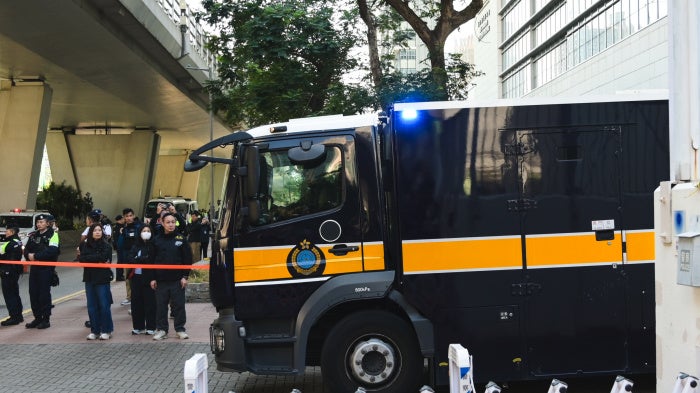
In December, the High Court convicted Jimmy Lai, founder of the now-shuttered Apple Daily newspaper, of “foreign collusion” and “sedition.” Lai faces a sentence of up to life imprisonment; he had been held in prolonged solitary detention, a form of torture, since December 2020.
The Hong Kong government continued to severely suppress peaceful expression. In June, police warned that anyone who downloads or shares the Taiwanese mobile roleplay game “Reversed Front,” in which players seek to “overthrow the communist regime,” may be punished under national security laws. In August, a court sentenced a student to 180 hours of community service for turning his back—thus “insulting” the Chinese national anthem—during a football match.
The government increasingly used administrative measures against those it dislikes. In May, at least eight media outlets and 20 affiliated individuals reported being asked by the government to pay what they say are bogus “back taxes.”
In some cases, the Hong Kong government acted after Beijing state-owned newspapers such as Wen Wei Po ran articles denouncing the targets. In July, an independent bookstore canceled its book fair after Wen Wei Po called the event an act of “soft resistance.” In September, after Wen Wei Po criticized a restaurant known for its pro-democracy stance, various government departments repeatedly inspected the restaurant, leading to fines and an order to remove its signpost.
As of June, the Hong Kong police national security hotline, which authorities encourage people to use to report on each other, had received over 920,000 tips since it was established in 2020. Bookshops, media outlets, and artists faced harassment from anonymous actors who sent false complaints to the government or other institutions.
Censorship is rampant. In June, the government barred at least three publishers from participating in the city’s largest book fair. In October, authorities cancelled the LGBT-themed play “We are gay” two hours before tickets were to go on sale, after Wen Wei Po accused it of “soft resistance” and “defaming Hong Kong.”
Since the government introduced political censorship requirements for film screening in 2021, 50 films had been required to be edited and 13 titles banned on “national security” grounds. In August, the Taiwanese film “Family Matters” was cut from the Hong Kong International Film Festival after it failed to meet the censorship requirements. The film “Deadline” could not screen in Hong Kong after a months-long delay in the approval process.
Academic freedom declined. In October, the Education Bureau reportedly asked university management to ensure that no faculty member would attend a conference on Hong Kong Studies hosted by Taiwan’s Academia Sinica.
The government’s transnational repression continued. In July, Hong Kong police issued baseless arrest warrants and bounties against 19 overseas activists involved in the group “Hong Kong Parliament” for “subversion.” In November, a national security judge sentenced a Hong Kong-based woman to one year’s imprisonment or promoting the group. To date, police have issued arrest warrants against 38 activists based abroad.
In May, Hong Kong authorities pressed national security charges against the father of “wanted” pro-democracy activist Anna Kwok, who grew up in Hong Kong but is living in the US. It was the first time authorities used the national security law to prosecute a Hong Kong-based family member of a critic based abroad.
In September, the Beijing-controlled Legislative Council voted down a bill to establish a legal framework for recognizing same-sex partnerships, despite the Court of Final Appeal’s order that the government do so.
Xinjiang
The Chinese government has since late 2016 committed a range of crimes against humanity in Xinjiang. The authorities conflated everyday behavior of Uyghurs, including Muslim religious practices, with extremism and terrorism, punishing and forcing Uyghurs to assimilate and become loyal subjects of the Chinese Communist Party.
Three years after a landmark UN report on Xinjiang concluded that abuses in the region “may amount to international crimes, in particular, crimes against humanity,” the Chinese government has continued to deny these abuses and harass those who speak out against them, without taking apparent actions to address them. In September, the UN Human Rights Office noted the lack of progress since the publication of their report. Rights groups have continued to appeal to the UN to provide a comprehensive update on the situation.
In October, a group of UN human rights experts “expressed serious concern over the increasing criminalization of Uyghur and other minority cultural expression in China.”
In September, Xi Jinping attended the 70th anniversary celebration of the founding of Xinjiang as an “autonomous region” and became the first-ever general secretary of the Chinese Communist Party to do so.
Since 2022, with the apparent aim of presenting a public image of normalcy in the region, the Chinese government has permitted some Uyghurs in the diaspora to make highly restricted visits to Xinjiang, where they are required to take part in propaganda activities. Authorities have also allowed some Uyghurs to travel abroad under similarly restrictive conditions.
Investigations by foreign-based organizations in 2025 continued to reveal the government’s use of forced labor against Uyghurs, including state-sponsored labor transfer programs, and global supply chains tainted by such abuses in the production of electronics, cars, footwear, sportswear, and critical minerals.