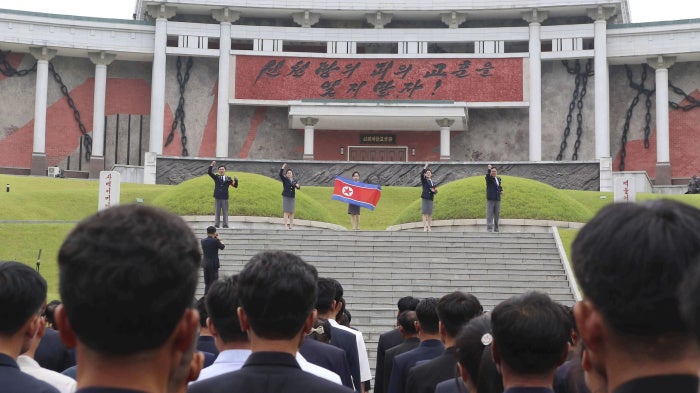
The Democratic People’s Republic of Korea remains one of the most repressive countries globally. In 2025, severe restrictions on rights continued amid economic decline for ordinary people, intensifying hunger and inequality, while the government prioritized weapons development.
A 2025 report from the United Nations Office of the High Commissioner for Human Rights (OHCHR) found the North Korean government increased surveillance, censorship, forced labor, and severe punishments over the past decade, with authorities maintaining “total control” of the population. This corroborated the 2014 UN Commission of Inquiry (COI) report that found systematic abuses constituting crimes against humanity.
Under Kim Jong Un's totalitarian rule, North Korea maintains fearful obedience through torture, executions, arbitrary imprisonment, collective punishment, and forced labor. Freedom of expression, assembly, religion, and information remained severely restricted.
Justice and Accountability
UN bodies and foreign governments continue to spotlight North Korea’s pervasive and severe human rights violations, but with no meaningful response from North Korean authorities or judicial accountability for the abuses. The UN Human Rights Council in April 2025 and the UN General Assembly Third Committee in November 2025 adopted resolutions condemning ongoing and past abuses. A February OHCHR report summarizing two years of accountability efforts noted greater restrictions on freedom of expression and access to information, increased food insecurity, and persistent forced labor. In September, the OHCHR published a 10-year review of human rights during Kim Jong Un’s rule, finding expanded use of the death penalty, increased repression, and deepened isolation since 2020, severely impacting the economy and food access.
Freedom of Expression and Information
The government tightly controls all media. Unsanctioned phones, computers, televisions, and radios are illegal. Distribution of illegal foreign media content is punishable by death.
Authorities regularly target those accessing banned content, particularly media with South Korean influence. In March, authorities reportedly arrested two people in Haeju city, South Hwanghae province, for watching South Korean television shows; they face up to five years of forced labor.
North Korea also jams Chinese mobile phone services at the border. In December 2024, the Ministry of State Security (secret police) reportedly further intensified crackdowns on cross-border communication. In February and June 2025, it increased surveillance inspections to hunt down users of Chinese cell phones.
US government funding cuts to independent broadcasting outlets that sent uncensored information into North Korea and the South Korean government’s reduction of broadcasting programming tailored to North Korean people left North Koreans without vital sources of information.
Freedom of Movement
Travel between provinces or abroad requires prior approval. As of September 2025, border guards along the northern border were still being ordered to “unconditionally shoot” unauthorized border crossers based on a 2020 Covid-19 related decree.
Crackdowns on Chinese mobile phones and border crossings, strengthened laws to increase citizen reporting of criminal or suspicious activities, the shoot-on-sight order, and increased mass surveillance in China have made escaping the country almost impossible. In 2019, over 1,000 North Koreans reached South Korea, but only 96 arrived between January and June 2025, most of them having lived in third countries for several years or more.
In February, North Korea allowed a small group of international tourists into the Rason Special Economic Zone, followed in April by the first Pyongyang marathon in six years. In June, a beach resort opened in Kangwon province, later visited by Russian tourists.
Several countries resumed diplomatic activities, including Nigeria, Brazil, India, Nicaragua, Sweden, and Poland. In June, Germany decided not to reopen its embassy due to concerns over North Korea’s military support for Russia in its war against Ukraine. In January, the UN granted sanctions exemptions to deliver aid to North Korea, but as of October, North Korea had not allowed international UN humanitarian staff to return.
Private, informal trade almost completely ceased. January 2025 trade figures showed official trade with China in 2024 remained below pre-pandemic levels, although exports hit a seven-year high, with significant year-on-year growth between January and July. Trade with Russia expanded, with record shipments of food and fuel in 2024 and continued growth in 2025.
Economic, Social, and Cultural Rights
Reliable data about North Korea is largely unavailable. But in August, South Korea’s central bank estimated that the average yearly per capita income in North Korea in 2024 was KRW 1.72 million (around US$1,246), placing it on the World Bank’s low to lower-middle income classification. The government continued to prioritize public expenditure on weapons development at the expense of economic, social, and cultural rights. Many people have little to no access to health care and face chronic food insecurity.
In March, Human Rights Watch found that Covid-19 related restrictions between 2020 and 2023 undermined income security for many people and reduced access to food and medicine. These policies especially harmed women, often the main household earners, eroding rights to food and health.
At a December 2024 factory opening, Kim Jong Un acknowledged widespread poverty and economic failure, and announced a rural development project.
In February, hunger reportedly intensified across several regions, driven by low incomes, skyrocketing food and foreign currency prices, and increased restrictions on individual market activities. In May, many farmers in Kumya county, South Hamgyong province, reportedly went without food during the spring food shortage. In August, there were reports of malnourished children in Pyongsong city, South Pyongan province, and Wonsan city, Kangwon province.
Forced Labor
The government systematically imposes forced, uncompensated labor on children, adults, state workers, detainees, and prisoners to sustain its economy. Authorities openly characterize the required labor as a demonstration of loyalty to the government and impose severe punishments for non-compliance.
A July report from the Daily NK Archive North Korea Data Center on workers in Chinese seafood plants and construction sites between 2023 and 2025 found that the state confiscated 80 to 90 percent of their wages, leaving them barely enough to live on. Workers also reported confiscated passports, restricted movement, harsh surveillance, and 12- to 14-hour workdays.
North Korea is one of seven UN member states not in the International Labour Organization.
Abusive Classification of People
North Korea uses songbun, a socio-political classification system that ranks people based on perceived loyalty to the Kim family. Those in lower classes face discrimination in employment, housing, health care, and education.
Abuses against Women
The OHCHR September report included allegations of widespread domestic violence that goes uninvestigated, sexual coercion by officials under threat of detention, and gender-based violence in detention, including abusive searches and sexual violence.
Foreign Policy
In January, Ukraine released footage of two captured North Korean soldiers who fought in Russia’s war against Ukraine. Ukrainian special forces and South Korean intelligence reported that injured North Korean soldiers were sometimes executed by their own units, and soldiers have been instructed to commit suicide rather than risk capture. Pyongyang’s state media glorified these suicides as heroic sacrifices, reinforcing the belief that surrender is treason and threatening retaliation against soldiers’ families.
In September, Kim Jong Un visited Beijing for China’s military parade commemorating the 80th anniversary of the Second World War's end. He held bilateral meetings with Chinese President Xi Jinping and Russian President Vladimir Putin.