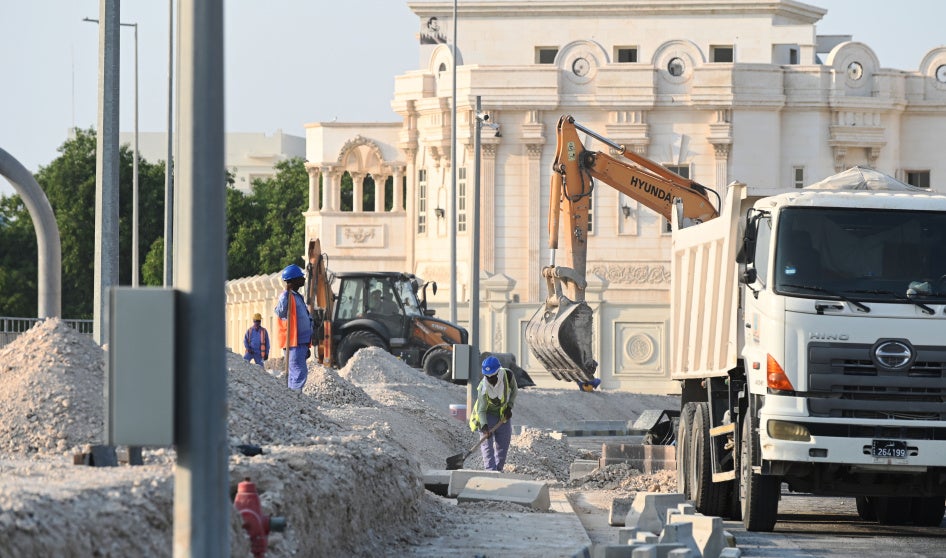
(Beirut) – Qatari government clients and other major businesses are failing to pay contractors on time for projects, leaving migrant workers unpaid, Human Rights Watch said today. Subcontractors and others in the supply chain are also affected and themselves shortchange workers.
“Clients at the top of the Qatari contracting supply chain, including government bodies, often have impunity, leaving subcontracting businesses that employ migrant workers bearing the cost,” said Michael Page, deputy Middle East director at Human Rights Watch. “Influential contractors and employers in Qatar should stop stiffing workers by failing to pay subcontractors what they owe.”
Between February and March 2024 and in September 2025, Human Rights Watch interviewed 16 people who had been employed by Qatar labor supply companies. Human Rights Watch also reviewed contractual agreements and email correspondence from two subcontractors. One employed thousands of migrant workers, including for Qatari government agencies and large-scale construction companies. The other was a labor supply company. Names of those interviewed are withheld because they fear retaliation.
Documents reviewed showed that both subcontractors struggled to pay workers when their clients did not release payments as contractually obligated. Multiple attempts by one to demand payment, including threats of legal action, did not yield payment, causing knock-on effects throughout the subcontracting chain.
When clients do not make timely payments, they may be complicit in contributing to wage theft against migrant workers, as many companies do not have the financial resources to pay workers until they themselves are paid. Human Rights Watch reviewed contracts specifying payment within 45 days of invoice submission, but payments had been delayed by almost a year.
“Non-payment by clients has badly affected our cash flow, as we couldn't pay our suppliers and subcontractors that we have engaged in our project,” a subcontracting company representative said. “We are also facing legal threats from them. The company has not been able to pay its own workers’ salaries either.”
Human Rights Watch reviewed letters supporting this claim, including those sent to clients that laid out the adverse outcomes and requested payment, as well as letters to downstream suppliers attempting to justify the payment delays, requesting payment extensions, and urging them to pause any legal proceedings.
Interviews revealed that when demands for payment via written notices, letters, or client visits don’t work, subcontractors consider legal remedy. Yet these avenues do not always yield positive results, and powerful clients even dismiss warnings from contractors about initiating legal action, Human Rights Watch found.
Human Rights Watch has documented that a “pay when paid” clause included in contracts can contribute to wage theft, and Qatar should instead extend liability for wages beyond the immediate employer in subcontracting chains. In addition to payment delays, interviews revealed that the underutilization of days or personnel compared with what is contractually agreed upon and project extensions or changes to the scope of a project without corresponding increases in budget also harm workers.
Multiple workers employed by at least five labor supply companies said that their management often delayed their wages and told them that they would be paid once the client company pays them. “The [client] company did not care until we stopped showing for work because we went on strike,” a worker said.
In other cases, however, labor supply companies may not pay even when paid by the client company, highlighting the need for strict oversight. One letter reviewed showed that the client company demanded that a subcontractor pay their workers after workers complained to them directly.
Client companies have enormous power over labor supply companies’ business practices that they contract with, enabling abuses when they fail to conduct proper due diligence. Businesses have responsibilities to uphold human rights throughout their operations. Human Rights Watch said.
Labor supply companies are at the bottom of often long and complex subcontracting chains. Human Rights Watch research in Gulf states has found that migrant workers employed by labor supply companies often face more abuses than those directly hired by companies. “Even when we are doing identical work, the company hires were paid almost double our salary,” one worker said. “How can we justify that?”
Labor supply companies sometimes submit low bids and keep overall operating costs low by paying low wages. Clients often do not inquire about wages paid in their subcontracting chains, interviews revealed. “It would have been better if the client company set a minimum salary out of the lump sum amount they pay per worker,” a worker said.
Workers described terrible living and commuting conditions at labor supply companies. “Even though my [work] duty started at 6:00 a.m., I had to wake up at 2:00 a.m., because the company adjusted schedules.” a worker said. “They dropped us at our site 90 minutes early to accommodate for other workers’ schedules.”
Workers said they lived in overcrowded rooms and had inadequate water and electricity access and unhygienic restrooms. One worker lost 55 pounds in his first year working in Qatar due to the physically demanding work and the inedible food. He said, “Nothing was fresh. The chicken had blood in it.”
Another worker said, “From [the client’s] perspective, they have basically bought us… and try to squeeze us to the maximum.” This was reflected in a contract between a contractor and labor supply company reviewed by Human Rights Watch, which reads: “[Labor Supply Company] will supply the required manpower, taking production from the workers and utilizing them to the maximum is the responsibility of [Client Company].”
Neither the bare-bones contract nor the bid specified standards for meals, accommodation, transportation, or any other human rights obligations of either party. The incomplete contracts also explicitly breached the labor law by setting minimum daily hours worked at 10 instead of 8. Even when work is irregular, employers did not allow workers to transfer jobs and instead told them to leave the country and come back on a new visa, workers said.
In migrant communities, “labor supply companies” are viewed as a risky choice. However, aspiring migrant workers are often misled by recruiters to believe that they are direct hires or are unable to distinguish supply companies.
Under the International Labour Organization conventions ratified by Qatar, including the Forced Labor Convention (No. 29), withholding and non-payment of wages is a coercive practice that may amount to forced labor.
Under Qatar’s Civil Code, subcontractors and workers can claim payment directly from the client if the contractor fails to pay.
Qatari authorities should hold major companies responsible for labor abuses committed by subcontractors and labor supply companies. All businesses should uphold worker protections across their operations and supply chains.
“Qatari authorities are failing twice over to protect migrant workers, first as clients themselves fail to pay contractors for work on time and second as ineffective regulators,” Page said. “Highly touted systems like the Wage Protection System and the Wage Support and Insurance Fund are insufficient to prevent and remedy rampant wage theft.”