The Persecution of Environmentalists and Indigenous Leaders in Indonesia
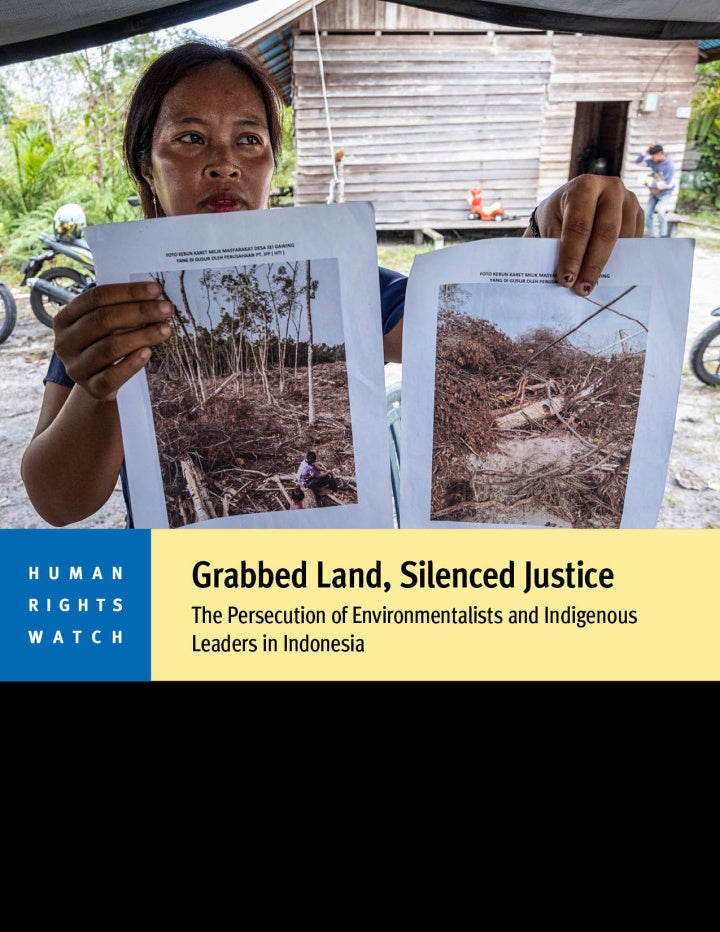
The 70-page report, “Grabbed Land, Silenced Justice: The Persecution of Environmentalists and Indigenous Leaders in Indonesia,” documents how Indonesian police have responded to complaints filed by company officials or politicians by silencing Indigenous villagers who demand their customary land rights and the activists who defend them. The authorities have targeted environmental and Indigenous community defenders using the criminal code and other laws to bring charges ranging from defamation to “spreading communism” to silence protest over environmental harm.
This 50-page report documents violations of human rights and humanitarian law since the Indonesian government imposed martial law in Aceh on May 19 and renewed military operations against the armed, separatist Free Aceh Movement (Gerakan Aceh Merdeka, or GAM).
This 29-page report documents how violence in Nigeria’s southern Delta State this year, especially during the state and federal elections in April and May, resulted in hundreds of deaths, the displacement of thousands of people, and the destruction of hundreds of homes. Among the dead were probably dozens killed by the government security forces.
The Conduct of the War and Civilian Casualties in Iraq
Hundreds of civilian deaths in the U.S.-led invasion of Iraq could have been prevented by abandoning two misguided military tactics. The use of cluster munitions in populated areas caused more civilian casualties than any other factor in the coalition´s conduct of major military operations in March and April. U.S.
Addressing the Plight of Kosovo Roma Refugees in Macedonia
The plight of Kosovo Roma refugees in Macedonia—dramatically demonstrated by their protest occupation of a border area between Greece and Macedonia from May until August this year—highlights the gap between international refugee law on the one hand, and the reality for refugees in Europe today on the other.
On September 20, Algerian President Abdelaziz Bouteflika announced a new body to investigate the thousands of cases of persons who were "disappeared" during the civil strife of the 1990s and who remain unaccounted for.
This 110-page report documents serious violations of workers' human rights and examines the role of the government. It features case studies in the private and public sectors, in manufacturing and service industries, and concludes that workers face an uphill battle to exercise their rights, regardless of the sector.
This 40-page report documents killings, arrest, detention, ill-treatment, torture and other forms of harassment and intimidation of real or perceived critics of the government over the past two years. Most of these abuses have been carried out by the Nigerian police or by members of the intelligence services known as the State Security Service (SSS).
A Call for Action on HIV/AIDS-Related Human Rights Abuses Against Women and Girls in Africa
Violence and discrimination against women and girls is fueling Africa's AIDS crisis. African governments must make gender equality a central part of national AIDS programs if they are to succeed in fighting the epidemic.
The Indonesian government has blocked Indonesian and foreign correspondents from covering the military campaign in Aceh, where gross human rights violations are taking place.
This report investigates the role that oil has played in Sudan's civil war. This 754-page report is the most comprehensive examination yet published of the links between natural-resource exploitation and human rights abuses.
Historically, Iraqi women and girls have enjoyed relatively more rights than many of their counterparts in the Middle East. The Iraqi Provisional Constitution (drafted in 1970) formally guaranteed equal rights to women and other laws specifically ensured their right to vote, attend school, run for political office, and own property.
Human Rights Watch's engagement with IOM arises from our concern that IOM has no formal mandate to monitor human rights abuses or to protect the rights of migrants and other persons, even though literally millions of people worldwide participate in IOM-sponsored programs and projects. We began to monitor and document IOM operations in the field in the early 1990s.
Inadequate Nutrition and Health Care in the Russian Armed Forces
This 40-page report details how conscripts are deprived of adequate food. The diet of conscripts often lacks meat and green vegetables, and falls short of the Russian military’s own nutritional standard for soldiers. The food they do receive is often of poor quality, rotten, or bug-infested.
Egypt should investigate and discipline police and plainclothes security officials who beat demonstrators protesting the Iraq war and tortured some of those detained. In this 40-page report, Human Rights Watch documents excessive use of force by security forces to disperse demonstrators protesting the U.S.-led war against Iraq in March, violating their right to freedom of assembly.
On October 27, 2003, arms researcher Igor Sutiagin faces a troubling anniversary: four years will have passed since security service officers detained him at his home. Ever since, Sutiagin has been waiting in a jail cell for a court to decide his fate.