War Crimes and Crimes Against Humanity in Burkina Faso by All Sides
The 316-page report, “‘None Can Run Away’: War Crimes and Crimes Against Humanity in Burkina Faso by All Sides,” documents the devastating impact on civilians of an armed conflict that has received scant global attention. Researchers documented 57 incidents involving Burkinabè military forces and allied militias known as the Volunteers for the Defense of the Homeland (VDPs), and the Islamist armed group Jama’at Nusrat al‑Islam wa al‑Muslimin (JNIM) since the current military junta seized power in September 2022. Human Rights Watch issued a question and answer document to explain the legal issues involved.
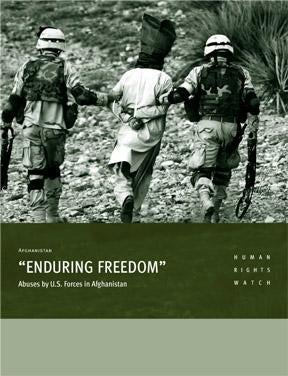
This 59-page report is based on research conducted by Human Rights Watch in Afghanistan and Pakistan in 2003 and early 2004. Human Rights Watch documented cases of U.S. forces using military tactics, including unprovoked deadly force, during operations to apprehend civilians in uncontested residential areas—situations where law enforcement standards and tactics should have been used.
South Africa's Efforts to Prevent HIV in Survivors of Sexual Violence
This 73-page report documents how government inaction and misinformation from high-level officials have undermined the effectiveness of South Africa’s program to provide rape survivors with post-exposure prophylaxis (PEP) — antiretroviral drugs that can reduce the risk of contracting HIV from an HIV-positive attacker.
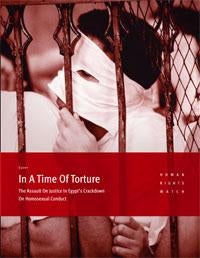
The Assault on Justice in Egypt's Crackdown on Homosexual Conduct
This 144-page report documents the government’s increasing repression of men who have sex with men. The trial of 52 men in 2001 for the “habitual practice of debauchery”—the legal charge used to criminalize homosexual conduct in Egyptian law—was only the most visible point in the ongoing and expanding crackdown.
Rebel forces are advancing on Haiti’s capital Port-au-Prince, sparking fears of widespread bloodshed. Among the leaders of the insurgency are such notorious figures as Louis Jodel Chamblain, a former paramilitary responsible for countless atrocities under the military government that ruled Haiti from 1991 to 1994.
What is new about this policy? The Bush Administration’s policy on landmines, announced February 27, 2004, reverses many of the positive steps the U.S. has made over the past decade to eradicate antipersonnel mines. The use of self-destructing mines is permitted indefinitely without any geographic restrictions.
The concept of smart (i.e., self-destructing) mines certainly has humanitarian allure. In theory, a mine that blows itself up in a relatively short period of time is preferable to a mine that lasts for decades, and should pose less danger to civilians.
Torture in Egypt is a widespread and persistent phenomenon. Security forces and the police routinely torture or ill-treat detainees, particularly during interrogation. In most cases, officials torture detainees to obtain information and coerce confessions, occasionally leading to death in custody. In some cases, officials use torture detainees to punish, intimidate, or humiliate.
A Human Rights Watch Briefing Paper, February 24, 2004
After the November 23, 2003 revolution, leading to the formation of a new government and the election of Mikheil Saakashvili as president, an opportunity has opened to make real progress on human rights in Georgia. The new government must take up this opportunity by making respect for human rights the core of its reform program.
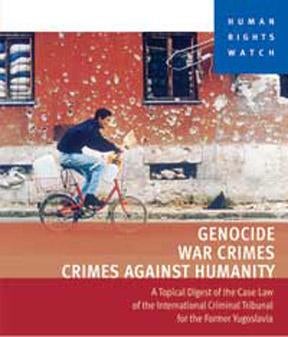
Topical Digests of the Case Law of the ICTR and the ICTY
This 285-page book organizes the tribunals’ decisions by topic, including genocide, crimes against humanity, war crimes, individual criminal responsibility, command responsibility and sentencing.
A Human Rights Watch Briefing Paper , February 2004
The purpose of this briefing paper is to outline Human Rights Watch's main concerns regarding the barrier as the International Court of Justice, at the request of the United Nations General Assembly, considers the barrier's legal consequences.
Background information on the detention and harassment of human rights defenders and organization in Tunisia in anticipation of President Ben Ali's visit to Washington D.C.
Stemming Slovakia's Arms Trade with Human Rights Abusers
The government of Slovakia must do more to bring its arms trade under control. Slovakia adopted some legal reforms in 2001 and 2002, but serious problems remain that allow arms to be exported or illegally trafficked to human rights-abusing countries in Africa and elsewhere. Human Rights Watch says that the country has served as both an exporter and transit hub for arms deals from other countries.
Human Rights Watch has received information about human rights abuses against Dalits in virtually every sphere of life in Nepal, including marriage, religious practice, access to land, and access to education. This submission to the government’s 15th and 16th periodic report to the Committee documents continued conditions of oppression and abuse.
This 108-page report by Human Rights Watch says that the persecution of Tenzin Delek Rinpoche, a highly-respected Tibetan lama facing a death sentence on unproven allegations of involvement in a bombing, highlights the ongoing strictures placed on Tibetans in China. In recent years, the Chinese government has consolidated secular control at the expense of monastic influence.