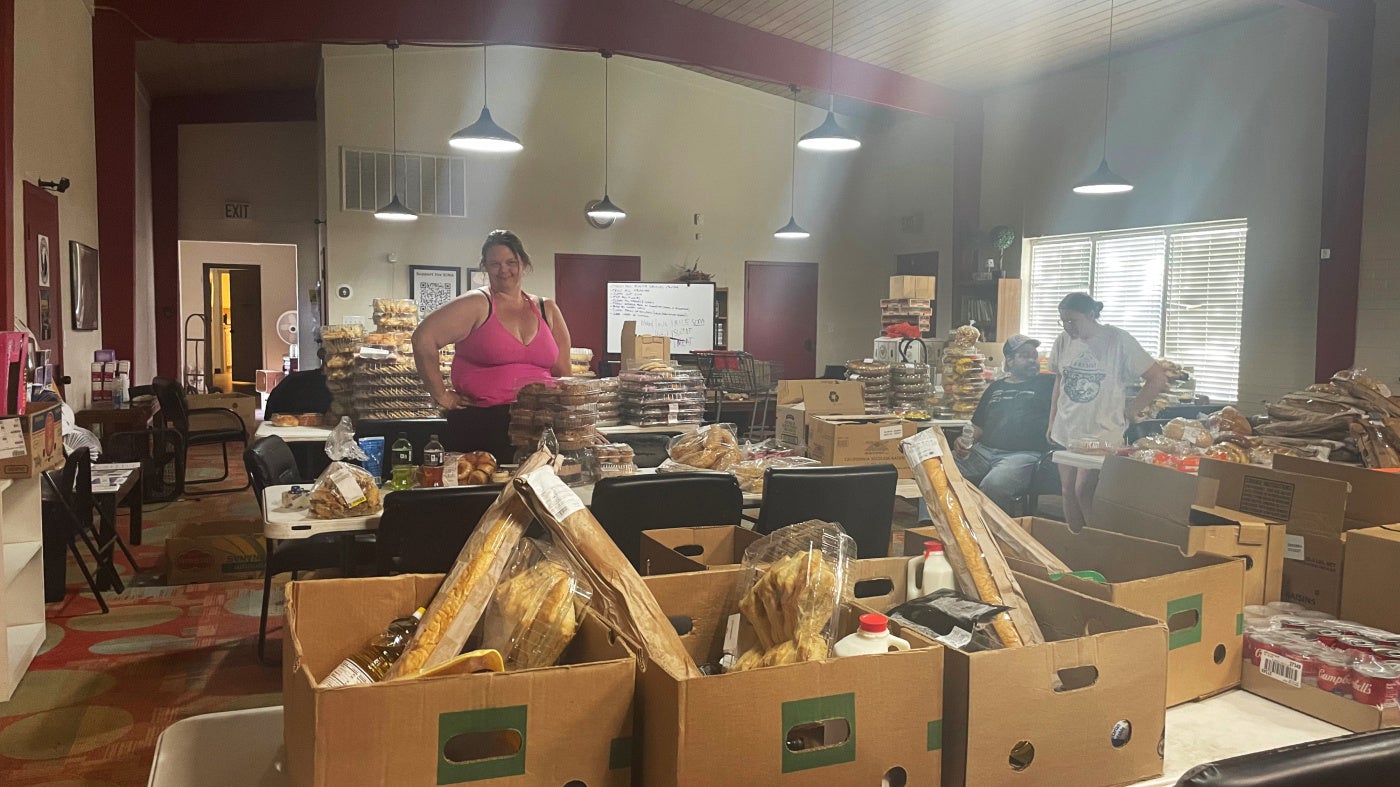
AATAG’s president, Sam Burnett—truck driver by day, organizer by night—moved through the pantry still in his work uniform: a navy-blue button-down with fluorescent yellow stripes, the scent of diesel wafting off him. Around him, volunteers—young and old, cisgender and trans—pack and stack boxes of bread, produce, and ready-to-eat meals.
AATAG said it feeds more than 9,000 people in the larger Amarillo area each month, serving a diverse group of people from different racial, ethnic, and faith backgrounds.
From Support Group to Food Distribution
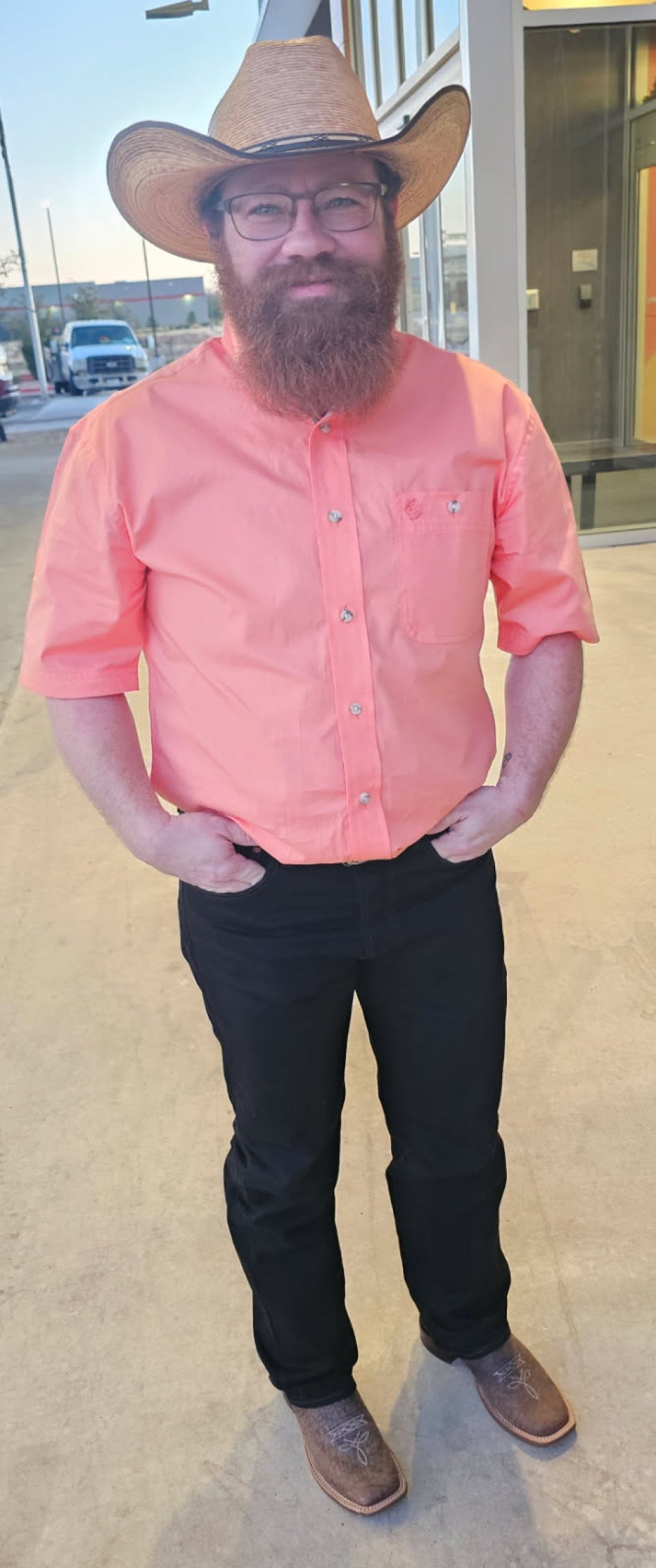
The next day I met Sam and his wife, Teresa, at a coffee shop off Route 66. Sam donned a long orange beard and bulky, neon sunglasses. He’s a father of five and a longtime Amarilloan. Sam has been involved with AATAG since it began in 2019. At the time, the group offered support services, conducted local advocacy, and ran a mental health hotline for transgender people and their families.
“When I started attending, we had 40 people going … it got to a point that we wanted to do more than be just a support group,” he said.
Sam and Teresa wanted AATAG to offer food assistance to the wider community. Eventually, the money to do so came from an unlikely source: a settlement ending a years-long dispute with the neighboring city of Canyon.
A Permit Denied
In 2021, the Canyon Independent School District debated ending LGBT-inclusive suicide prevention programming. AATAG responded the following spring with the Celebration of the Queer Kind, held in a Canyon public park, to uplift LGBT visibility in the wake of the district’s deliberations.
The community enjoyed the event, which included vendors, performers, and a drag show, Sam said. However, a couple of counterprotesters attempted to disrupt the programming; one physically attacked Sam, grabbing him and wrestling him to the ground, leaving him bruised.
Undeterred by the violence, AATAG held the event again the next year, with police present for security.
In 2024, AATAG applied for a permit to hold the event a third time. Teresa filed the paperwork as she had each year, with the same map, location, and program. Days later, Sam received a letter in the mail from the city claiming that the group had broken the penal code. The municipality denied the permit at the City Commission's direction, citing officers’ accounts of lewd behavior in violation of state obscenity laws.
But AATAG received no prior reports from attendees or police that the 2023 performances were lewd, Sam said. “You had two cops there,” he said. “Why did you not arrest anybody if you saw something lewd and inappropriate in front of children?”
Sam said he contacted city officials immediately, believing there had been a mistake. When he asked what AATAG had done wrong so it could correct it, the city manager refused to discuss the matter, told him to call the city’s lawyer, and hung up.
AATAG filed a federal lawsuit arguing that the denial violated its First Amendment rights.
The city’s denial came amid Texas officials’ broader campaign against drag performances. However, a 2023 state law restricting “sexually oriented performances” in the presence of anyone under 18, widely understood to target drag shows, had been blocked by a federal court and remained unenforceable during AATAG’s litigation. So, instead, the City of Canyon relied on the state’s general obscenity provisions.
Depositions did not seem to support the city’s account. One officer, whose report described the performances as crude and sexually offensive, pointed to a performer who had removed a layer of clothing to reveal a bathing suit but did not explain why a bathing suit was lewd. The mayor testified that he had not seen footage of the event before the lawsuit and, once he did, saw nothing lewd.
Messages disclosed in the litigation suggested the mayor objected to drag and pride events themselves. When a resident forwarded him an article about another Texas drag show’s cancellation, writing that it was hopefully “starting to wind down,” he replied, “Hopefully so.” He later wrote, “We can remember back to the good old days … cattle and no gay pride.”
Feeding the Panhandle
After the case settled in 2025, AATAG put the payout toward a need its board had long discussed: a food pantry. Sam said the group placed its first food order the same day the federal government announced it was halting food assistance benefits.

“I said, we throw all of our plans out the window, we pull the trailer in the parking lot, and we start giving people food,” Sam said.
Some community members questioned whether to run the pantry under the AATAG name, fearing a visible link to trans people would draw hostility. Sam refused.
“We want people to know that trans people are serving the community,” he said. “Ever since Trump was re-elected, we get people telling us to kill ourselves. They call us and cuss us out. They tell us they hope we die. When we started the food bank, we had some hateful comments, but within a month I didn’t have to respond because the people that were coming to the food bank were like, ‘Quit attacking the people that are trying to help us.’”
Sam said the pantry has changed how trans people are seen in Amarillo. “We had one guy show up and he's like, ‘Oh, it's a bunch of trannies.’ And Teresa’s like, ‘We don’t use that language here.’ And she stopped and educated him. Come to find out he had never met a transgender person, he’d only heard what was on the news. Now he comes every week and is our fiercest supporter.”
In addition to support from local community members, eight Panhandle churches committed to LGBT inclusion have offered financial support for the pantry.
Staying to Fight
The pantry’s success has not shielded Sam from the anti-trans policies that are escalating at both the state and federal level. In 2024, officials stopped processing gender marker changes on driver’s licenses. Like dozens of other trans Texans Human Rights Watch interviewed, Sam has been unable to update his license since. As a commercial truck driver, he is routinely stopped for inspections where officers check his license. Some have been understanding, he said, but on four occasions officers turned hostile after seeing the “F” marker.
Texas’s 2025 bathroom bill has also cut Sam off from one of his main arenas for advocacy: city council meetings. The law requires people in government buildings to use facilities matching their sex assigned at birth. Sam used to attendthe monthly meetings where he frequently spoke as part of his advocacy. Because he has spoken openly about being trans at those meetings, and with sessions often running for hours, he fears being confronted if he uses the men’s room. Since the ban took effect, he has stopped attending.
Outside the coffee shop, a dry wind barrels down Route 66, the road many Panhandle families once took to escape the Dust Bowl. Nearly a century later, some trans Texans are weighing their own departures from a hostile climate.
Sam is not among them.
He intends to stay and rally, “We're all fighting the exact same fight. But when we're fighting it like all these little groups, we don't look like a lot of people ... [but] when we all group together, there's a lot of [us],” he says exhaling into an inky Amarillo night.