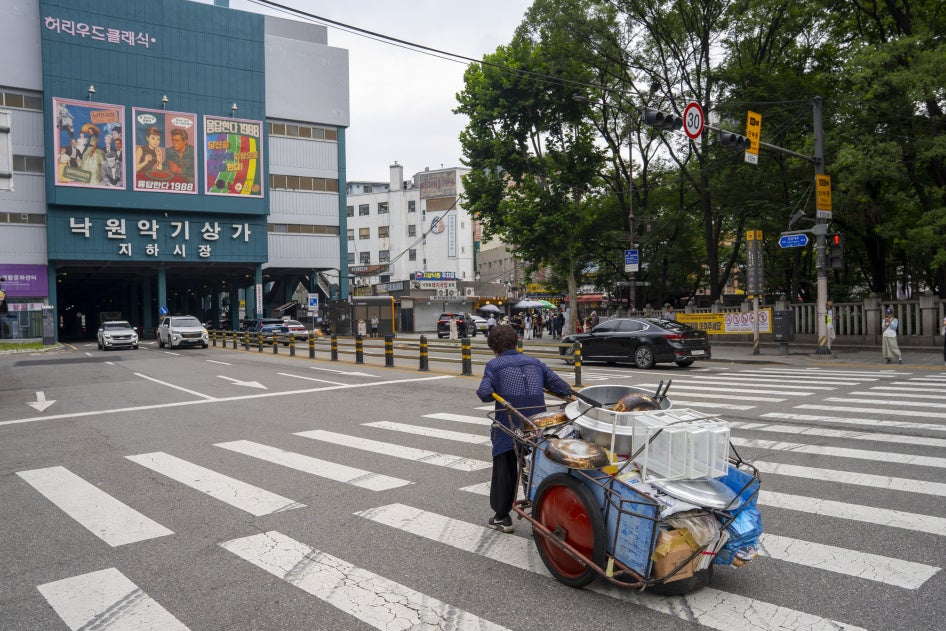
Choi Gap-rae served another customer before telling me how she had left school at 13 in 1972 and gone to work in Seoul to support her parents, two brothers and three sisters. She worked as a nanny, then in a factory, and did piece work at home for a pharmaceutical company. “My family was poor,” Choi said. “I still wanted to learn more.”
But she was never able to return to school. Choi has spent her whole working life in a system stacked against her, first because she is a woman and even more as she became older.
At first, she gave all her wages to her mother to help support her family, as daughters were expected to do at the time. When her brother went to study in Germany, she gave all her pay to him to support his education, as sisters were expected to do.
After getting married at 27, she stayed at home to raise her children until her husband lost his job, and she had to become the main breadwinner. Returning to work at 31, she had a succession of low-paid jobs, including in a supermarket and a restaurant. At 55, after her youngest son began his military service, she started looking for work again but found few jobs available to older women. So, she became a self-employed street vendor.
Choi Gap-rae’s story is common. Between 2024 and 2025, I interviewed 41 women between the ages of 28 and 87 as part of a Human Rights Watch investigation. What they described was deeply disturbing: social attitudes limiting their education, unfair treatment in hiring, disrupted careers due to family responsibilities, limited promotion opportunities, glass ceilings, sexual harassment, and gender pay and pension gaps.
As women got older, they said, their work opportunities narrowed to a handful of low-paid, precarious jobs that often caused them physical and mental harm. Mandatory retirement as young as age 60 and reduction of their wages through a “peak wage” system compounded this.
Few women I interviewed described their experience as systemic gender and age discrimination. Yet that’s what it is.
By their late 50s, women are earning, on average, 50 percent less than men their age. This is not based on individual women’s choices or skills, but on entrenched social attitudes toward gender and age, combined with employment policies and practices that disadvantage and segregate them into particular occupations.
Jobs the employment and labor ministry promotes for women in their 30s to 50s on Work24, its employment website, revolve predominantly around beauty, care work, education, and relationship support. Those they promote for people age 50 or older funnel women into low-paid care, cleaning, kitchen, and social service work.
As the type of work narrows, working conditions deteriorate and become increasingly precarious, with short-term contracts, little union representation, low hourly pay, and limited or no social security.
The pension system is also stacked against women.
Choi was 66 when I spoke to her. She told me her Basic Pension, a non-contributory pension that provides financial support for people 65 and older on low incomes, was KRW340,000 (US$240) per month, just 16 percent of the national minimum wage and 72 percent below the poverty line in 2025 of KRW1,196,007 ($800).
Even if Choi had been in a position to pay into the National Pension Program, she would still have faced a significant gender pension gap. Self-employed people, like Choi, can join the program but have no employer to share the cost of contributions with and may not be able to afford the full amount themselves. In 2025, women received on average just 53 percent of the monthly National Old Age Pension that men did.
Other regulations governing the National Old Age Pension also contribute to women’s low pensions. Women are more likely than men to get a reduced pension because they have not contributed for the 20 or more years necessary to qualify for a full one. When they return to work in their 40s and 50s, the contribution age cap of 59 means they only have a few years left to contribute.
The design of the “childbirth credit” also disadvantages women. Because the benefit is paid at pension eligibility age and generally allocated to the family’s higher earner, only 3 percent of childbirth credit recipients in 2025 were women, even though they are the primary caregivers.
South Korea has failed to live up to its domestic and international legal obligations to protect women from systemic gender and age discrimination. It should promptly take steps to ensure their equality at work, improve their access to decent work as they age, and provide equal access to adequate pensions.
Choi Gap-rae told me she planned to work until she was 80. “If my body can endure it,” she said.