August 25, 2026, marks nine years since the Myanmar military and authorities launched a widespread campaign of atrocity crimes against the Rohingya population in Myanmar’s Rakhine State.
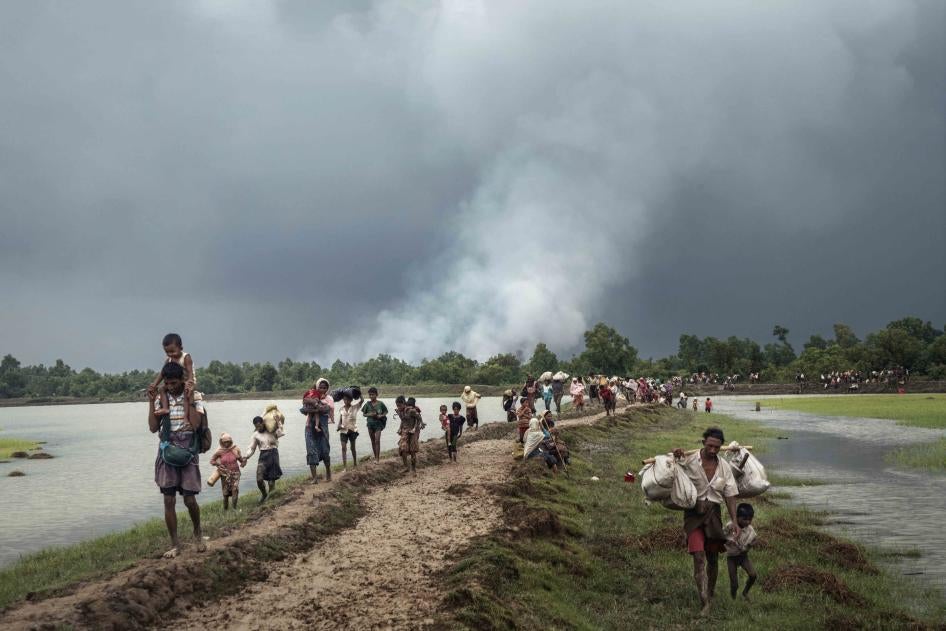
Starting in August 2017, Myanmar security forces killed thousands of Rohingya women, men, and children and razed several hundred Rohingya villages throughout northern Rakhine State, forcing at least 700,000 to flee to Bangladesh. The United Nations Independent International Fact-Finding Mission on Myanmar concluded that “named senior generals of the Myanmar military should be investigated and prosecuted in an international criminal tribunal for genocide, crimes against humanity and war crimes.”
As then commander-in-chief of Myanmar’s Armed Forces, Min Aung Hlaing oversaw security forces responsible for these atrocities against the Rohingya. In February 2021, he led a military coup against the elected, civilian-led government and later was picked by a military controlled Parliament as the “president” following what observers saw as sham elections in December 2025 and January 2026. A number of countries, including members of the Association of Southeast Asian Nations (ASEAN), the European Union, the United Kingdom, Canada, Australia, and Japan, have not recognized the election results.
Since the 2017 atrocities, no one has been held accountable, although there has been some progress in international justice efforts. A universal jurisdiction case brought in Argentina by a Rohingya-led organization resulted in arrest warrants for Myanmar military officials, including Commander-in-Chief Min Aung Hlaing.
In November 2024, the prosecutor of the International Criminal Court (ICC) requested an arrest warrant against Min Aung Hlaing for the alleged crimes against humanity of deportation and persecution of the Rohingya. There is no publicly available information as to whether the judges have ruled on the request.
In January 2026, the International Court of Justice (ICJ) held hearings on the merits of The Gambia’s genocide case against Myanmar, marking a significant step towards justice for the Rohingya. The case, filed in 2019, alleges that Myanmar’s atrocities against the Rohingya in 2016 and 2017 violate the Genocide Convention of 1948. The court’s judgment is pending.
As part of the case brought by The Gambia, ICJ judges issued legally binding provisional measures requiring Myanmar to prevent all genocidal acts against the Rohingya, to ensure that security forces do not commit acts of genocide, and to take steps to preserve evidence related to the case. However, our organizations have documented ongoing grave abuses and persecution targeting Rohingya remaining in Myanmar, including the crime against humanity of apartheid and war crimes, contravening the court-ordered provisional measures.
The Myanmar military junta has carried out airstrikes on populated Rohingya homes and villages and continues to impose severe restrictions on freedom of movement, humanitarian aid and access to health care in Rakhine State. The Arakan Army has also gravely violated the rights of the Rohingya since gaining control of most townships in Rakhine State, following resumed fighting with the Myanmar military in late 2023. Rohingya have been subjected by the Arakan Army to arbitrary detention, forced labor, torture, extrajudicial killings, and restrictions on movements. The group has also committed mass killings of Rohingya that amount to war crimes, and large-scale arson of Rohingya homes in Buthidaung and Maungdaw townships in 2024.
The Myanmar junta and Rohingya armed groups have unlawfully recruited Rohingya in Bangladesh and Myanmar to fight against the Arakan Army, which also uses forced recruitment.
An estimated 150,000 Rohingya have fled to Bangladesh since mid-2024, bringing the total population to over 1.2 million refugees. Rohingya refugees are facing increasingly dire conditions in the Cox’s Bazar camps, including abductions, forced recruitment, death threats, sexual violence, and the impact of aid cuts on health care, education, and food.
Persecution of Rohingya by the Arakan Army and deteriorating conditions in Bangladesh’s refugee camps, exacerbated by cuts in international aid, have led to a sharp increase in desperate and perilous boat journeys by Rohingya in search of safety and a future, particularly in Malaysia. In just the first few months of 2026, more than 820 Rohingya are believed to have lost their lives attempting these dangerous sea crossings. They have become increasingly vulnerable to large and well-organized human trafficking and smuggling and other forms of exploitation.
The roots of the Rohingya crisis and the atrocities since the 2021 coup—which include war crimes and crimes against humanity—can be found in decades-long impunity in Myanmar. Upholding the human rights of the Rohingya as well as the entire population of Myanmar depends on achieving justice for these grave abuses. All parties to the armed conflict in Myanmar should cooperate with international accountability mechanisms to ensure justice for the victims and adhere to international humanitarian law.
The United Nations Security Council should intensify efforts to secure accountability for past and ongoing crimes committed against all communities by referring the situation in Myanmar to the ICC, imposing targeted financial sanctions, and establishing a global arms embargo on the Myanmar junta.
Concerned governments, including ASEAN member states, should press Min Aung Hlaing and the Myanmar military to end unlawful attacks on civilians and civilian infrastructure and release thousands of political leaders and activists being detained in inhumane conditions in violation of their human rights.
In close collaboration with the government of Bangladesh, the international community should urgently seek to increase funding to meet the needs of Rohingya refugees until conditions exist for voluntary, safe, dignified, and sustainable return to their homeland in Myanmar, with full citizenship and socio-economic rights.
All countries hosting Rohingya refugees should protect their rights, including by implementing effective protection mechanisms to safeguard them from hate, hostility, forced returns, abduction, kidnapping, trafficking, forced recruitment, and other forms of targeted violence and ensuring their access to education and livelihoods.
The Rohingya have waited far too long for justice, recognition, and a safe return, and urgent steps need to be taken so that they are not made to suffer any longer.
Signed:
- All Victims and Veterans Network – Bangladesh
- Amnesty International
- Anti-Death Penalty Asia Network
- Arakan Rohingya National Union
- Asia Justice and Rights
- Asian NGO Network on National Human Rights Institutions
- Association of Rohingya in Thailand
- Asylum Access Global
- Asylum Access Malaysia
- Asylum Access Mexico
- Asylum Access Thailand
- British Rohingya Community
- Burma Campaign UK
- Burma Concern
- Burma Human Rights Network
- Burmese Rohingya Organization UK
- Capital Punishment Justice Project
- CIVICUS: World Alliance for Citizen Participation
- Coalition for the Rights of Refugees and Stateless Persons
- Education and Wisdom Development for Rohingya Women
- Education Garden for Rohingya
- Exile Hub
- EarthRights International
- FE5 Tanintharyi
- Fortify Rights
- FORUM-ASIA
- Free Rohingya Coalition
- Frontline Ethics
- Human Integration for Change
- Human Rights Foundation of Monland
- Human Rights Watch
- Info Birmanie
- Kachin Gender Star Group
- Kachin Human Rights Watch
- Kaladan Press Network
- Karen Human Rights Group
- Karenni Human Rights Group
- Mayu Region Human Rights Documentation Center
- Minority Affairs Institute
- Myanmar Defense & Security Institute
- Myanmar Ethnic Rohingya Human Rights Organization Malaysia
- NOVI
- Political Repository
- Politics for Women Myanmar
- Progressive Voice Myanmar
- Refugees International
- Robert & Ethel Kennedy Human Rights Center
- Rohingya Advancement Committee
- Rohingya Cooperation Network
- Rohingya Education Development Plan
- Rohingya Gen Z Movement
- Rohingya Human Rights Initiative
- Rohingya Human Rights Network
- Rohingya Peace Network of Thailand
- Rohingya Refugee Youth Committee
- Rohingya Rights Response
- Rohingya Solidarity Network
- Rohingya Student Union
- Rohingya Women Association for Education and Development
- Rohingya Youth Empowerment Initiative
- Rohingya Youth Empowerment Network
- Rohingya Youth for Legal Action
- Spirit in Education Movement
- Stop Online Harm
- Tavoyan Women’s Union
- Thailand Migration Reform
- The International Bar Association’s Human Rights Institute
- Voice of Rohingya Women and Students
- Women’s Peace Network
- Yangon People’s Strike
- Youth Congress Rohingya