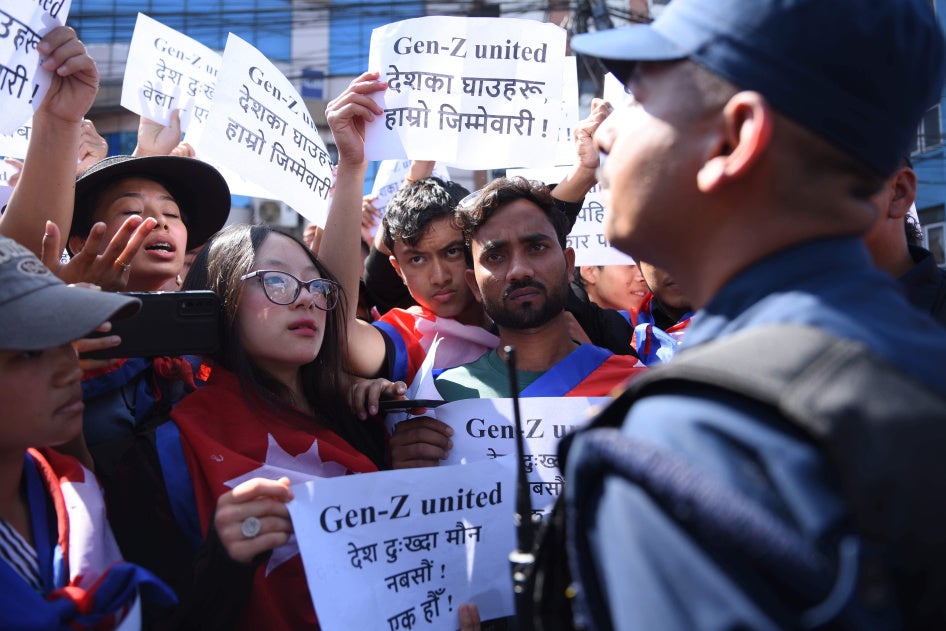
(Bangkok) – Nepal was rocked by disorder and arson after police killed 19 protesters during the September demonstrations that toppled the government, Human Rights Watch said today in its World Report 2026. An interim government mandated to conduct fresh elections in March was sworn in under the leadership of former chief justice Sushila Karki, who has pledged action on corruption and a judicial inquiry into the violence.
“The failure of successive governments to hold people accountable for human rights abuses and widespread corruption have undermined the rights of all Nepalis and led to repeated abuses,” said Meenakshi Ganguly, deputy Asia director at Human Rights Watch. “Nepali authorities should take immediate steps to uphold the rule of law, whether crimes are committed by members of security forces, violent mobs, or by corrupt politicians.”
In the 529-page World Report 2026, its 36th edition, Human Rights Watch reviews human rights practices in more than 100 countries. In his introductory essay, Executive Director Philippe Bolopion writes that breaking the authoritarian wave sweeping the world is the challenge of a generation. With the human rights system under unprecedented threat from the Trump administration and other global powers, Bolopion calls on rights-respecting democracies and civil society to build a strategic alliance to defend fundamental freedoms.
- Forty percent of Nepal’s population is aged under 18, yet economic opportunities are few, forcing many to migrate abroad in search of work. Successive governments have failed to expand Nepal’s Child Grant, a social security program that currently benefits less than 10 percent of children.
- Progress on justice for human rights violations committed during the 1996-2006 conflict stalled after victims’ groups rejected the commissioners appointed to the transitional justice bodies, saying they were unqualified and lacked political independence.
- Nepal’s citizenship laws continued to discriminate against children of Nepali mothers by limiting their ability to obtain citizenship. Millions of Nepalis are estimated to lack citizenship documents because they cannot prove that their father is Nepali.
- Nepali migrant workers often take out informal loans at exorbitant interest rates to pay recruitment fees; once abroad, they face abuses by foreign employers and domestic recruitment agents, including wage theft, contract violations, sexual violence, and death and chronic illness linked to unsafe working conditions.
- Dalits and other marginalized communities continued to face discrimination.
The interim government should fulfill its mandate by ensuring that the September violence, and also recent allegations of corruption, are thoroughly investigated, the findings made public, and perpetrators appropriately prosecuted, while preparing to conduct fair and peaceful elections. Nepal’s next government should address victims’ concerns about the transitional justice process, to ensure it meets Nepal’s obligation to provide accountability and reparation. The new government should also expand the Child Grant, so that all Nepali Children enjoy the right to social security.