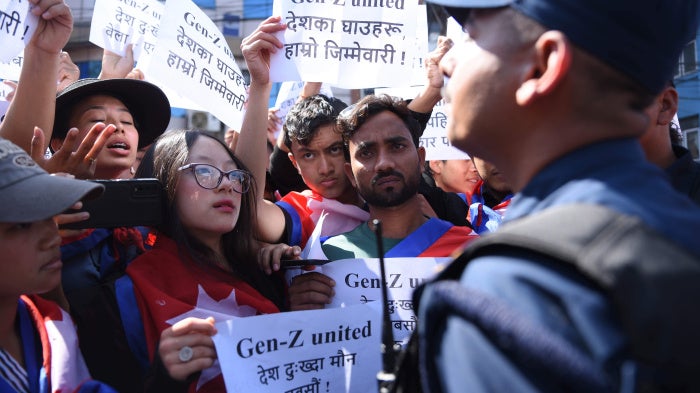
In September, Nepal was rocked by violence after police shot and killed 19 protesters, precipitating a day of disorder and arson that toppled the government of Prime Minister K.P. Oli. The protesters, mostly young people rallying in the name of “Gen Z,” had marched towards parliament demanding an end to corruption and the lifting of a sweeping social media ban. Within days, an interim government mandated to conduct fresh elections was sworn in under the leadership of former Chief Justice Sushila Karki.
Progress on justice for human rights violations committed during the 1996-2006 conflict stalled after victim groups rejected commissioners appointed to the transitional justice bodies, saying they were unqualified and lacked political independence. Lack of accountability and security sector reform led to continuing abuses, including custodial torture.
The government failed to expand Nepal’s Child Grant, a proven social security program that currently benefits less than 10 percent of children.
Dalits and other marginalized communities continued to face discrimination.
Deadly Protests
On September 8, police used excessive and lethal force to suppress youth protests against political corruption and a government ban on 26 social media sites. Seventeen people were shot dead outside the parliament in Kathmandu, and two others were killed in police action in Itahari, Koshi Province. Hundreds were injured.
The following day, crowds of people outraged by the shootings took to the streets of Kathmandu and towns across the country. Prime Minister K.P. Oli resigned. On September 9, arson attacks across the country targeted politicians’ homes, police stations, businesses, schools, media organizations, jails, and government buildings including parliament, the supreme court, and several ministries. At least 76 people were killed in two days of violence.
On September 12, after several days of uncertainty, including over the political role of the army, Sushila Karki was sworn in by the president as interim prime minister, and parliament was dissolved. Her government appointed a judicial commission to investigate the violence and also publicly committed to investigate corruption allegations. New elections were scheduled for March 2026.
Child Rights
Child marriage remains a serious problem, with 33 percent of girls and 9 percent of boys married before age 18.
Only around 4 percent of the government’s social security budget is allocated to children. The Child Grant, also known as the child nutrition grant, provides monthly payments to families with children under the age of five. At time of writing, grants were available in 25 out of Nepal’s 77 districts, and for all Dalit children under five nationwide, but covered only about 9.5 percent of Nepali children. Eligible families received a monthly payment of NPR 532 (US$3.85) each for up to two children. Studies show that the Child Grant has improved the rights and well-being of children, and enhanced public perceptions of the government among recipients. Around 40 percent of Nepal’s population is under 18.
The Child Grant has been endorsed by numerous Nepali civil society organizations and international policy experts. However, successive governments have not kept commitments to make it universally available.
Accountability and Justice
Progress on accountability and reparations for human rights violations and abuses committed during the 1996-2006 conflict between Maoist insurgents and security forces was undermined by controversial appointments to Nepal’s two transitional justice commissions.
Impunity prevails for numerous well-documented, grave violations and abuses because successive governments have sought to shield perpetrators. In 2024, parliament adopted a law that victims’ groups broadly accepted as a viable basis to restart the long delayed transitional justice process. However, in May 2025 the appointment of new commissioners to the Truth and Reconciliation Commission and Commission of Investigation on Enforced Disappeared Persons was widely opposed by victims who said that the commissioners lacked credentials or political independence.
Freedom of Expression
Proposed legislation and government actions under existing laws threatened Nepal’s relatively free and open public discourse.
In September, the K.P. Oli government briefly banned 26 social media sites that had failed to register with the government, contributing to deadly protests that toppled his government the following week. The Electronic Transactions Act, a law purportedly to prevent online fraud, continued to be used to arrest and prosecute journalists and members of the public for legitimate online expression.
Women’s and Girls’ Rights
Nepal’s citizenship laws continue to discriminate against women by limiting their ability to pass citizenship to their children. Millions of Nepalis are estimated to lack citizenship documents because they cannot prove that their father is Nepali.
Survivors of rape in Nepal have only two to three years to report the crime. UN women’s rights experts have urged Nepal to enact comprehensive laws against all gender-based violence and to repeal this short statute of limitations.
Migrant Workers
Remittances from Nepalis working in other countries are a mainstay of the Nepali economy. Migrant workers often take out informal loans at exorbitant interest rates to pay recruitment fees and face abuses by foreign employers and domestic recruitment agents including wage theft, contract violations, and sexual violence, with continuing reports of death and chronic illness linked to unsafe working conditions.
Nepal continues to limit issuance of permits for domestic work by Nepalis abroad, which disproportionately affects women. Although the rules are intended to protect Nepali women, economic pressures drive many to use irregular channels to obtain such work, increasing their vulnerability to trafficking, exploitation, and abuse.
Sexual Orientation and Gender Identity
Nepal has a record of relatively progressive legal protections for lesbian, gay, bisexual, and transgender (LGBT) people, including landmark Supreme Court rulings recognizing same-sex marriages on an interim basis. However, these rulings are not consistently implemented by officials. For example, in 2025 a lesbian couple attempted to register their marriage but faced harassment, delays, rejection, and were forcibly separated, with police complicity and family hostility exacerbating their ordeal.