
British Prime Minister Keir Starmer plans to visit China in late January, the first China trip by a British prime minister since 2018.
The timing is troubling: In December, a Hong Kong court convicted media tycoon Jimmy Lai, a British citizen, on bogus “national security” charges. He now faces up to life imprisonment for exercising rights guaranteed under Hong Kong Basic Law and the 1984 Sino-British Joint Declaration.
Another challenge stems from the UK government’s decision to allow a controversial new Chinese embassy at the Old Royal Mint site—a decision that put Starmer in conflict with a direct request from Chinese President Xi Jinping to approve the embassy project and concerns from members of parliament that the new embassy could open the door to espionage and foreign interference. The issue raises disturbing questions about the UK’s willingness to let Beijing dictate its domestic policies and, if indeed, Starmer’s upcoming visit to China hinged on a greenlight for the new Chinese embassy.
The trip also raises concerns as to whether the UK’s increasingly tenuous relations with Donald Trump’s America may push Starmer to pursue economic opportunities in his meeting with Xi Jinping at the expense of human rights.
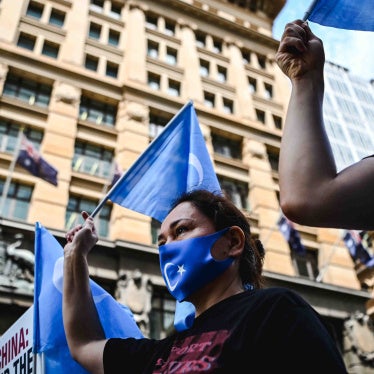
But Starmer should recognize that Xi Jinping’s China is not a credible alternative: Under Xi, repression has sharply intensified. Beijing has dismantled Hong Kong’s long-cherished freedoms. Chinese authorities are committing crimes against humanity against Uyghurs in Xinjiang, including arbitrary detention, mass surveillance, cultural and religious persecution, and separation of families. Because the UK lacks robust regulations like those in the US and European Union, it risks becoming a dumping ground for Chinese products tainted by state-imposed forced labor, in high-risk sectors such as cotton, automotive, solar, and critical minerals.
China’s abuses do not stop at its borders. Beijing has escalated cross-border targeting of its critics, known as transnational repression, in the UK. Hong Kong pro-democracy activist and UK resident Carmen Lau has faced repeated harassment, including through sexually explicit deepfakes. Sheffield Hallam University terminated Professor Laura Murphy’s project on forced labor in China after intimidation from Beijing and legal threats from a Chinese company.
Prioritizing economic engagement over human rights concerns leaves the UK vulnerable to pressure that, ultimately, undermines its own interests; Starmer should reject this failed paradigm. Human rights are also critical to a healthy long-term Sino-British relationship.
While in Beijing, Starmer’s delegation should engage with China within the guardrails of British interests and values, of which human rights are central.
This means that when discussing bilateral trade, Starmer should also discuss China’s state-imposed forced labor and broader labor violations – such as the prohibition of independent labor unions – that undercut rights at the expense of trade with the UK and globally. He should press for an end to Beijing’s crimes against humanity in Xinjiang and its national security regime in Hong Kong. He should press for Jimmy Lai’s release, and freedom for other political prisoners.
And he should not neglect in talks on security to take issue with Beijing’s transnational repression on British soil.
The disregard for human rights shown by the world’s superpowers puts countries like the UK in a difficult position. But the UK is not powerless: it has significant economic and diplomatic leverage and has historically been one of the more vocal global advocates for human rights in Hong Kong, Xinjiang, Tibet, and elsewhere in China.
Starmer should continue that legacy and use his China visit to center human rights for the sake of people in China and the UK, as well. To defend its values and interests, the UK needs a plan, and it needs to act now by banding together with partners to uphold rights and resist pressure to disregard them, whether that pressure comes from Washington or Beijing.