(London, December 17, 2025) – Authorities in Kazakhstan have targeted independent journalists and media outlets in recent weeks, a coalition of nine human rights groups said today. The authorities have searched the newsroom of an independent news agency, detained media workers, and pressured journalists over their reporting.
The coalition includes Amnesty International, Civil Rights Defenders, Crude Accountability, Freedom for Eurasia, Kazakhstan International Bureau for Human Rights and Rule of Law, Helsinki Foundation for Human Rights, Human Rights Watch, International Partnership for Human Rights, and the Norwegian Helsinki Committee.
“Astana should end the crackdown on free expression and independent journalism, which are essential to protecting human rights and civil liberties,” said Maisy Weicherding, Central Asia researcher at Amnesty International. “Kazakhstan should respect and uphold the right to media freedom and access to information.”
On December 1, 2025, police searched the independent Orda.kz media agency’s newsroom and detained media workers, at least one of whom is facing criminal charges. Other independent journalists have been under pressure from government officials and their social media accounts have been taken down. On December 2, the website of an independent media outlet experienced a distributed denial of service attack, to make a website unavailable by overwhelming it with traffic from multiple sources.
The Kazakhstan government has repeatedly pledged to uphold the right to freedom of expression, consistent with its Constitution and international obligations, including in January at its fourth Universal Periodic Review at the UN.
On December 1, police in Almaty detained Gulnara Bazhkenova, editor-in-chief of the independent news outlet Orda.kz, as a person of interest in several criminal cases, including for allegedly spreading “repeated and deliberate” false information. On the same day, a court ordered her held for two months of house arrest, her lawyer said.
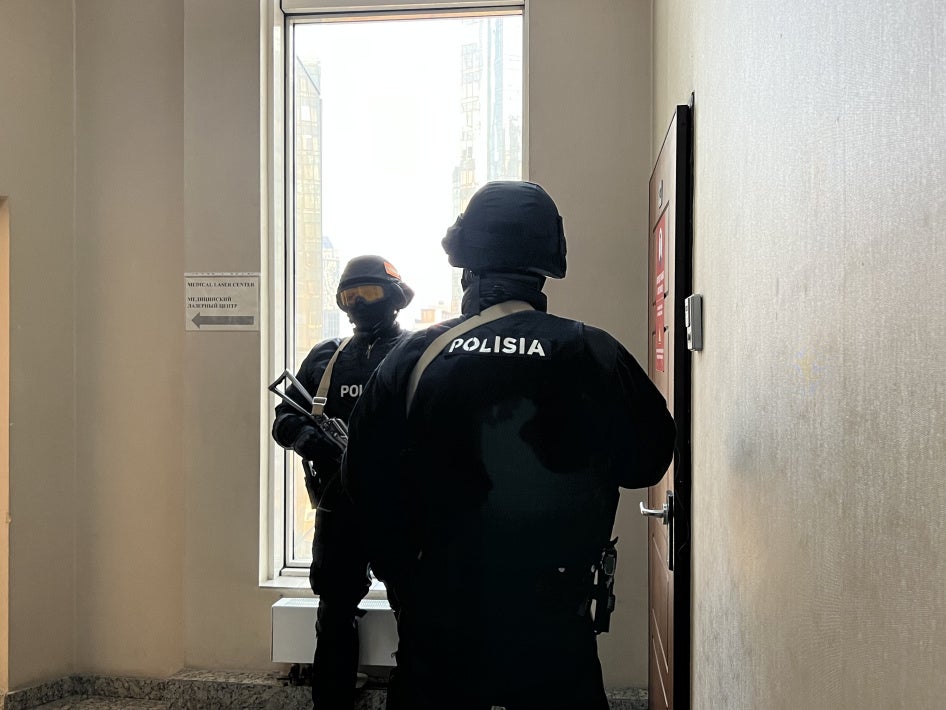
Bazhkenova was arrested following a police search of the Almaty newsroom of Orda.kz and Bazhkenova’s home. The outlet’s legal representatives and staff said that investigative teams seized documents, equipment, and money for staff salaries. They forced open a safe. Officials physically searched Bazhkenova and an accountant. The authorities at the office denied Orda.kz’s lawyers permission to enter even though the lawyers had proper authorization, and barred them from reviewing the search warrant, both criminal procedural code violations.
On the same day in Astana, police questioned Dmitry Kim, head of Orda.kz’s capital bureau, for several hours at the outlet’s office and later took him to a police station. He was released the same day.
On November 28, independent journalists Lukpan Akhmedyarov and Raul Uporov published a documentary film, “The Duty of the Motherland,” on their YouTube channel “Prosto Journalistika” (JustJournalism_kz), highlighting the deaths of 270 Kazakhstani soldiers over the past three years. Most were conscripts who apparently died following illnesses, weapons-related incidents, or suicides.
The film followed a protest on November 10 in Astana, where mothers of deceased and injured soldiers gathered outside the House of Ministries demanding accountability and justice for soldiers’ deaths and injuries.
Akhmedyarov told the rights groups and reported in the media that several days before the film’s release, he received a phone call from a contact in the Defense Ministry relaying a request from “a high-ranking official” to avoid “stirring up the issue with the army.” After Akhmedyarov published a Facebook post about the threat, his Facebook account became inaccessible for three days.
A separate Instagram account he ran for his “Just Journalism” project was temporarily removed in July. He said it was a targeted attack.
The Facebook incident appears to be the latest of a recent string of interference in online expression in Kazakhstan. In late November, the Instagram accounts of three other independent voices in Kazakhstan became inaccessible or were temporarily removed.
Vadim Boreyko, an independent journalist based in Almaty, reported on November 22 that he found his Instagram account emptied of content. He described the incident as the latest in multiple instances of harassment that includes repeated removals of older posts on Instagram and Facebook for vague “violations.” Since then, the content on his account appears to have been restored.
An Almaty-based activist, Askhat Niyazov, received notification on his Instagram that his account had been removed for “community guidelines violations.” On November 28, another Almaty-based activist, Sanjar Bokayev, received notification on Instagram that his account had been removed for “community guidelines violations.” Their accounts have since been restored. On November 30, Bokayev’s account on Facebook was blocked “for security reasons.” It too has been restored.
On December 12, Human Rights Watch sent a letter to Meta, the parent company of Instagram and Facebook, asking about the temporary blocking and removal of accounts and if these actions had been taken in response to Kazakhstan government requests. Meta responded saying that they “strive to notify users and share information externally” about taking action on content that violates local law, but were unable to respond substantively to the specific questions posed by the time of publication.
The editorial team of the independent outlet Vlast.kz reported on December 2 that its website had experienced intensive DDoS attacks over several days, especially on December 2. They said the attacks caused significant interruptions to the website’s operations.
Kazakhstan’s parliament has also advanced legislation severely restricting the rights and visibility of LGBTI individuals, including broad and vaguely defined prohibitions on public expression relating to sexual orientation and gender identity. These provisions pose a direct threat not only to people identifying as LGBTI (lesbian, gay, bisexual, transgender and intersex), but also to journalists, academics, artists, human rights defenders, and civil society actors who risk administrative sanctions for reporting on or advocating for the rights of these groups, or for expressing positive views of LGBTI rights publicly or online.
Such measures constitute discrimination and violate Kazakhstan’s Constitution, including guarantees of equality before the law and freedom of expression, as well as the country’s binding obligations under the International Covenant on Civil and Political Rights.
They also contradict Kazakhstan’s commitments within the Organization for Security and Cooperation in Europe framework to uphold pluralism, tolerance, and non-discrimination, as well as international standards articulated by UN experts. The experts have repeatedly emphasized that states may not restrict expression relating to sexual orientation and gender identity to suppress public debate or silence marginalized groups.
“The advancement of so-called propaganda legislation is not only blatantly homophobic and discriminatory, but it also marks a dangerous expansion of state control over public discourse and further erodes the already shrinking civic space in the country,” said Leila Seiitbek, director of Freedom for Eurasia. “On December 18, when the bill goes to a vote in Kazakhstan’s Senate, lawmakers should decisively vote against this harmful piece of legislation.”
The Kazakhstan government, in particular the Ministry of Internal Affairs and the Prosecutor General’s Office, should cease harassment, intimidation, and pressure against journalists and media outlets, the groups said. It should protect the public’s right to access to information, and cease spurious criminal investigations into independent journalists, including against Bazhkenova.
The authorities should also withdraw the discriminatory “propaganda” bill. Kazakhstan should guarantee the right to freedom of expression for all and ensure that government policies promote tolerance and nondiscrimination.
Social media platforms should respect the human rights of users in Kazakhstan and resist any content or account takedown requests that unlawfully restrict expression protected under international human rights law, the groups also said.
“Unfounded restrictions on journalists and freedom of expression are long-standing rights issues in Kazakhstan,” said Mihra Rittmann, Central Asia adviser at Human Rights Watch. “The government needs to stop all attacks on independent journalists and media outlets and create an enabling environment for freedom of expression.”