
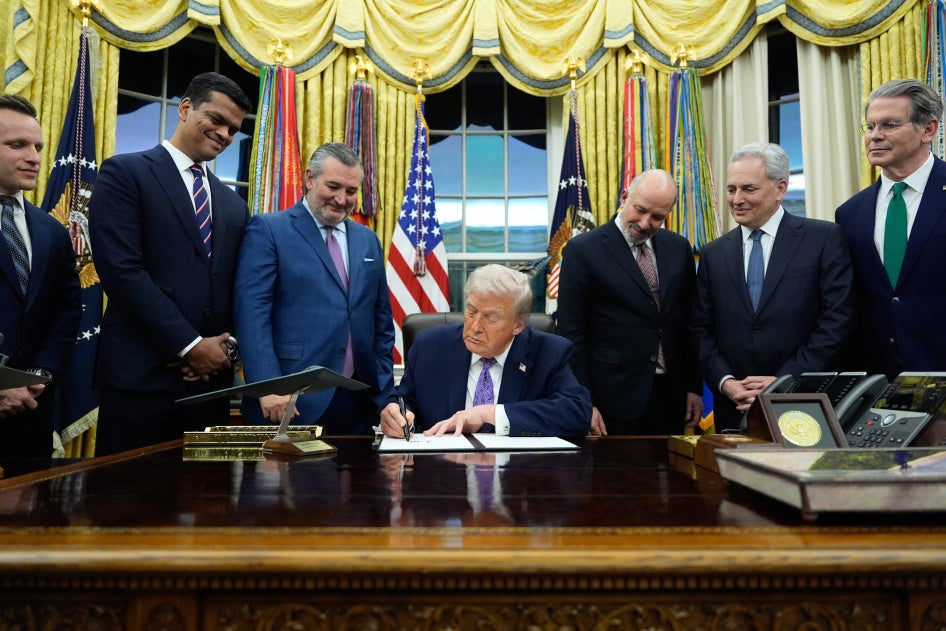
Last week, President Trump signed an executive order that proposes to challenge and dismantle a range of “cumbersome” artificial intelligence (AI) laws at state and city level in the US and replace them with a not yet defined national AI regulatory framework.
The move is supposedly an effort to “sustain and enhance the United States’ global AI dominance through a minimally burdensome national policy framework for AI.” But at what cost?
By attempting to void existing regulatory frameworks, the Trump administration is promoting a future in which many components of society are reliant on AI, but where accountability for the impact of these systems is further out of reach.
In an ideal world, a national regulatory framework governing AI would expand safeguards, transparency, and access to justice for people across the US who are harmed by algorithmic and automated systems, in a consistent and equitable way. But in the context of this administration, the reality is likely to be a regulatory vacuum.
Since taking office in January, the Trump administration has ripped up previous federal policies governing discriminatory AI, removed safeguards across government-held data, and given tech companies expansive access to sensitive personal federal data. It has also increased its financial and political stakes in the tech industry and appointed an industry leader with a personal interest in deregulation to oversee the government’s approach to AI.
We know that integrating algorithms and automation to any process creates particular risks to human rights. AI systems have led to the wrong person being imprisoned, workers mistakenly fired, and lives ended too soon, and without adequate accountability for the companies behind the tech. It is imperative that this technology is created and deployed with the utmost care.
Trump’s executive order won’t just impact AI either. It threatens to rescind federal support for internet connectivity infrastructure via the BEAD (Broadband Equity Access and Deployment) Program, and would withhold funding to states that do not revoke AI accountability laws. This could significantly restrict equitable access to affordable, reliable broadband internet services for many.
There are worthwhile, evidence-driven efforts to secure accountability for AI injustices. The administration could, for example, adopt the AI Bill of Rights. But rather than increase steps toward accountability, this executive order marks yet another step in the Trump administration’s erosion of rights.