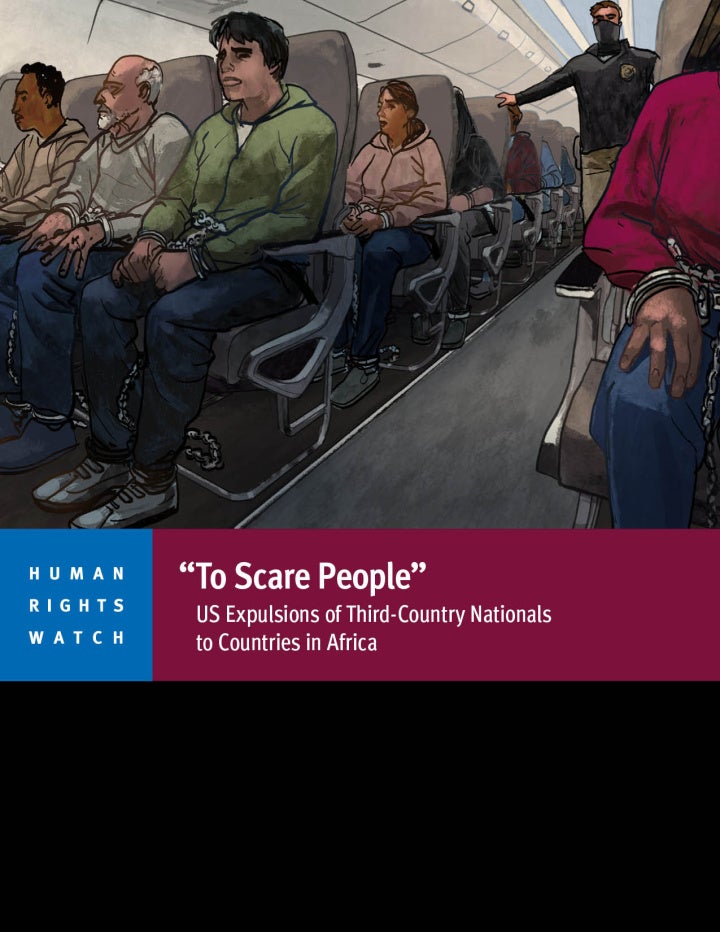
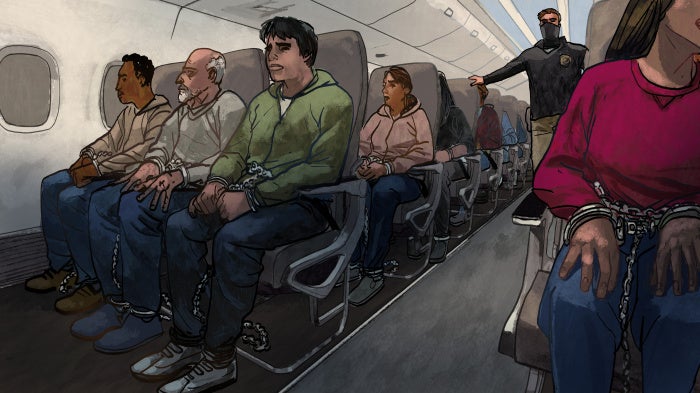
US Expulsions of Third-Country Nationals to Countries in Africa
The 125-page report, “‘To Scare People’: US Expulsions of Third-Country Nationals to Countries in Africa,” documents that US authorities denied the more than 500 people transferred to third countries a meaningful chance to contest their removals or to articulate their fears of being removed to these countries. Some countries arbitrarily detained people they had accepted, and some have sent people onward to the risk of persecution or torture in their home countries, violating the international law principle of nonrefoulement.
This report has the limited goal of assessing the number of civilian deaths from NATO attacks, as a step toward assessing NATO forces' compliance with their obligation to make protection of civilians an integral part of any use of military force. The benchmarks to be used for judging NATO's attacks are those of international humanitarian law, also known as the laws of war.
Russian soldiers summarily executed at least thirty-eight civilians in the Staropromyslovski district of Grozny, Chechnya, between late December and mid-January, according to testimony taken by Human Rights Watch. Most of the victims were women and elderly men, and all appear to have been deliberately shot by Russian soldiers at close range.
There are currently more than twenty thousand prisoners in the United States, nearly two percent of the prison population, housed in special super-maximum security facilities or units. Although supermax facilities are ostensibly designed to house incorrigibly violent or dangerous inmates, many of the inmates confined in them do not meet those criteria.
On November 4, 1999, an armed gang killed seven Nigerian policemen in the community of Odi, Bayelsa State, in the oil producing Niger Delta region in the far south east of the country. Five other police were killed in subsequent days.
As the 50th anniversary of the Universal Declaration of Human Rights is being celebrated around the world, Human Rights Watch is deeply concerned about the harsh steps that Egyptian authorities have taken in recent days against the Egyptian Organization for Human Rights (EOHR), an independent Cairo-based nongovernmental organization.
On December 5, Uzbekistan's voters will go to the polls for the second time since independence in 1991 to elect 250 deputies to the Olii Majlis, or parliament. Despite government claims that elections will be free and pluralistic, the parliamentary and local council elections will be a highly-controlled exercise in Potemkin democracy.
In the run-up to important parliamentary elections, civil and political rights are seriously restricted in Croatia, Human Rights Watch said in this report. The report describes this political repression as the "human rights legacy" of the late President Franjo Tudjman, who died earlier this month. Parliamentary elections in Croatia are scheduled for January 3, 2000.
This report is based on interviews with more than one hundred East Timorese returnees in transit centers in Dili, the capital of East Timor. It documents the continuing obstacles to return for East Timorese refugees in West Timor and other parts of Indonesia.
Colonel Mengistu Haile Mariam headed the junta which in 1974 overthrew the government of Emperor Haile Selassie in a bloody coup. Known as the "Derg" or "Dergue," the "committee," the junta consisted of about a hundred junior officers drawn from all regions of Ethiopia.
Multi-party democracies remain stable throughout most of Latin America and the Caribbean, with the notable exception of Cuba, where the government of Fidel Castro celebrated its fortieth anniversary in power with no sign of a significant political opening on the horizon.
Every recognized country in the world, except for the United States and the collapsed state of Somalia, has ratified the Convention on the Rights of the Child, pledging to uphold its protections for children. Today the convention stands as the single most widely ratified treaty in existence.
Human Rights Watch has prepared this assessment of the Patten Commission report-issued on September 9, 1999-as a means of following up on its participation in the commission's consultation process and as a contribution to the government's three month post-report consultation period.
Sovereignty loomed less large in 1999 as an obstacle to stopping and redressing crimes against humanity. Governmental leaders who committed atrocities faced a greater chance of prosecution and even military intervention.
With frequent references to juvenile predators, hardened criminals, and young thugs, U.S. lawmakers at both the state and federal levels have increasingly abandoned efforts to rehabilitate child offenders through the juvenile court system. Instead, many states have responded to a perceived outbreak in juvenile violent crime by moving more children into the adult criminal system.
Though nine years have passed since Pakistan ratified the U.N. Convention on the Rights of the Child, Pakistani children in conflict with the law continue to be denied the juvenile justice protections of the convention.