US Expulsions of Third-Country Nationals to Countries in Africa
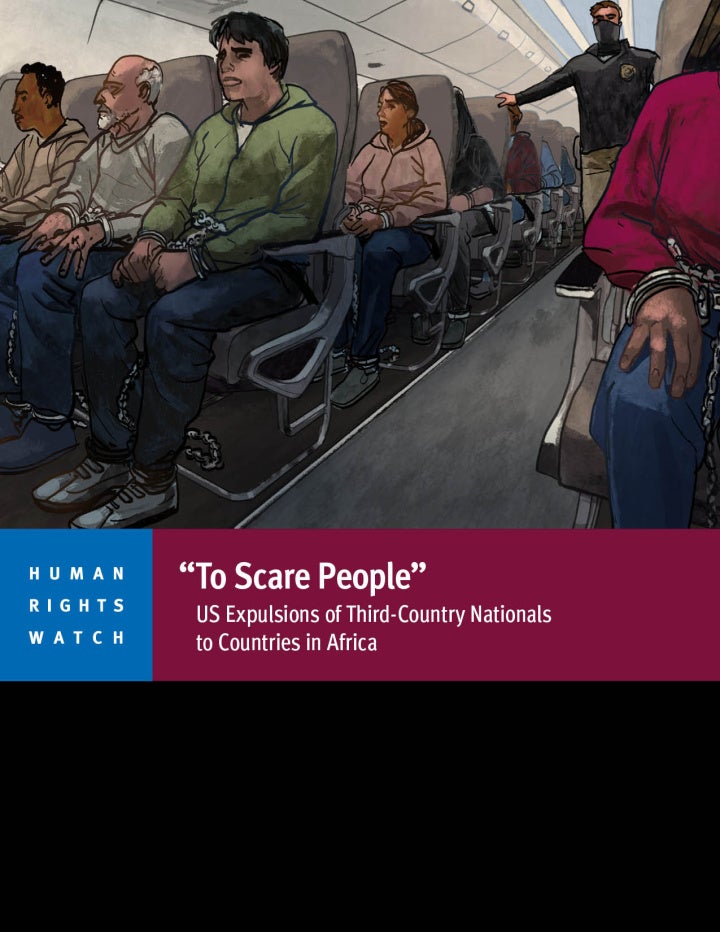
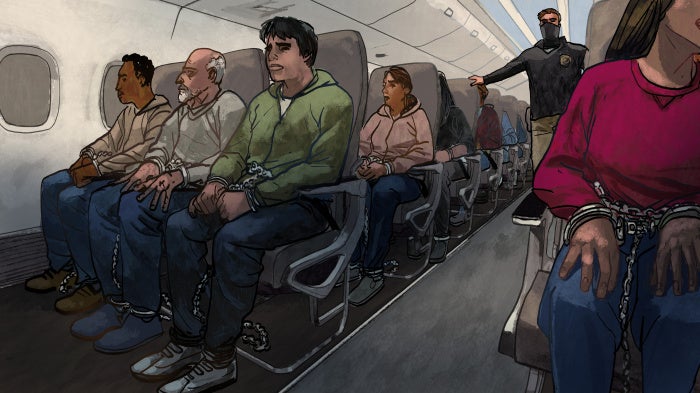
The 125-page report, “‘To Scare People’: US Expulsions of Third-Country Nationals to Countries in Africa,” documents that US authorities denied the more than 500 people transferred to third countries a meaningful chance to contest their removals or to articulate their fears of being removed to these countries. Some countries arbitrarily detained people they had accepted, and some have sent people onward to the risk of persecution or torture in their home countries, violating the international law principle of nonrefoulement.
This background briefing, based on over three weeks of research by Human Rights Watch, finds that Zimbabwe has suffered a serious breakdown in law and order, resulting in major violations of human rights. This environment has been created largely by actions of the ranking government officials and state security forces.
After the collapse of peace talks on May 19, 2003, Indonesian President Megawati Sukarnoputri signed Presidential Decree 28, authorizing Indonesia's security forces to launch full-scale military operations against the armed, separatist Free Aceh Movement (GAM).1 Aceh province was placed under martial law.
Analysis of the U.S. State Department's Certification of Uzbekistan
On May 14, the State Department certified that Uzbekistan made “substantial and continuing progress” in meeting its human rights and democracy commitments under the “Declaration on the Strategic Partnership and Cooperation Framework,” signed in March 2002. This certification is required to release U.S. assistance to the Uzbek government.
This report, based on four weeks of field research by Human Rights Watch researchers in southern Iraq, shows that more than six weeks after the fall of Basra, the security situation remained poorly addressed by coalition forces.
This report attempts to tell the story of the mass graves around al-Hilla. It identifies the victims, the circumstances of their arrest, and their ultimate execution and mass burial.
Since the mid-1990s, Armenian authorities have used administrative detention as a tool of repression, locking up protesters and activists at times of political tension. The 2003 presidential election and its aftermath mark the most sustained, extensive abuses in the last seven years.
State-Sponsored Homophobia and its Consequences in Southern Africa
Many leaders in southern Africa have singled out lesbian, gay, bisexual and transgender people as scapegoats for their countries' problems, Human Rights Watch and the International Gay and Lesbian Human Rights Commission (IGLHRC) state in this report.
Human Rights Watch urged Bhutan and Nepal to implement a screening and repatriation process that protects the human rights of more than one hundred thousand refugees of Nepalese ethnicity who were arbitrarily stripped of their citizenship and forced to flee Bhutan in the early 1990s.
Australia is the only country to grant temporary status to refugees who have been through a full asylum determination system and who have been recognized as genuinely in need of protection for 1951 Refugee Convention reasons.
Attacks on Refugees and Other Foreigners and Their Treatment in Jordan
Attacks and harassment amidst the security vacuum in Iraq forced refugees and other foreigners to flee the country and become refugees again, this time in Jordan. Based on research in Baghdad and Jordan, this 22-page Human Rights Watch report details the abuses against refugees and foreigners in Iraq, as well as their treatment upon arrival in Jordan.
This briefing paper analyzes the new peace plan in the light of previous Israeli-Palestinian agreements – all of which fatally ignored basic human rights and international humanitarian law protections. Instead, the plans let abuses proliferate to the point where they undermined the entire negotiating process.
The Rwandan Patriotic Front (RPF) is labeling possible political opponents "divisionist" and taking steps to silence them in order to ensure victory in upcoming elections.
Police Misconduct, Harm Reduction and HIV/AIDS in Vancouver, Canada
An anti-drug crackdown by the Vancouver Police Department has driven injection drug users away from life-saving HIV prevention services, raising fears of a new wave of HIV transmission in the city that is already home to the worst AIDS crisis in the developed world, said Human Rights Watch.
The Uzbek government persecutes human rights defenders and obstructs human rights work, in violation of its international commitments. In the past twelve months alone, it has imprisoned six human rights defenders and harassed numerous others.