How Kazakhstan’s Financing Terrorism List Compounds Human Rights Harms
The 29-page report, “Politically Targeted, Economically Isolated: How Kazakhstan’s Financing Terrorism List Compounds Human Rights Harms,” documents that people on Kazakhstan’s Financing Terrorism List face financial restrictions that cause them significant hardship. The restrictions lead to violations of rights guaranteed by the International Covenant on Economic, Social, and Cultural Rights (ICESCR) to which Kazakhstan is a state party, including the rights to an adequate standard of living and access to work and social security benefits. This is particularly egregious when the prosecutions are for alleged nonviolent “extremist” or “terrorist” crimes, that should not be considered crimes in the first place.
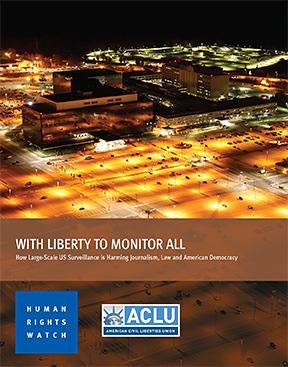
How Large-Scale US Surveillance is Harming Journalism, Law, and American Democracy
The 120-page report documents how national security journalists and lawyers are adopting elaborate steps or otherwise modifying their practices to keep communications, sources, and other confidential information secure in light of revelations of unprecedented US government surveillance of electronic communications and transactions.
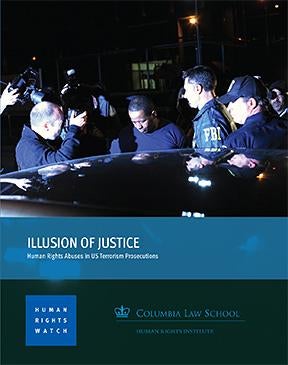
The 214-page report examines 27 federal terrorism cases from initiation of the investigations to sentencing and post-conviction conditions of confinement. It documents the significant human cost of certain counterterrorism practices, such as overly aggressive sting operations and unnecessarily restrictive conditions of confinement.
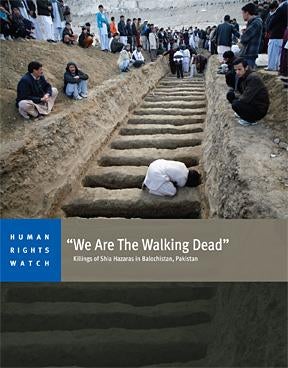
The 62-page report documents Sunni militant group attacks on the mostly Shia Hazara community in Balochistan. Since 2013, several hundreds of Hazara have been killed in steadily worsening targeted violence, including two bombings in the provincial capital, Quetta, in January and February 2013 that killed at least 180 people.
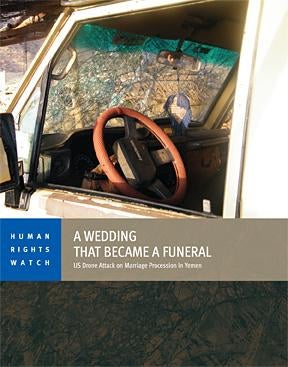
This 28-page report calls on the US government to investigate the strike, publish its findings, and act in the event of wrongdoing. The December 12 attack killed 12 men and wounded at least 15 other people, including the bride.
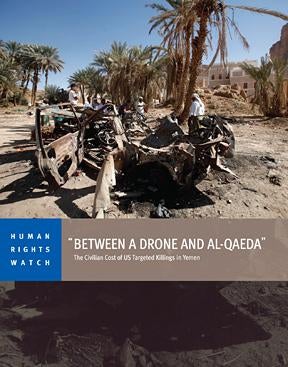
The Civilian Cost of US Targeted Killings in Yemen
The 97-page report examines six US targeted killings in Yemen, one from 2009 and the rest from 2012-2013. Two of the attacks killed civilians indiscriminately in clear violation of the laws of war; the others may have targeted people who were not legitimate military objectives or caused disproportionate civilian deaths.
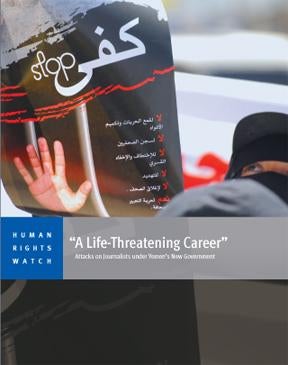
Attacks on Journalists under Yemen’s New Government
This 45-page report finds that while Yemenis generally enjoy greater freedom of expression since Hadi replaced Ali Abdullah Saleh as president in February 2012 after three decades of rule, this newfound freedom has been tempered by a rising incidence of threats and violence against the media.
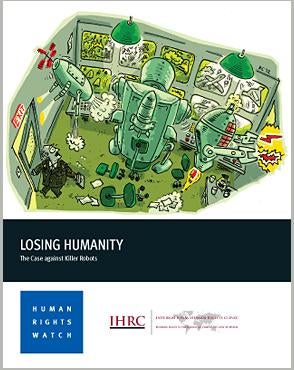
This 50-page report outlines concerns about these fully autonomous weapons, which would inherently lack human qualities that provide legal and non-legal checks on the killing of civilians. In addition, the obstacles to holding anyone accountable for harm caused by the weapons would weaken the law’s power to deter future violations.
Boko Haram Attacks and Security Force Abuses in Nigeria
This 98-page report catalogues atrocities for which Boko Haram has claimed responsibility. It also explores the role of Nigeria’s security forces, whose own alleged abuses contravene international human rights law and might also constitute crimes against humanity.
US-Led Abuse and Rendition of Opponents to Gaddafi’s Libya
This report is based on interviews conducted in Libya with 14 former detainees, most of whom belonged to an armed Islamist group that had worked to overthrow Gaddafi for 20 years. Many members of the group, the Libyan Islamic Fighting Group (LIFG), joined the NATO-backed anti-Gaddafi rebels in the 2011 conflict.
Counterterrorism Laws Worldwide since September 11
The 112-page report says that while terrorist attacks have caused thousands of deaths and injuries, that is no justification for counterterrorism laws that violate the basic rights of suspects and that are also used for politically motivated purposes.
A Briefing on Eritrea’s Missing Political Prisoners
In September 2001, President Isaias Afewerki of Eritrea ordered the detention of 21 senior government members and journalists who criticized him and his government. Since then, Isaias has closed all independent media outlets and turned Eritrea into a country where arbitrary arrest, torture, disappearance, and death are rife and where it is almost impossible to leave.
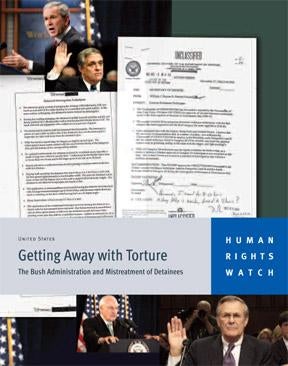
The Bush Administration and Mistreatment of Detainees
This 107-page report presents substantial information warranting criminal investigations of Bush and senior administration officials, including former Vice President Dick Cheney, Defense Secretary Donald Rumsfeld, and CIA Director George Tenet, for ordering practices such as “waterboarding,” the use of secret CIA prisons, and the transfer of detainees to countries where they were tortured.
Arbitrary Detention and Torture of Terrorism Suspects in India
This 106-page report documents consistent abuse by Indian security forces in their response to the scourge of terrorism attacks. State police, jail officials, and other authorities have committed a range of human rights violations, including arbitrary arrest and detention, torture, and religious discrimination.
The Arbitrary Use of Terrorism Laws to Prosecute and Incarcerate Demonstrators in Turkey
This report is based on a review of 50 cases. It describes 26 cases of individuals prosecuted for terrorism simply for taking part in protests deemed by the government to be sympathetic to the outlawed armed Kurdistan Workers’ Party (PKK). Hundreds of Kurdish demonstrators are currently in prison pending the outcome of their trials or appeals against convictions.
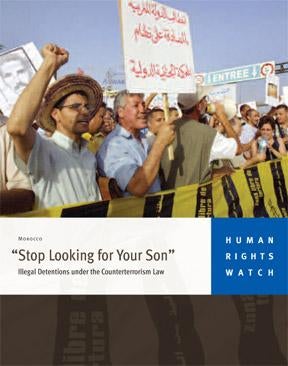
This report documents a pattern of abuse under Morocco's counterterrorism law, which was adopted 12 days after coordinated suicide bombings in Casablanca on May 16, 2003, took 45 lives. Many of these abuses violate the progressive legislation Morocco adopted to safeguard against torture and illegal detention, as well as international conventions that Morocco has signed.