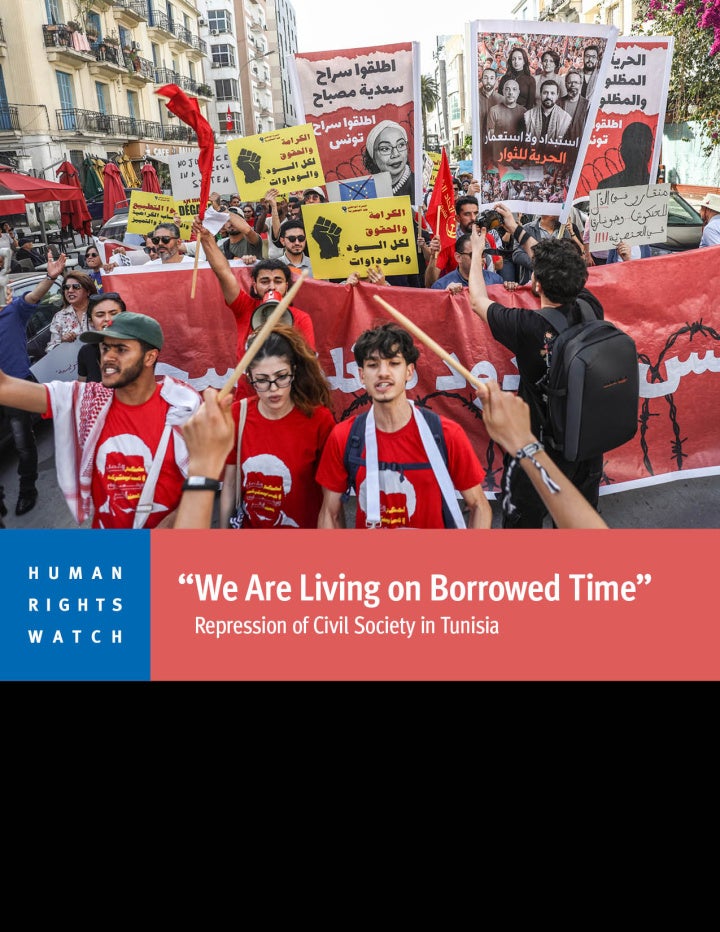
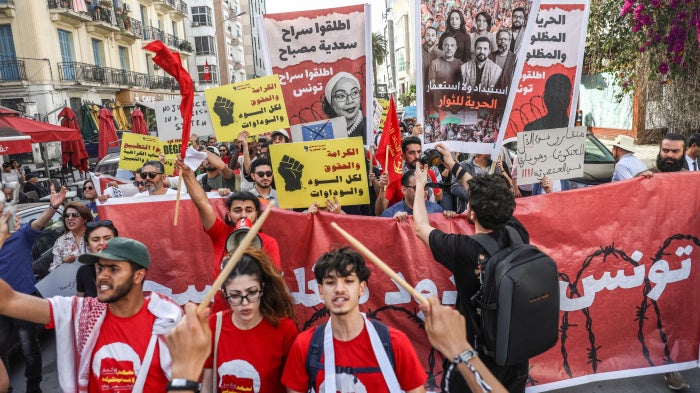
The 49-page report, “‘We Are Living on Borrowed Time’: Repression of Civil Society in Tunisia” documents the Tunisian authorities’ escalating repression of local and international civil society groups, workers, members, and affiliates through the weaponization of abusive prosecutions, arbitrary arrests, detention, financial and criminal investigations, mass suspensions, and threats of dissolution.
An investigation of the prevalence of forcible virginity control exams and the role of the government in conducting or tolerating such exams, this report cites several separate incidents in the spring of 1992 when young females committed suicide after authorities ordered them to submit to examinations of their hymens.
Heightened political tension has been characterized by physical attacks on journalists critical of the former Meciar government. HRW/Helsinki urges the interim government to give special consideration to the concerns outlined in this report and to disassociate itself from the media policies of its predecessor in order to create an environment in which the independent press can flourish.
Despite the considerable progress that has been made to ensure an independent press both in practice and in law, there is troubling evidence of official harassment of journalists whose views are critical of the ruling powers, ranging from selective denial of press credentials to the imprisonment of a journalist who wrote an allegory considered defamatory of the President of Romania.
Abuses by All Parties in the War in Southern Sudan
Since 1983, the civil war in southern Sudan has claimed the lives of some 1.3 million civilians as a result of targeted killings, indiscriminate fire, or starvation and disease. Both government and rebel forces are culpable as they wage war in total disregard for the welfare of civilians, violating almost every rule of war applicable in an internal armed conflict.
Israel’s Interrogation of Palestinians from the Occupied Territories
Despite the historic peace process that is under way in the Middle East, Israel’s interrogation agencies in the occupied territories have continued to engage in a systematic pattern of torture and ill-treatment. Well over 100,000 Palestinians have been detained since the start of the intifada in 1987.
While land has always played a central role in the cultures, identities, and religions of indigenous peoples, Indians who attempt to exercise the rights that are guaranteed to them in the Brazilian Constitution are frequently the victims of violent attacks and other human rights abuses.
The people of Guatemala have suffered savage repression at the hands of security forces, civil patrols, and guerrillas waging a thirty-year civil war. Their villages were razed and tens of thousands disappeared — presumably murdered — their bodies occasionally discovered in clandestine graves throughout the highlands.
In late 1993, a new armed faction emerged in Liberia known as the Liberian Peace Council (LPC), and engaged Charles Taylor's National Patriotic Front of Liberia (NPFL) in combat. While both are responsible for severe human rights abuses, the LPC stepped up its campaign against civilians, especially those it considers members of the NPFL.
The mysterious death of President Habyarimana of Rwanda in April 1994 was the pretext for Hutu extremists from the late president's entourage to launch a campaign of genocide against the Tutsi, a minority that made up about 15 percent of the population. The extremists also killed Hutu willing to cooperate with Tutsi in forming a more democratic government.
Iraq’s 1988 Anfal campaign of extermination against the Kurdish people living within its borders resulted in the death of at least 50,000 and as many as 100,000 people, many of them women and children. This book, co-published with Yale University Press, investigates the Anfal campaign and concludes that this campaign constituted genocide against the Kurds.
Human Rights in Chile at the Start of the Frei Presidency
Under former President Aylwin's four-year “transitional” administration, Chile took notable steps toward consolidating democracy, reestablishing civil and individual rights, and healing the wounds caused by decades of political strife and gross human rights violations under military rule.
Although ethnic Macedonians in northern Greece make up a large minority with their own language and culture, their internationally-recognized human rights and even their existence are vigorously denied by the Greek government. Free expression is restricted; several Macedonians have been prosecuted and convicted for the peaceful expression of their views.
In April 1994, tens of thousands of workers took to the streets in Medan, Indonesia, demanding higher wages, improved benefits and freedom of association. Notable for their size and anti-Chinese violence, the protests underscored the Indonesian government's urgent need to address worker's rights issues.
The bloody conflict in the Indian state of Punjab drew to a close in 1993, but the restoration of an elected government has not meant the restoration of the rule of law. To the contrary, the Punjab police continue to torture, kill or cause their victims to disappear with impunity.