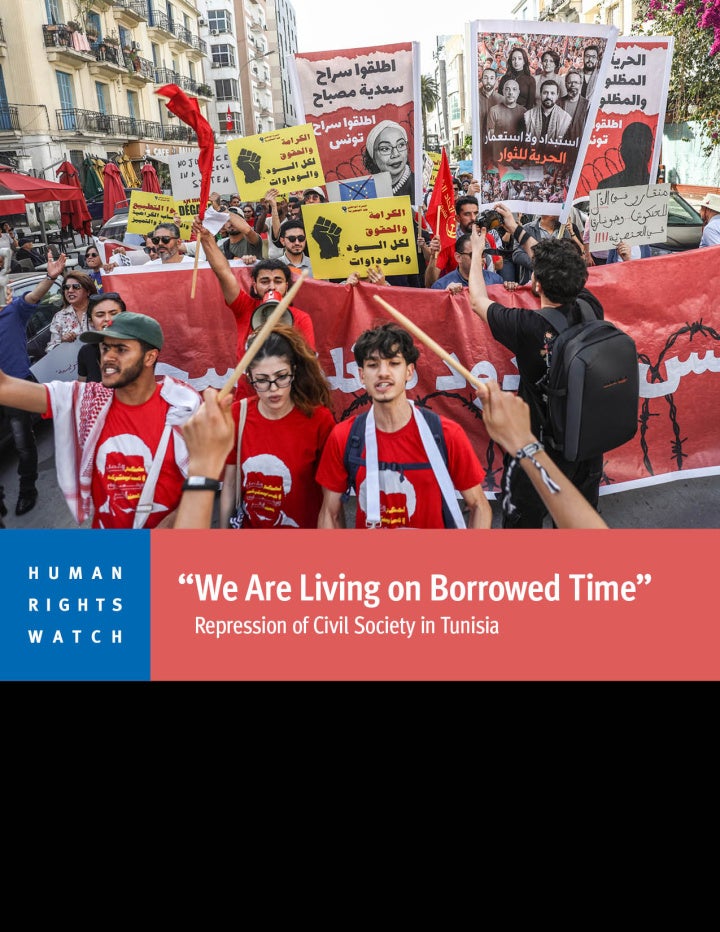
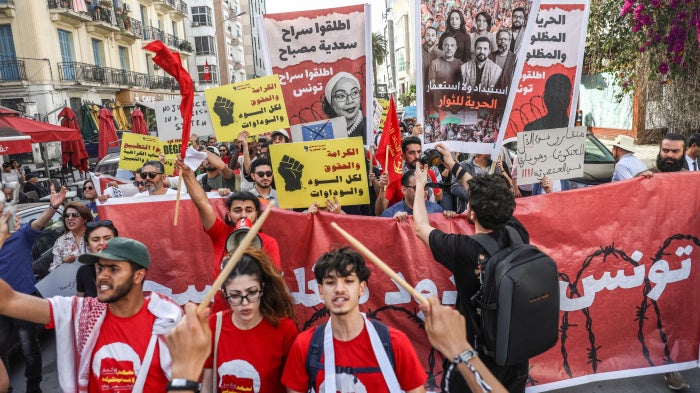
The 49-page report, “‘We Are Living on Borrowed Time’: Repression of Civil Society in Tunisia” documents the Tunisian authorities’ escalating repression of local and international civil society groups, workers, members, and affiliates through the weaponization of abusive prosecutions, arbitrary arrests, detention, financial and criminal investigations, mass suspensions, and threats of dissolution.
This report documents serious violations of international humanitarian law committed by Serbianand Yugoslav government forces in Kosovo's Drenica region during the last week of September1998.
The historic Good Friday Agreement states that the Independent Commission on Policing for Northern Ireland must work to ensure that future policing structures and arrangements result in a policing service that "operates within a coherent and co-operative criminal justice system, which conforms with human rights norms." This imperative exemplifies the parties' commitment to a number of basic princi
Torture, “Disappearance,” and Extrajudicial Execution in Mexico
Torture, "disappearances," and extrajudicial executions remain widespread in Mexico, despitenumerous legal and institutional reforms adduced by successive Mexican governments asevidence of their commitment to protecting human rights. Indeed, reforms have taken place, butthey have failed to abate, much less resolve, these serious, seemingly intractable problems.
Under the pretext of “depoliticizing” the campuses, the Serbian parliament in May 1998 enacted a law that removed basic protections for academic freedom and destroyed the autonomy of universities in Serbia.
This report examines the situation of the ethnic Turkish minority of Thrace, a region of Greece. It serves as a follow-up to two earlier reports issued by Human Rights Watch, Destroying Ethnic Identity: The Turks of Greece (August 1990) and "Greece: Improvements for Turkish Minority;Problems Remain" (April 1992).
Jamaican Children in Police Detention and Government Institutions
In the island nation of Jamaica, many children-often as young as twelve or thirteen-are detained for long periods, sometimes six months or more, in filthy and overcrowded police lockups, in spite of international standards and Jamaican laws that forbid such treatment.
This report documents how, from the moment the state assumes their care, orphans in Russia---of whom 95 percent still have a living parent---are exposed to shocking levels of cruelty and neglect.
In the aftermath of President Soeharto's resignation in May 1998, political tension in Irian Jaya, Indonesia's easternmost province, has increased. The province, called West Papua by supporters of independence, occupies the western half of the island of New Guinea.
Continued Sex Discrimination in Mexico’s Maquiladora Sector
In this report Human Rights Watch documents the Mexican government's failure to enforce its own labor laws in the export processing (maquiladora) sector. In violation of Mexican labor law, maquiladora operators oblige women to undergo pregnancy testing as a condition of work. Women thought to be pregnant are not hired.
At least 1,000 ethnic Albanians are currently believed to be in Serbian prisons and police stations, according to Human Rights Watch. In Detention and Abuse in Kosovo, released today, Human Rights Watch charges that many have been subjected to beatings and torture to extract confessions or to obtain information about the Kosovo Liberation Army (KLA), and are being tried on charges of "terrorism."
Children in the Custody of the U.S. Immigration and Naturalization Service
In this report, Human Rights Watch charges the U.S. Immigration and Naturalization Service (INS) with violating the rights of unaccompanied children in its custody.
Freedom of Expression and the Public Debate in Chile
Since the 1980s, the term “transition to democracy” has been used to describe those processes of political change that aim toleave behind a dictatorial past, a situation of internal armed conflict or another type of radical breakdown of the political orderor absence of the rule of law, and to advance toward the foundation or reconstruction of a democratic system.