The Persecution of Environmentalists and Indigenous Leaders in Indonesia
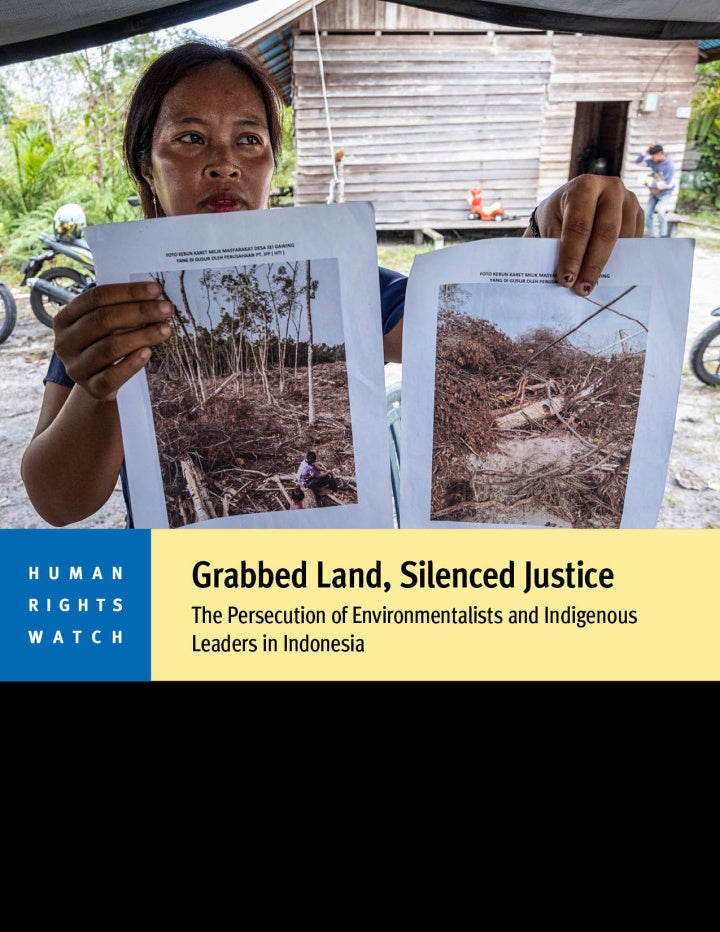
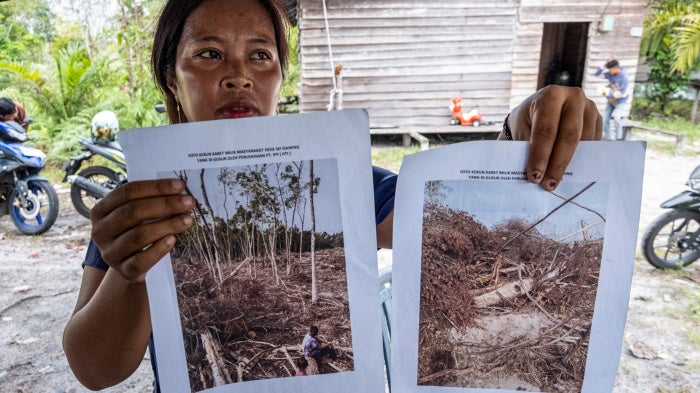
The 70-page report, “Grabbed Land, Silenced Justice: The Persecution of Environmentalists and Indigenous Leaders in Indonesia,” documents how Indonesian police have responded to complaints filed by company officials or politicians by silencing Indigenous villagers who demand their customary land rights and the activists who defend them. The authorities have targeted environmental and Indigenous community defenders using the criminal code and other laws to bring charges ranging from defamation to “spreading communism” to silence protest over environmental harm.
Arbitrary Detention of Women and Girls for “Social Rehabilitation”
This 40-page report documents numerous and serious human rights abuses that women and girls suffer in "social rehabilitation" facilities in Libya. These include violations of their rights to liberty, freedom of movement, personal dignity, privacy and due process. Libyan authorities are holding many women and girls in these facilities who have committed no crime, or who have completed a sentence.
This document details recent violations by both the Burundian government and the rebel National Liberation Forces (Forces Nationales de Libération, or FNL), with which the government is still at war. The report calls on both the government and the international community to establish mechanisms to deliver justice for serious past crimes by government and rebel forces.
This report documents an alarming rise in attacks against civilians in Chad by Sudanese government-backed Janjaweed militias and Chadian rebel groups. The Janjaweed and Chadian rebel forces operate from bases in Sudanese government-controlled areas of Darfur. Sudanese government troops and helicopter gunships have at times supported these cross-border attacks in eastern Chad.
On September 30, 2005, the Danish newspaper Jyllands-Posten published twelve cartoon depictions of the Prophet Mohammed that its editors said they solicited as part of an experiment to overcome what they perceived as self-censorship reflected in the reluctance of illustrators to depict the Prophet.
Despite impressive displays of independence from the Electoral Commission and the judiciary, the first multiparty elections in two decades have been marred by intimidation of the opposition, military interference in the courts and bias in campaign funding and media coverage, Human Rights Watch said in a <a href="http://hrw.org/backgrounder/africa/uganda0206/">briefing paper</a> released today.
Since October 19, 2005, Saddam Hussein and seven other former Iraqi officials have been on trial for crimes that took place in the town of al-Dujail in 1982. Government security forces allegedly detained and tortured hundreds of individuals from al-Dujail in retaliation for an assassination attempt on Saddam Hussein as his motorcade passed through the town, sixty kilometers north of Baghdad.
In March 2005, the War Crimes Chamber began operations within Bosnia’s State Court to try cases of serious war crimes in Bosnia and Herzegovina that could not be prosecuted within the mandate or timeframe of the International Criminal Tribunal for the former Yugoslavia (ICTY). The chamber will also handle serious war crimes cases initiated locally.
The absence of legal guarantees is one of the main causes of Saudi Arabia’s serious human rights problems. Without specific legal protections, neither the government nor judges, not to mention ordinary citizens, can know with certainty what is permissible and what is forbidden.
This 84-page report is based primarily on Human Rights Watch’s first-ever trip to Libya, made in mid-2005, which the organization praised as a welcome step towards transparency. The authorities provided access to a wide range of high-level officials, as well as police stations, an immigration detention center and five prisons, where 32 prisoners were interviewed in private.
This report examines the evolving role in the Darfur conflict of the African Union Mission in Sudan (AMIS), from its inception as a ceasefire monitoring body in June 2004 to its current incarnation as a major operation with a mandate to protect civilians that includes armed troops, unarmed civilian police, unarmed military observers, and support teams.
At the Sixth Summit of the African Union (A.U.) in Khartoum on January 23 and 24, Human Rights Watch calls on the Assembly of African Heads of State and Government to put the protection of civilians and the prosecution of human rights abusers at the top of its agenda.
The Supreme Court of Rwanda is scheduled to rule January 17 on the bid by former president Pasteur Bizimungu and seven others to have their convictions on charges of having formed a criminal association quashed.
This report describes trends in human rights abuses in Côte d’Ivoire by state security and militia forces and by rebel forces, and examines the human rights and humanitarian consequences of the “no war no peace” stalemate.
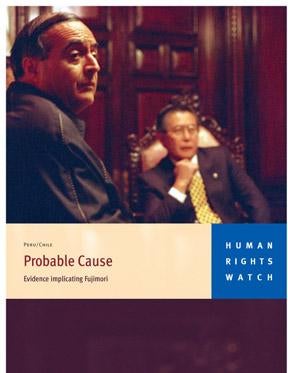
This 22-page report focuses specifically on information implicating Fujimori in five criminal cases currently pending in Peru, including human rights violations as well as acts of corruption that undermined Peru’s democratic institutions.