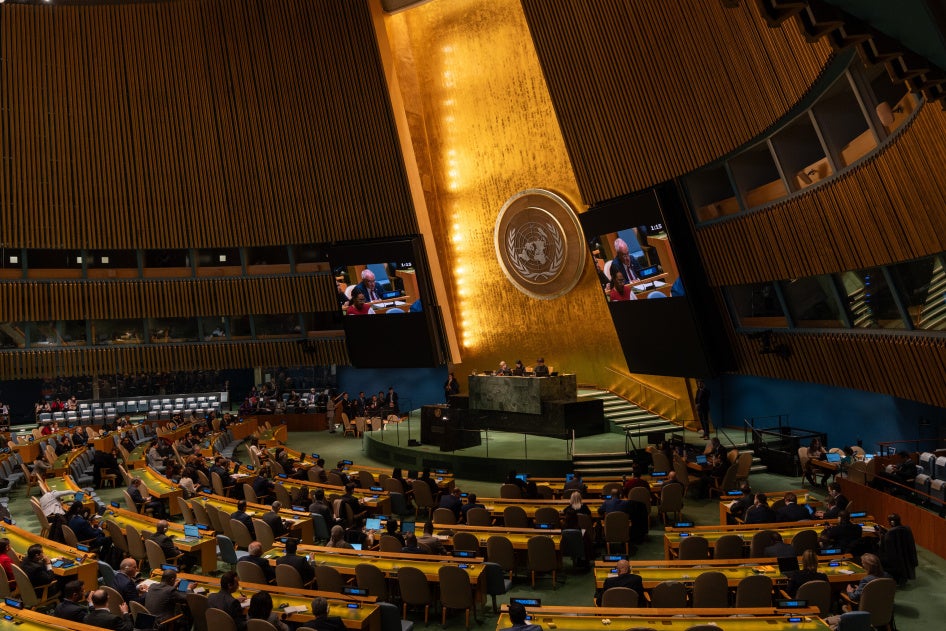
The United Nations General Assembly took a crucial step on June 30, 2026, towards easing the world body’s deepening liquidity crisis by amending a longstanding rule that would have required it to refund member state contributions it had never actually received.
The UN’s liquidity shortfall has forced its leadership to lay off thousands of staff and cut back on lifesaving human rights, humanitarian, and peacekeeping operations. The world body’s financial difficulties are largely the result of the United States withholding billions of dollars in obligatory dues, as well as China paying its dues late. Dozens of other member countries also pay late or not at all.
Below are questions and answers about how the UN is funded, what led to the UN’s liquidity crisis, its impact on the UN’s human rights work, and what needs to be done to resolve it.
How is the UN funded?
The UN is largely funded through two sources: assessed contributions and voluntary contributions.
Assessed contributions are what the UN’s 193 member countries are required to pay based on the size of each country’s economy and other factors. Assessed contributions fund the UN’s regular administrative budget, tribunals, and peacekeeping. Every three years the UN General Assembly revisits its Scale of Assessment to adjust how much member states are required to pay.
The US is responsible for the biggest share of the UN’s regular budget, 22 percent, the maximum permissible contribution. Its assessment for peacekeeping is 26.15 percent. In the 1990s, Congress capped the US peacekeeping contribution at 25 percent, though Congress often waived that cap until 2017. As a result, even before the US stopped paying its UN contributions altogether in 2025, it had accrued more than a billion dollars in arrears due to the peacekeeping cap alone.
As the world’s number two economy, China is the second-largest contributor, responsible for just over 20 percent of the regular budget and 23.8 percent of the peacekeeping budget. Japan, Germany, and the United Kingdom are the next biggest contributors.
The UN’s regular budget for 2026 is US$3.45 billion, a small amount compared to the $50.7 billion US State Department budget for the 2026 fiscal year. The UN peacekeeping budget for the 2026-2027 fiscal year is $5.1 billion.
Voluntary contributions are discretionary donations that governments choose to make to support UN activities and programs. Most of the UN’s funding—nearly three quarters—comes from voluntary contributions. Voluntary core contributions can be used for anything by the UN funds, agencies, or mechanisms that receive them. Increasingly, governments that make voluntary contributions to the UN earmark them for specific activities or programs.
The UN Office of the High Commissioner for Human Rights, which oversees much of the UN work on human rights around the world, is roughly 60 percent funded through voluntary contributions and 40 percent via assessed contributions through the regular UN budget.
The UN system also includes 15 specialized agencies that have their own separate governing bodies and funding streams independent of the UN’s regular budget. These include the UN Children’s Fund (UNICEF), the UN Development Programme, the UN Office of the High Commissioner for Refugees, the World Food Programme, the International Atomic Energy Agency, and the UN Population Fund, among others. Unlike the regular UN budget and peacekeeping, some specialized UN agencies accept voluntary contributions from the private sector and individuals.
How is the UN budget approved?
The UN budget is approved by the UN General Assembly’s Fifth Committee, its main administrative and budgetary committee. The UN secretary-general proposes a budget that it shares with member states. The UN Advisory Committee on Administrative and Budgetary Questions then assesses the budget proposal and makes recommendations about where it should be amended. Individual member countries and blocs also make their own recommendations based on the secretary-general’s proposal and the advisory committee’s analysis and collectively adopt the budget.
In theory, the advisory committee is a body of 21 independent budgetary experts, but it has become increasingly political. UN diplomats have told Human Rights Watch that experts from countries such as China and Russia essentially follow the leads of Beijing and Moscow, especially when it comes to evaluating funding proposals for human rights posts.
In budget negotiations, China, Russia, and other countries with poor human rights records have long led efforts to cut funding for human rights posts and partially or completely defund investigations into human rights abuses around the world. The US, Israel, and a handful of European governments have in the past supported unsuccessful efforts to defund the UN commission of inquiry investigating abuses in Israel and Palestine.
Overall, the US and European governments, along with some Latin American, Asian and African countries, traditionally resisted efforts to cut human rights funding in the Fifth Committee. Now it is mostly the European governments and a shrinking group of countries in other regions leading the resistance to defunding human rights.
Why is the UN in a financial crisis?
The US, in addition to defaulting on payment of its mandatory assessed contributions, has ended the vast majority of its voluntary contributions to UN agencies and programs. When President Donald Trump began his second term in January 2025, he announced a review of all US foreign aid and its participation in international organizations, including the UN and its funds and agencies. In January 2026, his administration announced the US withdrawal from 66 organizations and entities, more than half of them affiliated with the UN.
The US has only made small payments toward its mandatory assessed contributions to the UN since January 2025. In February 2026, the UN said the US had paid about $160 million for the regular budget out of the nearly $4 billion that it owes the organization in total arrears for the regular budget, peacekeeping, and tribunals.
Another problem is China, which has made its payments extremely late in recent years. In 2024, China did not pay in full until December 27, four days before the end of the year. In 2025, China did not pay in full until October 29.
As a result, the UN regular budget was out of nearly half of its funds for all of 2024 and 10 months in 2025. It finished 2025 with a record $1.6 billion in unpaid assessed contributions. The problem continued into 2026, leading the UN to warn member states of the growing risk of bankruptcy. In addition to the US and China, about 82 of the UN’s 193 member countries had not paid their dues in full by the end of May 2026, similar to the previous three years.
The Trump administration has defended withholding payments with accusations that the UN is inefficient, corrupt, and hostile to the US and Israel. It has demanded reforms ranging from more layoffs to preventing China from paying into a discretionary fund. The UN leadership approved a reform initiative called “UN80” in honor of the organization’s 80th anniversary, which included a 15 percent reduction in its 2026 budget, relocating personnel, and thousands of job cuts.
What else has the UN done to ease the crisis?
The UN rule that requires the organization to return money that was budgeted but not used dates back to its founding. The funds are returned to member states in the form of credits backed by cash for future payments of assessed contributions, even if the reason the UN did not carry out budgeted expenditures was that it did not have the money to do so. In practice it meant the UN would refund money it never received from member countries in the first place.
However, on June 30 the UN General Assembly amended that rule for a trial period of four years so that it would not have to refund money that member states never paid. Under the amended rule, the refund requirement will only apply to funds the UN receives but does not use, not money member states never paid.
While this move will not solve the UN’s financial crisis, it will reduce the risk of near-term bankruptcy. The only sustainable solution to the UN’s liquidity problems is for member countries to pay their obligatory dues in full and on time, and for wealthy states to increase voluntary funding as much as possible.
How much does the UN spend on human rights?
Not very much. Spending on the UN human rights work accounts for a small fraction of the budget, even though it is one of the UN’s three main pillars, alongside peace and security and development. In 2024, the UN human rights office received $170 million, or 4.7 percent, of the organization’s $3.7 billion regular budget. Adding voluntary contributions and other revenue sources across the entire UN system, spending on human rights accounted for less than one percent of the UN’s $68.3 billion income in 2024.
Given the global demands, the amount that the UN spends on human rights is so little that further cuts to this under-resourced part of the organization’s work would do nothing to resolve the UN’s liquidity problems. It would, however, have a devastating impact on the ability of the UN human rights office and of multiple independent human rights investigations, fact-finding missions, and commissions of inquiry to carry out the mandates that member states have given them.
How is the financial crisis affecting UN humanitarian and human rights work?
Among the thousands of staff layoffs across the UN, with more to come, peacekeeping missions have had to cut staff and reduce patrols, while humanitarian aid operations have been forced to reduce the amount and scale of assistance they can provide. The UN World Food Programme announced in 2025 that it would cut 30 percent of its staff because of its funding shortfall.
The UN high commissioner for human rights, Volker Türk, said that as a result of a decrease in funding from the regular budget and voluntary contributions, his office had cut the number of human rights missions it conducted around the world by more than half, from 11,000 in 2024 to 5,000 in 2025.
UN member countries have mandated multiple independent investigations into atrocities being committed in conflict situations like Syria, Ukraine, Sudan, Israel/Palestine, and the Democratic Republic of Congo. Their work is being significantly hampered by the financial crisis and UN hiring freeze, with many teams reporting being at 40 to 60 percent of budgeted staffing. A Human Rights Council-mandated inquiry into grave abuses in eastern Democratic Republic of Congo, established in February 2025, did not hire its first team members until June 2026.
Similarly, independent UN accountability mechanisms for Syria and Myanmar are facing funding shortfalls and staff cuts.
Are the problems with funding the UN’s human rights work new?
The UN-wide liquidity crisis escalated dramatically in 2025. But attempts to cut funding for UN human rights work go back more than a decade. Since 2017, Human Rights Watch has tracked the efforts of China, Russia, and other countries to undermine UN human rights mechanisms by reducing the number of staff posts dedicated to human rights throughout the UN, at peacekeeping missions, in the UN Secretariat, and in field offices around the world.
Most recently China, backed by Russia, attempted to defund numerous human rights posts during negotiations on the 2026-2027 UN peacekeeping budget.
What else can UN member states do to end the UN financial crisis?
In addition to paying their obligatory dues in full and on time and increasing voluntary contributions, UN member states should take steps to hold countries defaulting on their dues accountable. Under article 19 of the UN Charter, member states whose arrears are equal to or exceed two full years of assessed contributions lose their General Assembly voting rights. However, this rule only applies to the General Assembly, not the UN Security Council or the other main UN bodies. Furthermore, the US and others in arrears can avoid losing their voting rights in the General Assembly by making small partial payments.
A better approach would be something like the recent move by the International Labour Organization. The Geneva-based organization, one of the specialized UN agencies, canceled the appointment of a senior US official to be the agency’s deputy head over delays in US payments. US nationals traditionally hold a number of senior posts throughout the UN system.