(Washington, DC) – The reported plans for the United States Department of Defense to purchase cluster munitions from Israel further weaken global norms that protect civilians from the widely banned weapons, Human Rights Watch said today. If used, these weapons would put civilians at grave risk.
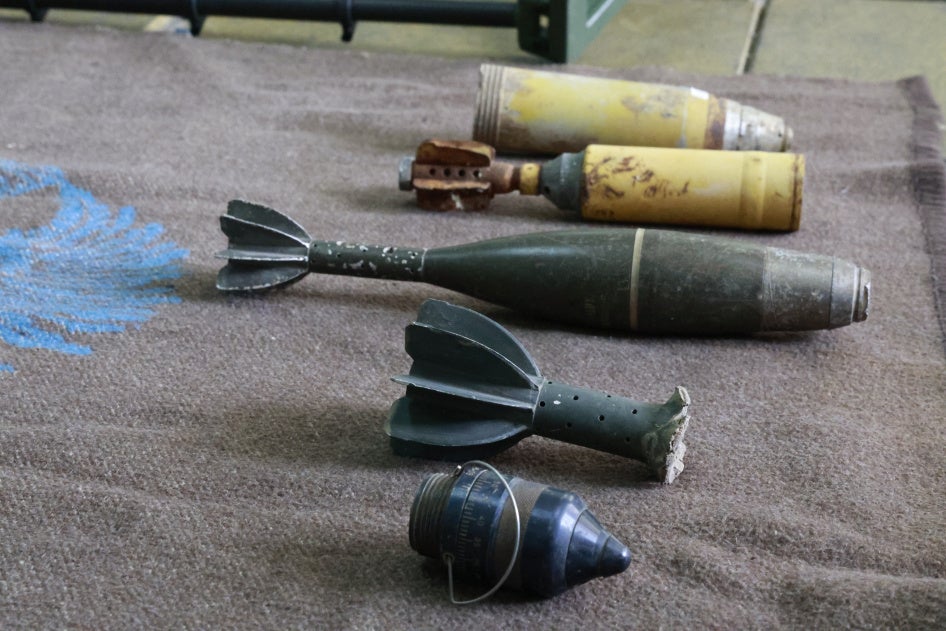
The media reported that the Pentagon signed a deal worth at least $210 million to acquire XM1208 155mm cluster munition artillery projectiles produced by an Israeli government-owned manufacturer. Human Rights Watch and its partners have long documented the devastating and lasting impact of cluster munitions on civilians.
“The US government’s revival of indiscriminate weapons that the world has worked to ban puts civilian lives at risk,” said Sarah Yager, Washington director at Human Rights Watch. “The Trump administration is simply disregarding foreseeable harm to civilians, from children who pick up unexploded bomblets to communities forced to live with unmarked minefields long after a conflict ends.”
Cluster munitions can be fired from the ground or dropped by aircraft and typically open in the air, dispersing multiple submunitions or bomblets over a wide area. These submunitions cannot distinguish between combatants and civilians at the time of attack, putting civilians at risk. In addition, many submunitions fail to explode on initial impact, leaving unexploded duds that, like antipersonnel mines, can indiscriminately injure and kill people for years until they are cleared and destroyed.
The reported purchase signals a dangerous retreat by the United States from global norms that have helped reduce civilian harm. The 2008 Convention on Cluster Munitions, adopted in response to overwhelming evidence of humanitarian harm from these weapons, bans the use, production, transfer, and stockpiling of cluster munitions and requires clearance of remnants and assistance to victims.
While the United States is not a party to the treaty, it has long benefited from the powerful stigma against these weapons and has not used cluster munitions in its own military operations since 2009. Reinvesting in cluster munitions weakens that stigma at a time when restraints on the conduct of war are already under severe strain.
Human Rights Watch has been documenting a broader pattern of the Trump administration’s systematic dismantling of policy guardrails meant to limit civilian harm and uphold international law. In December 2025, Defense Secretary Pete Hegseth rolled back restrictions on the US’ use of antipersonnel landmines, another inherently indiscriminate weapon banned by the 1997 Mine Ban Treaty.
The National Defense Strategy issued in January 2026 further entrenched this shift by removing human rights and civilian harm mitigation as explicit considerations in defense policy. The “America First Arms Transfer Strategy,” outlined in an executive order issued on February 6, 2026, reinforces this approach by reorienting US arms export policy toward prioritizing weapons sales to benefit US defense manufacturing without noting human rights considerations and risk assessments.
The Trump administration and Congress should halt any procurement of cluster munitions and recommit to policies that prioritize civilian protection in US defense decisions, Human Rights Watch said.
“US military forces have done important work in recent years to reduce civilian harm, with much more still to do,” Yager said. “The Trump administration’s decision to purchase cluster munitions shows that the Pentagon no longer considers protecting civilians a priority.”