A Hindu man beaten to death by a Muslim mob in Bangladesh incensed over alleged blasphemy, an allegation later proved untrue. An official from India’s Hindu nationalist Bharatiya Janata Party storming an annual Christmas lunch for children with special needs, with false allegations of forced conversion, assaulting and berating a blind woman. The death of a Dalit man in Nepal following beatings after being wrongly accused of stealing a mobile phone.
These are just some of the recent cases of horrific violence and human suffering in South Asia, indicating a breakdown in rule of law.
Sadly, such incidents are often the outcome when leaders seek to use cycles of abuse and revenge for political purposes. They rally their followers against perceived enemies, be it minority communities, refugees, immigrants, or bordering countries, apparently hoping that generating hatred against marginalised groups will distract from economic insecurity and an uncertain future.
The rhetoric promoting hatred can extend beyond borders. Many Indians complained about the attacks on Hindus in Bangladesh, while Bangladeshis denounced the continuing attacks on Muslims in India. The rage percolated even to sport, where India’s cricket board ordered a Premier League team to dismiss a Bangladeshi player because of his nationality, prompting the Bangladesh government to declare its national team would not be safe playing an international tournament in India.
Meanwhile, cricket and culture had long fallen prey to the troubled ties between India and Pakistan, which terrifyingly deteriorated into armed hostilities in April, after Muslim militants killed Hindu tourists in Jammu and Kashmir. Pakistanis and Indians expressed anger, often provoked by their leaders.
Online hate
It is now clear that in the age of social media, political idealogues can deliberately misuse algorithms to rouse discontent, claiming that abiding by laws, respecting human rights, and accommodating different choices or diverse identities is all just unnecessary pandering. When such approaches fail, politicians resort to human rights abuses, having dismantled the institutions that would deter them.
In Sri Lanka, Bangladesh and Nepal, in recent years, unpopular leaders were eventually chased out by enraged citizens who had been doomed to economic stagnation due to corruption and nepotism or manipulated with political division. In other places, like India, Pakistan, or the Maldives, nervous rulers have stifled protests.
Instead of trying to hold on to power by stoking hatred, leaders could of course commit to the hard work needed to improve conditions in a way that upholds rights, but seem loath to do so.
In Bangladesh in 2024, after a decade and half of repression by Sheikh Hasina’s Awami League government, a small demonstration over quotas in government jobs exploded into a mass uprising, and Hasina eventually fled the country. But the interim government that took charge, pledging reforms, soon lost its way hobbled by mob demands for reprisals.
It barred the Awami League from contesting elections in February, which leaves Bangladeshis once again without the right to vote for leaders of their choice. The situation will be the same as in the three previous consecutive elections under Hasina’s government, when opposition parties were blocked from competing in a free and fair manner.
Gen Z protesters
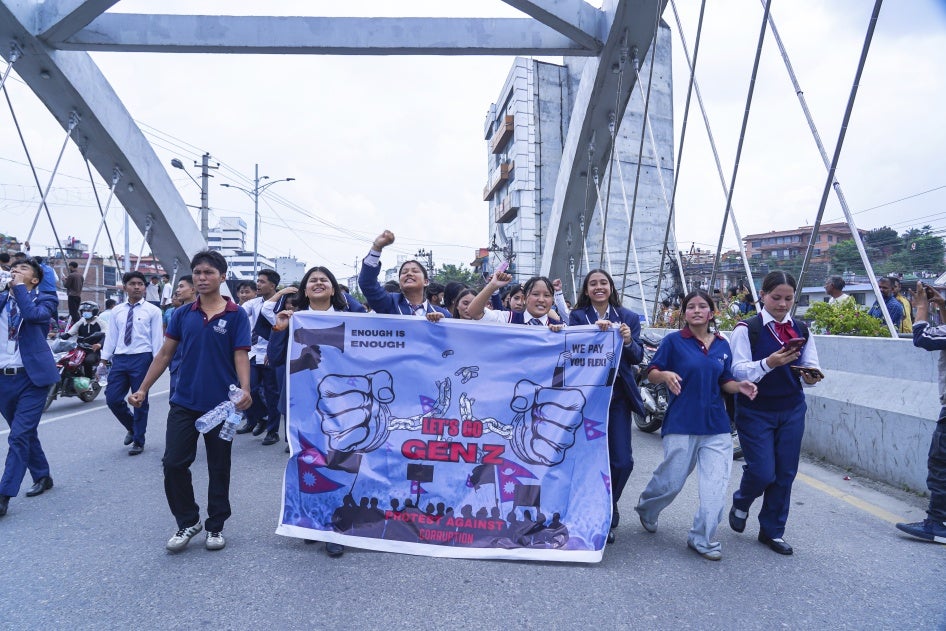
In Nepal, 76 people were killed in September in protests sparked by a ban on social media and anger over nepotism and political corruption. The prime minister resigned and was replaced by a caretaker government selected by “Gen Z” protesters. Now disappointed protesters are back, because they believe nothing has changed. The same old corrupt leaders, they say, will run for office again in upcoming elections.
In Sri Lanka, Anura Kumara Dissanayake became president with a huge majority, in the first elections after protests overthrew the authoritarian government of Gotabaya Rajapaksa in 2022. Dissanayake promised to end corruption, protect freedom of expression, and promote accountability, including for widespread abuses linked to the 1983-2009 civil war.
Instead, as the United Nations human rights office reported, the Dissanayake government has continued to deploy a draconian counterterrorism law that is typically used to target minority Tamil and Muslim communities. Torture in custody continued, as did surveillance, intimidation, harassment and suppression of families of the disappeared, civil society and human rights activists.
In India, after two terms in office, the BJP still pursues toxic Hindu majoritarianism to win votes. BJP leaders engage in hate speech during election campaigns, and after mobilising hostilities, they are unable, or unwilling, to rein in their supporters when they beat Muslims to death, jeer at Christians, or abuse Sikhs and Dalits. When protests break out, the authorities use a range of abusive laws, including terrorism allegations, to jail people, and demolish private properties in violation of Supreme Court orders.
Political leaders should recognise that hatred, failure to provide justice without bias, or suspending human rights, will only generate more abuse and eventually could even lead to public rage that could result in an abusive political leader’s desperate flight abroad to escape a popular uprising.
They should instead try working toward equality, generating employment, delivering health care, providing quality education, and otherwise ensuring that the population’s rights are protected. In the end, real improvements in people’s lives – not manipulation and division for political gain – is a meaningful measure of success.