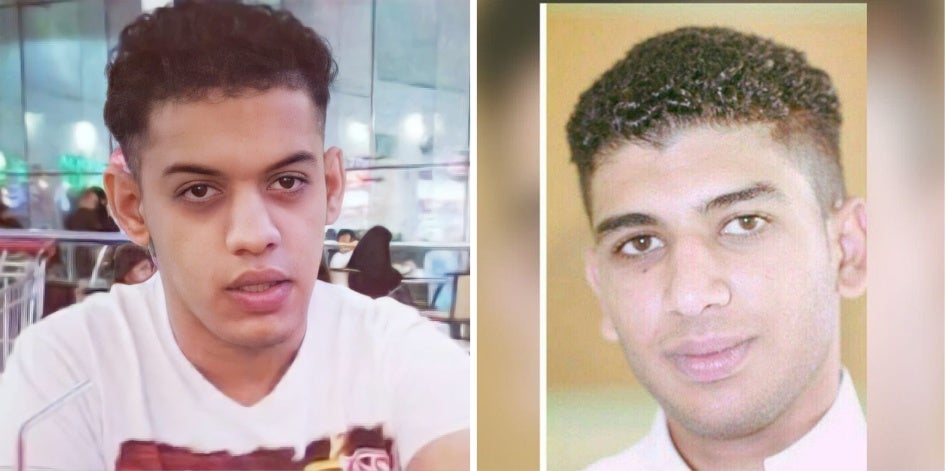
The undersigned organizations are deeply concerned by an alarming escalation in executions in Saudi Arabia, in which authorities implemented in the past weeks the execution of Abdullah al-Derazi, who was a child at the time of his alleged crimes, and two Egyptian nationals, Mohamed Saad and Omar Sherif, who were sentenced to death for non-lethal drug offenses. Abdullah al-Derazi’s execution on October 20, 2025, marked the 300th execution carried out in Saudi Arabia this year. This ongoing execution spree puts the Kingdom on track to surpass last year’s record of 345, which would make 2025 the deadliest year on record for executions in the country.[1] The following morning, on October 21, 2025, Mohamed Saad and Omar Sherif were executed in Tabouk.
The executions of Abdullah al-Derazi, Mohamed Saad, and Omar Sherif highlight the indiscriminate nature of Saudi Arabia’s current wave of executions, which has targeted children accused of offenses and individuals convicted of non-lethal drug offenses. None of the victims’ families were notified in advance or given the chance to say goodbye, according to Reprieve, in contravention of Saudi Arabia’s obligations under international law,[2] and most learned of the executions through social media.
Abdullah al-Derazi was arrested at the age of 18 for allegedly attending protests when he was a child. He was subjected to prolonged incommunicado detention, solitary confinement, and severe physical and psychological torture that left him hospitalized and in a coma.[3] He was forced to sign a false confession and was ultimately sentenced to death following a grossly unfair trial. Abdullah was targeted for his alleged participation in protests against the government’s treatment of the Shia minority which he belonged to. For these reasons, the Working Group on Arbitrary Detention deemed his detention arbitrary and in violation of international human rights law in Opinion No. 71/2024.[4]
UN experts, including the Special Rapporteur on extrajudicial, summary or arbitrary executions (SUMEX), have also repeatedly raised Abdullah’s case and those of other child defendants. In September 2025, SUMEX and other UN experts issued a statement urging Saudi Arabia to halt such executions,[5] reiterating their 2024 Urgent Appeal that the killing of child defendants constitutes an arbitrary deprivation of life.[6]
In 2020 Saudi authorities announced a Royal Decree which purported to abolish the death penalty for children accused of offenses.[7] Mustafa al-Darwish was executed the following year, for offenses he was accused of committing at age 17,[8] but from July 2021 to July 2025, Saudi Arabia did not execute anyone for crimes committed as children. Jalal al-Labbad’s execution in August 2025, for alleged crimes including attending demonstrations at age 15, was a frightening escalation, showing that Saudi authorities are again reneging on their claim to have stopped executing children accused of offenses. Abdullah al-Derazi’s execution confirms this.
In 2024, during its Universal Periodic review, Saudi Arabia supported only one recommendation on the issue of the death penalty, namely to “abolish the death penalty or at the very least limit it to the most serious crimes while applying a narrow definition of terrorism and abolishing it for all juvenile offenders” (43.109).
The executions of Mohamed Saad and Omar Sherif, both Egyptian nationals, took place despite UN experts having issued urgent appeals in December 2024[9] and June 2025[10] calling for a moratorium on the executions of drug-related defendants in Saudi Arabia, warning that such killings violate international human rights law and do not reach the threshold of “most serious crimes” warranting capital punishment. The men’s families were not notified in advance, and their bodies have not been returned, according to Reprieve. These executions once again expose claims from the Crown Prince about limiting the use of capital punishment to offenses involving intentional killing.[11]
These executions also mark a complete reversal of the previously announced moratorium on capital punishment for drug offenses, which was in effect for 33 months between February 2020 and November 2022. This year, the majority of executions have been carried out for drug-related crimes, disproportionately affecting foreign nationals from countries such as Somalia, Ethiopia, Pakistan, and Egypt.
The undersigned organizations are gravely concerned for others at imminent risk of execution including Youssef al-Manasif, who was a child at the time of his alleged crimes, and Egyptian national Issam al-Shazly, who remains on death row for non-lethal drug offenses, along with many others.
We urge the Government of Saudi Arabia to:
- Immediately halt all executions and impose a moratorium on the death penalty, with a view of abolishing the death penalty for all crimes.
- Deliver on its commitments to end the use of the death penalty for child defendants and those convicted of non-lethal offenses, pending full abolition of the death penalty.
- Return the bodies of those executed to their families and ensure full transparency in the publication of execution data and allow independent monitoring of death row conditions.
We call on all abolitionist governments to:
- Publicly condemn these executions and urge Saudi Arabia to halt further killings.
- Press Saudi authorities to uphold their stated commitments on child and drug-related cases pending full abolition.
- Review any justice cooperation or assistance that risks enabling executions.
Signatories
- Reprieve
- European Saudi Organisation for Human Rights (ESOHR)
- ALQST for Human Rights
- MENA Rights Group
- Egyptian Front for Human Rights (EFHR)
- Child Rights International Network (CRIN)
- Cornell Center on the Death Penalty Worldwide (CCDPW)
- World Coalition Against the Death Penalty
- Malaysians Against Death Penalty and Torture(MADPET)
- Coalition of Somali Human Rights Defenders (CSHRD)
- Lembaga Bantuan Hukum Masyarakat (LBHM)
- Capital Punishment Justice Project (CPJP)
- Center for Legal Support and Inmates’ Rehabilitation (CELSIR)
- ACAT Germany (Action by Christians for the Abolition of Torture)
- International Bar Association’s Human Rights Institute
- ACAT Belgium
- Iran Human Rights (IHRNGO)
- German Coalition to Abolish the Death Penalty (GCADP)
- ECPM (Together against the death penalty)
- LDH (Ligue des droits de l’ Homme)
- SOHRAM-CASRA Centre Action Social Réhabilitation et Réadaptation
- The Inclusion Project Nigeria (TIP)
- Horn Afrik News Agency for Human Rights HANAHR
- African Academy of Diplomacy AAD
- Harm Reduction International
- The Advocates for Human Rights
- DITSHWANELO - The Botswana Centre for Human Rights
- Colegio de Abogados y Abogadas de Puerto Rico (Puerto Rico Bar)
- Legal Defence & Assistance Project (LEDAP-Nigeria)
- International Federation for Human Rights (FIDH)
- Lifespark Movement against the death penalty
- The Transitional Justice Working Group (TJWG)
- Hands off Cain
- The Federal Association of Vietnamese Refugees in the Federal Republic of Germany
- Death Penalty Focus
- Americans for Democracy and Human Rights in Bahrain ( ADHRB)
- Collectif Français Libérons Mumia
- Prisoners’ Future Foundation (PFF) Zambia
- Abdorrahman Boroumand Center for Human Rights in Iran (ABC)
- After Violence Project (USA)
- L'Organisation Contre la Torture en Tunisie
- La Coalition Tunisienna Contre la Peine de Mort
- Witness to Innocent
- Human Rights Watch
[1]Information held on file at Reprieve and ESOHR.
[2] Special Rapporteur on extrajudicial, summary or arbitrary execution, et al, Urgent appeal to Saudi Arabia, UA SAU 2/2024 , page 7,9, (13 June 2024), available at: https://spcommreports.ohchr.org/TMResultsBase/DownLoadPublicCommunicationFile?gId=29155.
[3] European Saudi Organisation for Human Rights, MENA Rights Group: Saudi Arabia continues to threaten the lives of minors, disregarding the UN Working Group on Arbitrary Detention’s recent Opinion, 4 February 2025, https://www.esohr.org/en/%d9%85%d9%8a%d9%86%d8%a7-%d9%88%d8%a7%d9%84%d8%a3%d9%88%d8%b1%d9%88%d8%a8%d9%8a%d8%a9-%d8%a7%d9%84%d8%b3%d8%b9%d9%88%d8%af%d9%8a%d8%a9-%d8%a7%d8%b3%d8%aa%d9%85%d8%b1%d8%a7%d8%b1-%d8%aa%d9%87%d8%af/.
[4] UN OHCHR, Press Releases, Special Procedures, Saudi Arabia must halt executions of persons convicted for offences committed as minors: UN experts (5 September 2025), available at: https://www.ohchr.org/en/press-releases/2025/09/saudi-arabia-must-halt-executions-personsconvicted-offences-committed.
[5] Special Rapporteur on extrajudicial, summary or arbitrary execution, et al, Urgent appeal to Saudi Arabia, UA SAU 2/2024 , page 7,9, (13 June 2024), available at: https://spcommreports.ohchr.org/TMResultsBase/DownLoadPublicCommunicationFile?gId=29155.
[6] United Nations Working Group on Arbitrary Detention, Opinion A/HRC/WGAD/2024/71 concerning Abdullah al-Derazi, Jalal al-Labbad, Yusuf Muhammad Mahdi al-Manasif, Jawad Abdullah Qureiris and Hassan Zaki al-Faraj (18 December 2024), available at: https://www.ohchr.org/sites/default/files/documents/issues/detention-wg/opinions/session101/a-hrcwgad-2024-71-saudi-arabia-advance-edited.pdf.
[7] Saudi authorities have stated on several occasions, including in April 2022 and January 2024 during their Universal Periodic Review, that the 2020 Royal Decree means children are protected from the death penalty. See: United Nations Web TV, Saudi Arabia Review - 45th Session of Universal Periodic Review (22 January 2024), available at: https://webtv.un.org/en/asset/k1q/k1q9kupguv.
[8] BBC, Mustafa al-Darwish: Saudi man executed for crimes committed as a minor, 15 June 2021. https://www.bbc.co.uk/news/world-middle-east-57492219.
[9] Special Rapporteur on extrajudicial, summary or arbitrary executions and the Special Rapporteur on torture and other cruel, inhuman or degrading treatment or punishment, UA SAU 5/2024, 3 December 2024. Available at: https://spcommreports.ohchr.org/TMResultsBase/DownLoadPublicCommunicationFile?gId=29550.
[10] Office of the United Nations High Commissioner on Human Rights, UN expert urges Saudi Arabia to halt imminent execution of 26 Egyptian nationals for drug-related offences, 10 June 2025. Available at: https://www.ohchr.org/en/press-releases/2025/06/un-expert-urges-saudi-arabia-halt-imminentexecution-26-egyptian-nationals.
[11] Crown Prince Mohammed bin Salman publicly stated on several occasions that the death penalty in Saudi Arabia is restricted to crimes involving intentional killing. See: Time Magazine, Crown Prince Mohammed Bin Salman Talks to Time About Saudi Arabia, The Middle East and President Trump, 5 April 2018, available at https://time.com/5228006/mohammed-bin-salman-interview-transcript-full/; Saudi Gazette, Full transcript of Crown Prince interview on reforms, religious, future of Saudi Arabia and relations with US, 3 March 2022, https://saudigazette.com.sa/article/617738; and this claim was repeated in July 2024 when Saudi Arabia told the UN Human Rights Council (HRC) that the death penalty “can only be applied to the most serious crimes”: United Nations Web TV, ‘26th Meeting - 56th Regular Session of Human Rights Council’ (4 July 2024), minute 52:15, available at: https://webtv.un.org/en/asset/k1t/k1tt6njldu.