Thank you.
I am pleased to deliver this joint statement on behalf of 35 civil society organizations.
The civilian deaths and devastation caused by the firebombings of Dresden and Tokyo 80 years ago shocked the world. While it was not the first time incendiary weapons were used, the massive scale of the attacks fully demonstrated the horror of these weapons. The conflagrations immediately killed at least 125,000 people in the two cities, left civilian structures and major cultural landmarks in Dresden in ruins, and wiped out whole neighborhoods of wooden homes in Tokyo.
Due to the outrage these attacks caused and developments in international humanitarian law, particularly Protocol III to the 1980 Convention on Conventional Weapons (CCW), such large-scale strikes with incendiary weapons have not occurred in recent years. These developments underscore the potential power of law and stigma.
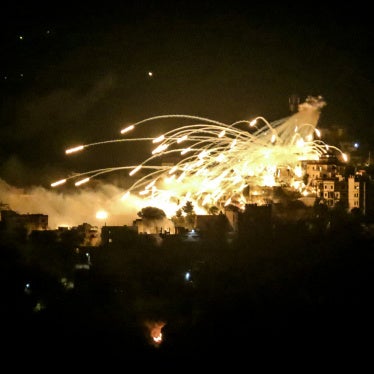
Protocol III, however, has not adequately addressed the humanitarian consequences of incendiary weapons, the use of which has been documented in several recent conflicts. The weapons cause excruciating burns, severe scarring, long-term pain, lifelong psychological harm, socioeconomic exclusion, and damage to the environment. It’s clear that stronger international action is needed.
Human Rights Watch research has found, for example, that South Sudan’s air force killed at least 58 people with improvised incendiary weapons in the Upper Nile state in March 2025. Villages went up in flames, destroying dozens of homes, shops, and other civilian structures. Medical personnel had limited resources to treat the injured.
Human Rights Watch also documented Russia’s use of quadcopter drones to deliver incendiary weapons onto civilians and civilian objects in Kherson, Ukraine in 2024. One attack destroyed two ambulances at an oncology center.
Protocol III has fallen short due to loopholes in its definition, which excludes multipurpose munitions, notably those containing white phosphorus, and its regulations, which are weaker for ground-launched incendiary weapons than for air-dropped ones.
The CCW Meeting of High Contracting Parties has also failed as a forum for change because its consensus decision-making process has created a roadblock to progress. Despite widespread support among states for discussing the impacts of incendiary weapons and possible solutions, Protocol III has not been formally reviewed or amended since its adoption 45 years ago.
Therefore, states need to consider other forums, including the First Committee, in which to take up the issue. We urge states at this meeting to:
- Raise awareness of the human cost of incendiary weapons and the need to improve international protections for civilians.
- Call for and convene dedicated discussions of the humanitarian consequences of the use of these weapons and the inadequacy of existing international law.
- Work to create stronger standards to close loopholes in international law and further stigmatize the use of incendiary weapons. A complete ban on incendiary weapons would have the greatest humanitarian benefits.
For more information, see the new publication, “Incendiary Weapons: Need for Stronger Law and a New Forum,” co-published by Human Rights Watch and Harvard Law School’s International Human Rights Clinic.
Thank you.
The following organizations have signed on to this statement:
- Action on Armed Violence
- Amnesty International
- Aotearoa New Zealand Campaign on Military Spending
- Aotearoa New Zealand Joint Working Group on Landmines and Cluster Munitions
- Aotearoa New Zealand National WPS NGO Network
- Article 36
- Asser Institute for International and European Law
- Campaign Against Arms Trade
- Campaña Colombiana Contra Minas
- Center for International Policy
- Centro de Estudios Ecuménicos México
- DAWN
- Disability Rights and Disarmament Initiative
- Explosive Weapons Trauma Care Collective (EXTRACCT)
- Human Rights Watch
- Humanity and Inclusion
- International Campaign to Ban Landmines-Cluster Munition Coalition
- International Peace Research Association
- Legacies of War
- Mines Action Canada
- National Network on the Use of Explosive Weapons (Aotearoa New Zealand)
- Nonviolence International
- Norwegian People's Aid
- Nuclear Age Peace Foundation
- PAX
- Peace Movement Aotearoa
- Perú por el Desarme
- Rete Italiana Pace e Disarmo (Italian Peace and Disarmament Network)
- Seguridad Humana para América Latina y el Caribe (SEHLAC)
- Scientists for Global Responsibility (SGR)
- Shadow World Investigations
- The Conflict and Environment Observatory
- Vision GRAM-International
- Women for Peace and Democracy Nepal
- Women's International League for Peace and Freedom (WILPF)