El Salvador lawmakers’ July 31 approval of a constitutional amendment ending presidential term limits was the latest action in a years-long process to dismantle the rule of law.
The international community—paying deference to President Nayib Bukele’s high approval ratings, hardline security policies, and geopolitical interests—has, for the most part, remained silent.
The European Union has been an exception, increasingly raising concerns about El Salvador’s deteriorating situation. But the U.S. government under President Donald Trump has been a vocal ally and happy to collude with Bukele’s dismissing of democratic standards, including deporting more than 250 Venezuelans and 20 Salvadorans to an El Salvador prison, despite credible evidence of torture and other abuses in the country’s prisons.
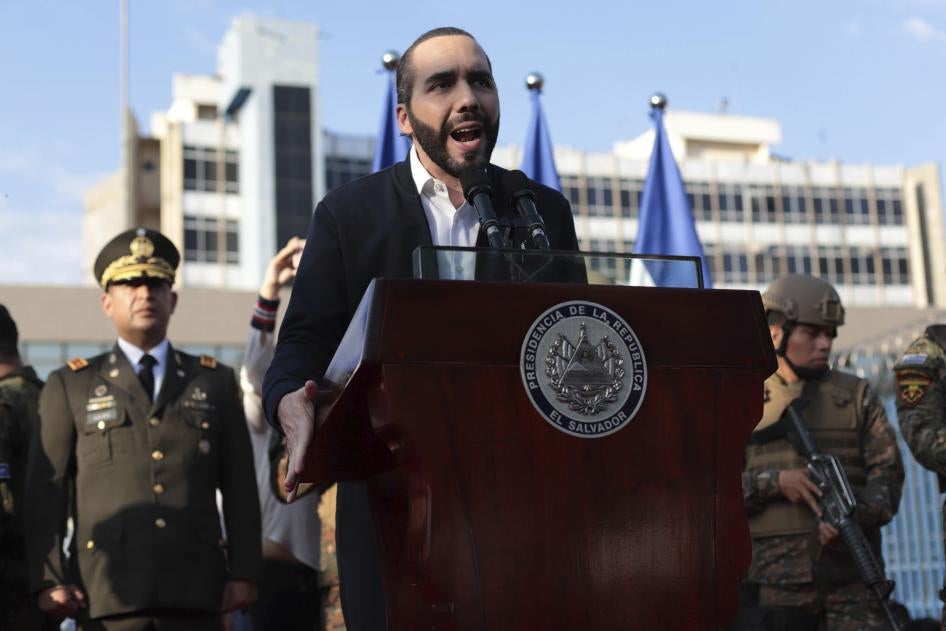
Warnings of Bukele’s turn to autocratic rule came as early as eight months into his presidency. On February 9, 2020, Bukele entered El Salvador’s Legislative Assembly flanked by armed soldiers, demanding approval of a loan to fund his security plan. After a theatrical prayer in the Assembly’s chamber, he said God had asked him to be patient—and gave legislators one week to approve the funds.
That intimidation of lawmakers was an important sign. But the international response was, for the most part, tepid.
What followed has been the erosion of democratic institutions.
First, Bukele challenged the power of other branches of government. Bukele disregarded the Supreme Court’s rulings relating to the COVID-19 pandemic.
In 2021, when Bukele’s party gained a two-thirds majority in the Assembly, lawmakers removed and replaced all five Constitutional Chamber magistrates and the attorney general, who was investigating government officials for corruption and negotiations with gangs. They later passed laws that enabled the removal of lower-level judges and prosecutors.
In 2021, the new Constitutional Chamber ruled that Bukele could seek reelection for an additional term in 2024, despite a constitutional prohibition on immediate reelection. In March 2022, after a wave of murders by gangs, the Legislative Assembly authorized a sweeping state of emergency, paving the way for mass arrests under the government’s “war on gangs.”
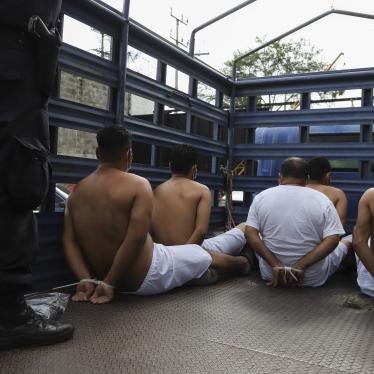
Bukele’s anti-gang campaign has yielded tangible results—homicide rates have dropped dramatically—but it has come at a steep cost. Roughly 2 percent of the country’s population has been detained. Human Rights Watch and other rights groups have documented arbitrary arrests based on fabricated or uncorroborated evidence, enforced disappearances, deaths in custody, and torture and ill-treatment in detention, including against children.
Dismantling checks on Bukele’s power has also allowed him to go after his critics. In May, Salvadoran authorities arrested Ruth López, a human rights lawyer with the prominent rights organization Cristosal, and Enrique Anaya, a constitutional lawyer and critic of the government. Both cases remain under seal.
The crackdown may only be starting in earnest. The Assembly passed a Foreign Agents Law, granting the government sweeping powers to restrict the work of civil society organizations and independent media that receive international funding. Over 100 journalists, lawyers, and activists have fled.
The recent amendment to El Salvador’s Constitution was made possible due to an earlier one, passed in January 2025, that allows lawmakers to amend the constitution in a single legislature.
Previously, any constitutional change required approval by one Assembly and ratification by the next, after a new term began. The change allowed Bukele’s lawmakers to approve the amendment at 8 p.m. and “ratify” it in a separate legislative session two hours later.
The reelection prohibition was long considered a cornerstone of the Salvadoran constitution, a “stone clause” that could not be changed. The Inter-American Court of Human Rights, the region’s highest rights court, has ruled that indefinite reelection, or an absence of term limits, runs counter to regional human rights obligations. Yet the Assembly under Bukele stripped this prohibition from Salvadoran constitutional law in a matter of hours.
The Organization of American States (OAS) has both the mandate and a responsibility to act. But the OAS Permanent Council has abdicated its responsibility to discuss the situation in El Salvador.
The recent constitutional amendment should be a wake-up call for the International Monetary Fund (IMF) too. In February, it reached a $1.4 billion agreement with Bukele’s government. The IMF has identified concerns over judicial independence as a factor in the country’s speculative-grade credit rating and as a barrier to foreign investment and issued recommendations related to judicial transfers and tenure.
However, an IMF review published in July found these reforms were “not implemented.” Similarly, conditions for the agreement relating to transparency and governance, including key anti-corruption measures, were also not met.
The IMF should strengthen loan measures related to judicial independence and ensure the government meets them.
For years, observers have warned that the so-called Bukele-model against organized crime included dismantling institutional checks and concentrating power indefinitely. The strategy is playing out in plain sight. The question is no longer whether foreign governments were warned. The question is whether they will act to prevent a new dictatorship in the Western Hemisphere.
..
Juanita Goebertus is the Americas director at Human Rights Watch.