Dear Foreign Minister Wong,
We write following the ministerial segment of the United Nations (UN) High-Level Conference on the Two-State Solution and Peace in the Middle East, co-hosted by France and Saudi Arabia, and in advance of the second segment to include heads of state and government before the UN General Assembly’s annual gathering of world leaders in September.
As your government considers next steps on recognizing the State of Palestine, we would like to both acknowledge the efforts made by your government to address Israel’s violations in the West Bank and Gaza, including sanctions on two Israeli ministers and on a number of violent settlers; and call on your government to take further concrete measures without delay.
The High-Level Conference and subsequent meeting represent a critical opportunity to move beyond repeated affirmations of support for human rights and international law, and toward concrete, time-bound measures to ensure their enforcement, and to end decades of impunity for egregious violations in Israel and the Occupied Palestinian Territory.
This Conference grew out of the landmark July 2024 advisory opinion by the International Court of Justice (ICJ) on Israel’s occupation of the Palestinian Territory. Based on applicable international law, the ruling found Israel’s decades-long occupation to be unlawful and in breach of the Palestinians’ right to self-determination. The Court found that Israel is responsible for apartheid and other serious abuses against the Palestinians, that its settlements are illegal and should be dismantled, and that the Palestinians are entitled to reparations.
The Court set out numerous obligations on third states to ensure the implementation of its findings, including that they should not recognize any changes in the physical character or demographic composition of the Occupied Palestinian Territory, and should take steps to prevent trade or investment relations that assist in the maintenance of the illegal situation created by Israel in the Occupied Palestinian Territory. It concluded, as it has previously, that all states parties to the Fourth Geneva Convention have the obligation to ensure compliance by Israel with international humanitarian law (IHL).
Regrettably, Australia is yet to comply with those obligations. While Australia has repeatedly denounced the Israeli settlements as illegal, linked to serious abuses, Australia continues to trade and allow business with them.
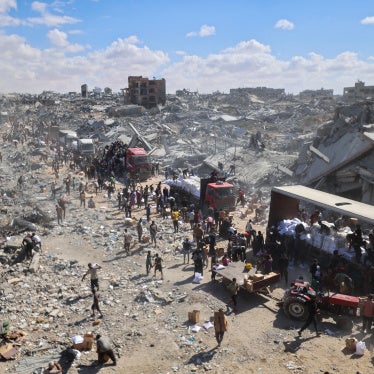
The decision about recognition also takes place in the context of hostilities in occupied Gaza marred by very serious, widespread breaches of international humanitarian law, including Israel’s use of starvation as a weapon of war, which is a war crime, crimes against humanity, including extermination, forced displacement, apartheid and persecution, and acts of genocide. These crimes have been perpetrated also in violation of three binding rulings of the International Court of Justice, in a case brought by South Africa claiming Israel’s violation of the UN Genocide Convention. The International Criminal Court (ICC) has issued arrest warrants for Israel’s prime minister and former defense minister, and a Hamas official (subsequently withdrawn by the court following his death) on charges of war crimes and crimes against humanity.
As parties to the UN Genocide Convention, Australia has an obligation to “employ all tools reasonably at their disposal” to prevent a genocide. That obligation is triggered not by a definitive determination that a genocide is occurring or has occurred, but at the time that a state learns, or should normally have learned, of a serious risk that genocide will be committed.
That threshold has long been crossed in the context of Israel’s assault on Gaza, given its systematic destruction of homes, apartment buildings, orchards and fields, schools, hospitals, and water and sanitation facilities, as well as the use of starvation as a weapon of war. The ICJ’s issuance of provisional measures in the genocide case, which Israel has ignored, also serve to make the serious risk of genocide undeniable. The UN High Commissioner for Human Rights and UN human rights experts have also alerted states to the risk or occurrence of genocide in Gaza. On May 7, the High Commissioner said he was concerned "that Israel’s actions are aimed at inflicting on Palestinians conditions of life increasingly incompatible with their continued existence in Gaza as a group.” Furthermore, this week, leading Israeli human rights groups have classified the Israeli governments abuses in Gaza as genocide.
Targeted sanctions have only been imposed on a few Israeli settlers and entities in the West Bank, and two Israeli ministers. No sanctions have been placed on any state officials implicated in the ongoing atrocities in Gaza. Any decision on recognition while announcing no concrete measures would only perpetuate the impunity that has emboldened decades of serious violations – and would do nothing to halt them.
Australia should also address abuses by the Palestinian Authority, which has long arbitrarily arrested critics and opponents and taunted, mistreated, beaten, and tortured detainees with impunity, as Human Rights Watch has extensively documented. It has escalated its repression of dissent in recent months. States should press Palestinian groups in Gaza to secure the release of the remaining civilians held hostage and on Israeli authorities to end the arbitrary detention of thousands of Palestinians, and the torture and ill-treatment of detainees.
For all these reasons, we urge your government to:
- Unequivocally denounce and attribute ongoing and longstanding serious violations of human rights and international humanitarian law, including Israeli authorities’ crimes of apartheid and persecution against Palestinians, and commit to put an end to the impunity that fuels them;
- Announce concrete steps to ensure the full implementation of the obligations laid out in the July 2024 Advisory Opinion by the International Court of Justice, in particular:
- Fully ban all trade and business with Israel’s illegal settlements in compliance with article 278 of the ICJ ruling;
- Suspend political, economic, and trade deals with Israel;
- Support and make use of the UN database on businesses operating in Israel’s illegal settlements in the West Bank, taking all appropriate measures to end businesses’ complicity in Israel’s illegal settlement enterprise;
- Adopt targeted sanctions against further Israeli officials currently responsible for atrocities in Gaza, Israel’s illegal settlement policy and apartheid;
- Support the establishment of an international mechanism for reparations and an international register of damage;
- Suspend any arms transfers and military support to Israel, given the high risk of complicity in very serious IHL violations and also in consideration of the obligations to prevent genocide;
- Cut security assistance to abusive Palestinian Authority security forces, including the Intelligence Services, Preventative Security, the Joint Security Committee, and the police;
- Express unequivocal support for the International Criminal Court, denounce all attacks against its independence and critical mandate, and commit to taking all necessary measures to protect the court and those cooperating with it, and to respect obligations to the ICC, including in carrying out all ICC arrest warrants, without exception.
We look forward to a prompt reply, and hope that your government will swiftly take the measures necessary to comply with international law and to end complicity in abuses.
Bruno Stagno Ugarte
Chief Advocacy Officer
Human Rights Watch
Daniela Gavshon
Australia Director
Human Rights Watch