How Kazakhstan’s Financing Terrorism List Compounds Human Rights Harms
The 29-page report, “Politically Targeted, Economically Isolated: How Kazakhstan’s Financing Terrorism List Compounds Human Rights Harms,” documents that people on Kazakhstan’s Financing Terrorism List face financial restrictions that cause them significant hardship. The restrictions lead to violations of rights guaranteed by the International Covenant on Economic, Social, and Cultural Rights (ICESCR) to which Kazakhstan is a state party, including the rights to an adequate standard of living and access to work and social security benefits. This is particularly egregious when the prosecutions are for alleged nonviolent “extremist” or “terrorist” crimes, that should not be considered crimes in the first place.
The U.N. Security Council's Approach to Human Rights Violations in the Global Anti-Terrorism Effort
This 17-page briefing paper documents how countries as diverse as Egypt, Uzbekistan, Malaysia, Morocco and Sweden—have violated human rights in their efforts to combat terrorism. These are the very kinds of violations that the U.N. Counter-Terrorism Committee should pay closer attention to.
Indefinite Detention Without Trial in the United Kingdom Under Part 4 of the Anti-Terrorism, Crime and Security Act 2001
The U.K. government introduced emergency legislation in the wake of the September 11 attacks in the U.S. The resulting Anti-Terrorism Crime and Security Act became law on December 14, 2001. This briefing paper details how indefinite detention, contained in part 4 of ATCSA, has seriously damaged the mental and physical health of the detainees.
This 38-page report examines how the Bush administration adopted a deliberate policy of permitting illegal interrogation techniques – and then spent two years covering up or ignoring reports of torture and other abuse by U.S. troops.
Detainees held by the United States in Iraq, Afghanistan, and elsewhere have been subjected to sleep and sensory deprivation, held in painful stress positions, forced to stand for long periods of time, interrogated while nude, and otherwise mistreated.
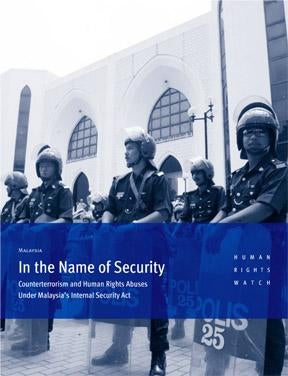
Counterterrorism and Human Rights Abuses Under Malaysia’s Internal Security Act
This 60-page report documents a pattern of serious abuses against detainees, including beatings, burning with lit cigarettes, and psychological abuse. In addition to suffering from various forms of physical and psychological abuse, detainees held under the Internal Security Act (ISA) have been denied basic due process rights.
Court Should Reaffirm Absolute Prohibition against Returning People to Torture in Uzbekistan
Human Rights Watch, in cooperation with the Association for Inidvidual Rights in Europe (AIRE), was granted leave to intervene in the controversial case of Mamatkulov and Askarov v. Turkey before the European Court of Human Rights.
Since January 11, 2002, the U.S. government has sent more over 700 people picked up from around the world to Guantanamo. As the detention camp begins its third year, the public still does not know who the detainees are, what they have allegedly done, and whether and when they will be charged with crimes or released.
Russia’s forces are committing abuses against displaced Chechens in Ingushetia as the conflict in Chechnya spills over into this neighboring republic. This 28-page report documents arbitrary arrest and detention, ill-treatment, and looting by Russia’s forces in Ingushetia this summer.
The U.S. government is moving closer to convening the military commissions authorized by President Bush in November 2001 to try suspected terrorists. Despite President Bush's oft-repeated insistence that the war on terror is a war to affirm and protect basic human rights, the rules for the proposed commissions fall far short of international due process standards.
A Human Rights Watch Briefing Paper for the 59th Session of the United Nations Commission on Human Rights
This paper first surveys initiatives taken by U.N., regional, and other intergovernmental bodies in the context of the international campaign against terrorism.
There is growing concern in the United States, and a growing belief around the world, that the United States itself has engaged in torture or condoned its use by others as part of its war against terrorism. Newspapers such as the New York Times and the Washington Post have published credible reports, based on interviews with former detainees and unnamed U.S. officials, alleging that U.S.
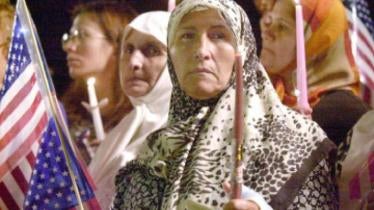
Hate Crimes Against Arabs, Muslims,and Those Perceived to be Arab or Muslim after September 11
Public officials tried vigorously to contain a wave of hate crimes in the United States after September 11, Human Rights Watch said in a report released today. Nevertheless, anti-Muslim hate crimes in the United States rose 1700 percent during 2001. The report documents anti-Arab and anti-Muslim violence and the local, state and federal response to it.