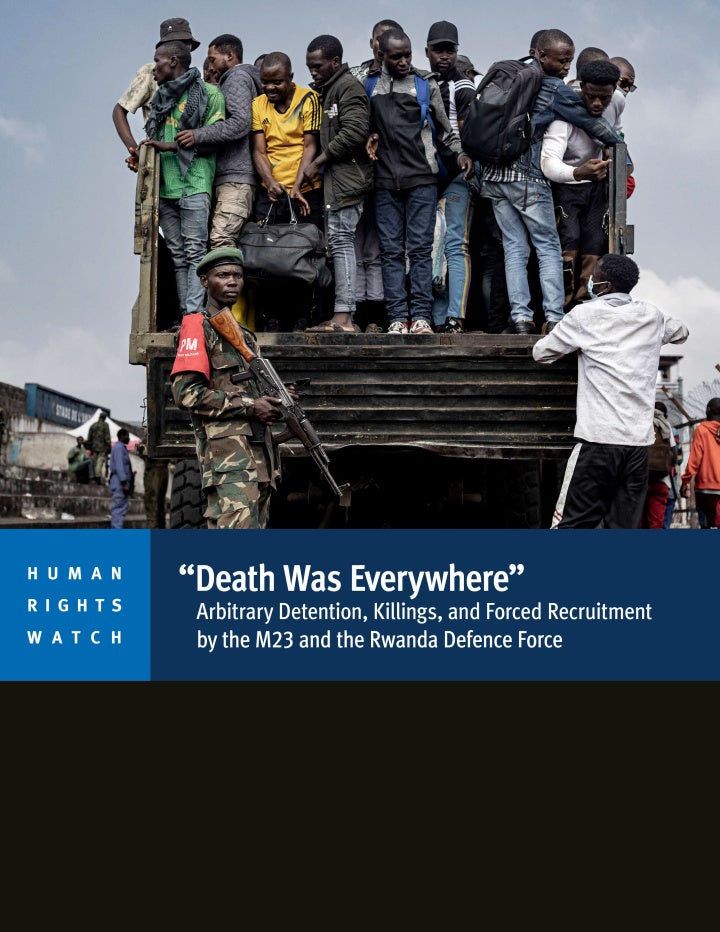
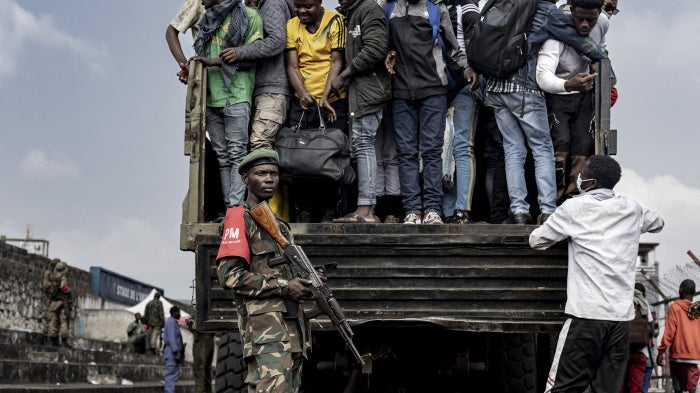
Arbitrary Detention, Killings, and Forced Recruitment by the M23 and the Rwanda Defence Force
The 78-page report, “‘Death Was Everywhere’: Arbitrary Detention, Killings, and Forced Recruitment by the M23 and the Rwanda Defence Force,” documents large-scale roundups and arrests in North and South Kivu provinces in eastern Congo, as well as grave abuses against detainees at the Rumangabo and Tshanzu training camps in North Kivu, between mid-2024 and December 2025. M23 fighters, backed by Rwandan military personnel, have committed murder, torture, corporal punishment, and used forced labor and child soldiers, researchers found. These abuses are war crimes and should be investigated as possible crimes against humanity.
On November 7, the Supreme Court agreed to review the case of Salim Ahmed Hamdan, who is challenging the lawfulness of the U.S. government trying him for alleged war crimes before a military commission at Guantánamo Bay. The Court is expected to render a decision in the case of Hamdan v. Rumsfeld in late June, 2006.
Findings of the Detainee Abuse and Accountability Project
This 27-page report presents findings of the Detainee Abuse and Accountability Project, a joint project of New York University’s Center for Human Rights and Global Justice, Human Rights Watch and Human Rights First. The project is the first comprehensive accounting of credible allegations of torture and abuse in U.S. custody in Iraq, Afghanistan and Guantánamo.
Will It Keep Evidence Obtained through Torture or Cruel Treatment out of Commission Trials?
On March 24, 2006, the General Counsel of the Department of Defense issued Military Commission Instruction No. 10, “Certain Evidentiary Requirements,” in response to growing public concern that evidence acquired through torture might be admissible in military commission proceedings.
Human Rights Watch has released a list of persons believed to be in U.S. custody as “ghost detainees” -- detainees who are not given any legal rights or access to counsel, and who are likely not reported to or seen by the International Committee of the Red Cross.
Techniques described in the November 18 ABC News report—prolonged forced standing, sleep deprivation, and exposure to cold—are illegal and may possibly amount to torture. These techniques were used by Soviet and North Korean interrogators, and have been reported more recently in Egypt, Burma, Iran and Turkey.
Firsthand Accounts of Torture of Iraqi Detainees by the U.S. Army's 82nd Airborne Division
This report provides soldiers' accounts of abuses against detainees committed by troops of the 82nd Airborne stationed at Forward Operating Base Mercury (FOB Mercury), near Fallujah.
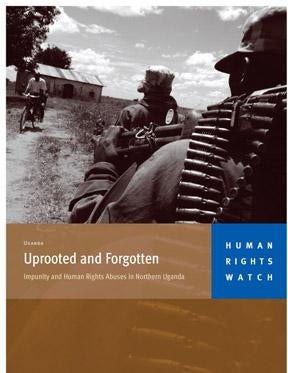
Impunity and Human Rights Abuses in Northern Uganda
This 76-page report documents how the ongoing lack of accountability and civilian protection in the north has fueled atrocities by both sides. In each of the displaced persons camps visited, Human Rights Watch found cases of abuse by Ugandan government forces as well as rebel combatants.
Human Rights Watch Report to the Commission of Inquiry on Maher Arar
On June 7, Julia Hall, Senior Researcher for Human Rights Watch, testfied before a Canadian Commission of Inquiry that is investigating the transfer of Maher Arar to Syria, where he alleges he was brutally tortured. Arar, a Canadian citizen, was transferred by U.S. authorities to Jordan with the understanding he would be turned over to Syria.
Human Rights Watch and Foundation for Human Rights Initiative submission to the U.N. Committee against Torture
Uganda ratified the Convention against Torture and Other Cruel, Inhuman or Degrading Treatment and Punishment in 1986. As the U.N. Committee against Torture scrutinizes Uganda’s compliance with the Convention, Human Rights Watch and the Foundation for Human Rights Initiative (FHRI) raised their concerns.
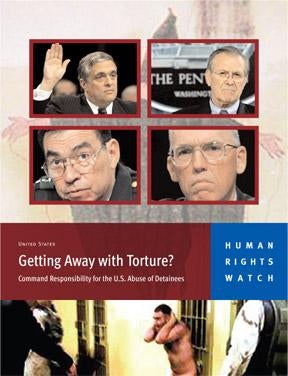
Command Responsibility for the U.S. Abuse of Detainees
This 95-page report, issued on the eve of the first anniversary of the publication of the Abu Ghraib photos, presents substantial evidence warranting criminal investigations of Rumsfeld and Tenet, as well as Lt. Gen. Ricardo Sanchez, formerly the top U.S. commander in Iraq, and Gen. Geoffrey Miller the former commander of the prison camp at Guantánamo Bay, Cuba.
Georgia has a long record of tolerating torture and ill-treatment by law enforcement agents. The new government that came to power after the November 2003 ‘Rose Revolution’ has taken some steps to address such abusive practices, but these efforts have proven inadequate to stem them.
Uzbekistan’s Implementation of the Recommendations of the Special Rapporteur on Torture
Three years ago, the government of Uzbekistan took the important step of issuing an invitation to the United Nations (U.N.) Special Rapporteur on torture and other cruel, inhuman degrading treatment or punishment, the first government of the five Central Asian states to do so.
Human Rights Watch’s key concerns on Turkey for 2005
At its December 16-17 summit in Brussels, the European Council is expected to decide whether or not to open negotiations for Turkey’s full membership of the European Union. The decision follows the October 2004 evaluation by the European Commission that “Turkey sufficiently fulfils the political criteria” and its recommendation that accession negotiations be opened.
The following is a compilation by Human Rights Watch of accounts by thirty-three former detainees at Guantanamo of their experiences there. Human Rights Watch interviewed sixteen of the detainees, reviewed press reports containing statements by former detainees interviewed by journalists, and used as well statements published by the detainees themselves.
In the aftermath of the September 11, 2001 attacks on the United States, the Bush administration has violated the most basic legal norms in its treatment of security detainees. Many have been held in offshore prisons, the most well known of which is at Guantánamo Bay, Cuba.