Bans on Gender-Affirming Care for Transgender Youth in the US
The 98-page report, “‘They’re Ruining People’s Lives’: Bans on Gender-Affirming Care for Transgender Youth in the US,” documents the devastating consequences of these bans for transgender youth, including increased anxiety, depression, and, in seven reported instances, suicide attempts. Human Rights Watch found that these laws contribute to an increasingly hostile, anti-trans climate, compelling youth to hide their identities and socially withdraw. The bans also destabilize health care systems and undermine civil society and create geographic and financial challenges in accessing care. The impact has intensified since early 2025, when the administration of President Donald Trump took a series of executive actions escalating federal attacks on transgender rights.
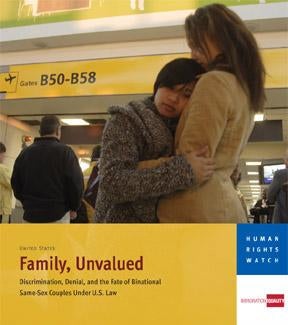
Discrimination, Denial, and the Fate of Binational Same-Sex Couples under U.S. Law
<table cellpadding="3" cellspacing="0"><tr><td><img src="http://hrw.org/images/home/2006/100/usdom13290.jpg" align="left" border="0" /></td> <td valign="top">This report documents how U.S immigration law and federal policy discriminate against binational same-sex couples.</td></tr></table>
HIV/AIDS is a preventable disease, yet approximately 5 million people were newly infected with HIV in 2003, the majority of them through sex. Many of these cases could have been avoided, but for state-imposed restrictions on proven and effective HIV prevention strategies, such as latex condoms.
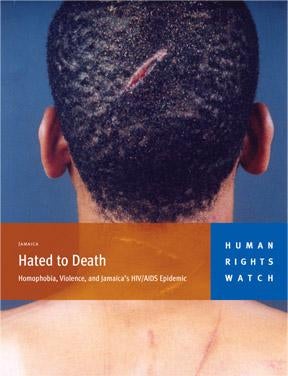
Homophobia, Violence, and Jamaica’s HIV/AIDS Epidemic
Jamaica’s growing HIV/AIDS epidemic is unfolding in the context of widespread violence and discrimination against people living with and at high risk of HIV/AIDS, especially men who have sex with men. Myths about HIV/AIDS persist.
The Assault on Justice in Egypt's Crackdown on Homosexual Conduct
This 144-page report documents the government’s increasing repression of men who have sex with men. The trial of 52 men in 2001 for the “habitual practice of debauchery”—the legal charge used to criminalize homosexual conduct in Egyptian law—was only the most visible point in the ongoing and expanding crackdown.
State-Sponsored Homophobia and its Consequences in Southern Africa
Many leaders in southern Africa have singled out lesbian, gay, bisexual and transgender people as scapegoats for their countries' problems, Human Rights Watch and the International Gay and Lesbian Human Rights Commission (IGLHRC) state in this report.
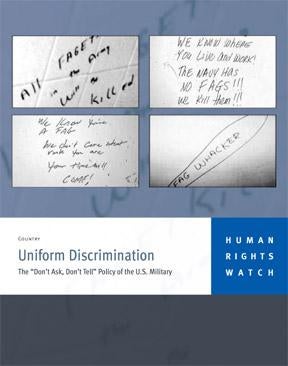
The “Don’t Ask, Don’t Tell” Policy of the U.S. Military
The U.S. military’s “Don’t Ask, Don’t Tell” policy of discharging gay and lesbian servicemembers who reveal their sexual orientation violates human rights and deprives the military of skilled personnel. Under “don’t ask, don’t tell,” any servicemember who acknowledges his or her homosexuality by word or deed is discharged.
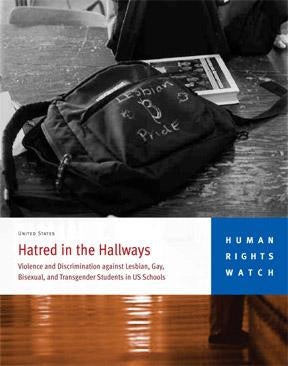
Violence and Discrimination Against Lesbian, Gay, Bisexual, and Transgender Students in U.S. Schools
In this report, Human Rights Watch documents attacks on the human rights of lesbian, gay, bisexual, and transgender youth who are subjected to abuse on a daily basis by their peers and in some cases by teachers and school administrators.
Today in Romania, gays and lesbians are routinely denied some of the most basic human rights guaranteed by international law. Despiteamendments in 1996 to the criminal code provisions relating to homosexual conduct, gays and lesbians continue to be arrested and convictedfor such relations if they become public knowledge.
A campaign to curb pornography has backfired dangerously in Canada, leading not toward its ostensible goal of gender equality, but to a weakening of fundamental liberties for women and gay men. The cornerstone of this campaign is R. v. Butler, an anti-pornography decision issued by the Canadian Supreme Court in 1992 that sets forth a litmus test for determining obscenity and has been used to prosecute a lesbian magazine, to destroy books intended for gay consumers, and to confiscate an array of political and erotic works.