The Inhumane Effects of White Phosphorus Munitions and the Need for Stronger Law
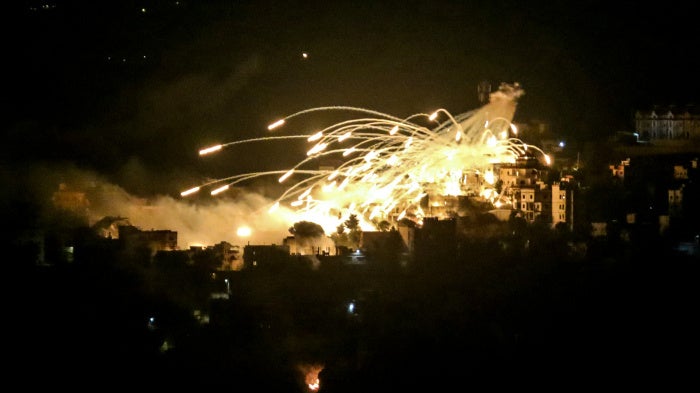
The 45-page report, “Uncontrolled Burn: The Inhumane Effects of White Phosphorus Munitions and the Need for Stronger Law,” documents 23 verified incidents of Israeli use in southern Lebanon between March and May 2026. The report also details the horrific harm the munitions have caused in armed conflicts in recent years. White phosphorus munitions, which produce fire when their payload is exposed to oxygen, are not currently regulated by a specific treaty.
In armed conflicts around the world, cluster munitions are the category of weapons most in need of stronger national and international law to protect civilians from harm.
During the Israel-Hezbollah war, Israel was accused by Human Rights Watch and numerous local and international media outlets of attacking two Lebanese Red Cross ambulances in Qana on July 23, 2006.
Memorandum to Delegates to the Convention on Conventional Weapons
This memorandum contains an updated analysis of the responses provided by states parties to the questionnaire on explosive remnants of war and international humanitarian law issued by members of the Convention on Conventional Weapons (CCW) Working Group on Explosive Remnants of War in 2005 .
In March 2005, members of the Convention on Conventional Weapons (CCW) Working Group on Explosive Remnants of War (ERW) issued a questionnaire to states parties regarding ERW and International Humanitarian Law (IHL).
The Bush administration appears poised to erase many of the positive steps the United States has taken in the past toward banning antipersonnel mines. The United States will decide in December 2005 whether it will begin the production of a new antipersonnel mine called Spider. According to a media report, which the Pentagon has yet to confirm or deny, in May 2005 the U.S.
No weapons used by U.S.-led coalition forces in Iraq in 2003 caused more civilian casualties than cluster munitions, large weapons that contain dozens or hundreds of smaller submunitions. This briefing paper critically examines the status and quality of current U.S.
The potential future dangers of widespread production and continued proliferation of cluster munitions demand urgent action to bring the humanitarian threat under control. At least seventy countries stockpile cluster munitions and the aggregate number of submunitions in these stockpiles is staggering.
The States Parties to the Convention on Conventional Weapons (CCW) have long recognized the dangers of cluster munitions. They first questioned the civilian harm these weapons cause at the Lucerne Conference in 1974 that eventually led to the CCW.
The United States Department of Defense Fiscal Year 2005 budget, which covers October 2004 to September 2005, includes several requests for procuring cluster munitions or their subparts. The Army, Marines, Air Force, and Navy all seek funding for variations of these weapons.
What is new about this policy? The Bush Administration’s policy on landmines, announced February 27, 2004, reverses many of the positive steps the U.S. has made over the past decade to eradicate antipersonnel mines. The use of self-destructing mines is permitted indefinitely without any geographic restrictions.
The concept of smart (i.e., self-destructing) mines certainly has humanitarian allure. In theory, a mine that blows itself up in a relatively short period of time is preferable to a mine that lasts for decades, and should pose less danger to civilians.
Stemming Slovakia's Arms Trade with Human Rights Abusers
The government of Slovakia must do more to bring its arms trade under control. Slovakia adopted some legal reforms in 2001 and 2002, but serious problems remain that allow arms to be exported or illegally trafficked to human rights-abusing countries in Africa and elsewhere. Human Rights Watch says that the country has served as both an exporter and transit hub for arms deals from other countries.
The Conduct of the War and Civilian Casualties in Iraq
Hundreds of civilian deaths in the U.S.-led invasion of Iraq could have been prevented by abandoning two misguided military tactics. The use of cluster munitions in populated areas caused more civilian casualties than any other factor in the coalition´s conduct of major military operations in March and April. U.S.
The Angolan government and the United Nations are failing to ensure the safe and voluntary return of millions of Angolans to their homes. This 29-page report documents several incidents of government authorities using violence, or the threat of violence, to drive people out of camps where they had been living sometimes for years.
The use of cluster munitions in Iraq will result in grave dangers to civilians and friendly combatants. Based on experiences in the Persian Gulf War in 1991, Yugoslavia/Kosovo in 1999, and Afghanistan in 2001 and 2002, these dangers are both foreseeable and preventable.