Recruitment and Use of Children by Colombian Armed Groups
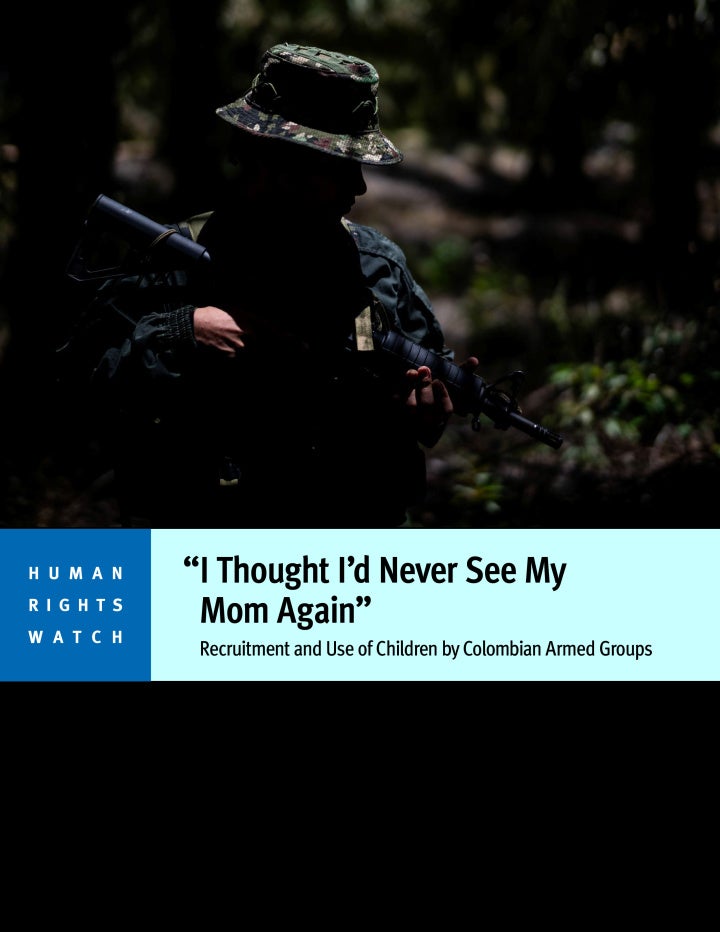
The 102-page report, “‘I Thought I’d Never See My Mom Again’: Recruitment and Use of Children by Colombian Armed Groups,” examines the dynamics of child recruitment, the factors that place children at risk, and the strategies and tools used by armed groups, including through social media platforms, to recruit them. Researchers also analyzed the government’s response and its shortcomings in preventing child recruitment, protecting and rescuing children, assisting the reintegration of those who have been released, and prosecuting the individuals responsible.
Sexual Violence Against Girls in South African Schools
In schools across South Africa, thousands of girls of every race and economic group are encountering sexual violence and harassment that impede their access to education, Human Rights Watch charged in a report released today.
When Colombian President Andrés Pastrana meets with President George W. Bush next Tuesday (February 27), the two leaders will discuss U.S. military aid to Colombia, including the issue of Colombia's progress on improving human rights.
In the past two years, Ugandans have recruited and trained both Hema and Lendu to serve in the forces of the Congolese Rally for Democracy-Liberation Movement (RCD-ML), a rebel group which is backed by Uganda and which nominally controls this area. Within the last year, however, at least some Ugandan officers have reportedly favored the Hema.
Each year over one million children between the ages of seven and twelve are hired by Egypt's agricultural cooperatives to take part in cotton pest management. Employed under the authority of Egypt's agriculture ministry, most are well below Egypt’s minimum age of twelve for seasonal agricultural work.
After fleeing systematic discrimination, forced labor, and other abuses in Burma, ethnic Rohingya in Malaysia face a whole new set of abuses in Malaysia. These include beatings, extortion, and arbitrary detention. The refugees are forced to live in poverty and constant fear of expulsion from the country.
United States Failure to Protect Child Farmworkers
Agricultural work is the most hazardous and grueling area of employment open to children in the United States.3 It is also the least protected. Hundreds of thousands of children and teens labor each year in fields, orchards, and packing sheds across the United States. They pick lettuce and cantaloupe, weed cotton fields, and bag produce.
Human rights conditions have taken a significant turn for the worse in Aceh in the past six months. Civilians continue to be caught in the middle of conflict between government troops and rebels belonging to the Free Aceh Movement (Gerakan Aceh Merdeka or GAM).
Though nine years have passed since Pakistan ratified the U.N. Convention on the Rights of the Child, Pakistani children in conflict with the law continue to be denied the juvenile justice protections of the convention.
Every recognized country in the world, except for the United States and the collapsed state of Somalia, has ratified the Convention on the Rights of the Child, pledging to uphold its protections for children. Today the convention stands as the single most widely ratified treaty in existence.
With frequent references to juvenile predators, hardened criminals, and young thugs, U.S. lawmakers at both the state and federal levels have increasingly abandoned efforts to rehabilitate child offenders through the juvenile court system. Instead, many states have responded to a perceived outbreak in juvenile violent crime by moving more children into the adult criminal system.
For most Kenyan children, violence is a regular part of the school experience. Teachers use caning, slapping, and whipping to maintain classroom discipline and to punish children for poor academic performance. The infliction of corporal punishment is routine, arbitrary, and often brutal.
Sierra Leonean refugee children in Guinea are among the most vulnerable children in the world. They have lived through an extremely brutal war -most have witnessed or suffered unspeakable atrocities including widespread killing, mutilation, and sexual abuse.
The Global Use of Child Soldiers: An estimated 300,000 children under the age of eighteen are currently participating in armed conflicts in more than thirty countries on nearly every continent. While most child soldiers are in their teens, some are as young as seven years old.
Jamaican Children in Police Detention and Government Institutions
In the island nation of Jamaica, many children-often as young as twelve or thirteen-are detained for long periods, sometimes six months or more, in filthy and overcrowded police lockups, in spite of international standards and Jamaican laws that forbid such treatment.
Children in the Custody of the U.S. Immigration and Naturalization Service
In this report, Human Rights Watch charges the U.S. Immigration and Naturalization Service (INS) with violating the rights of unaccompanied children in its custody.