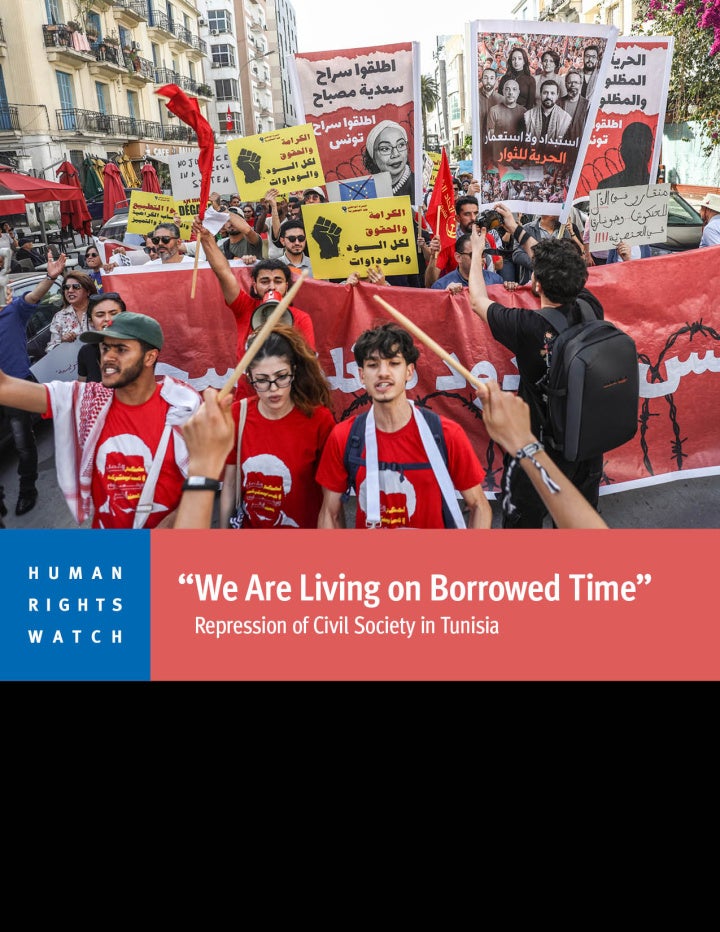
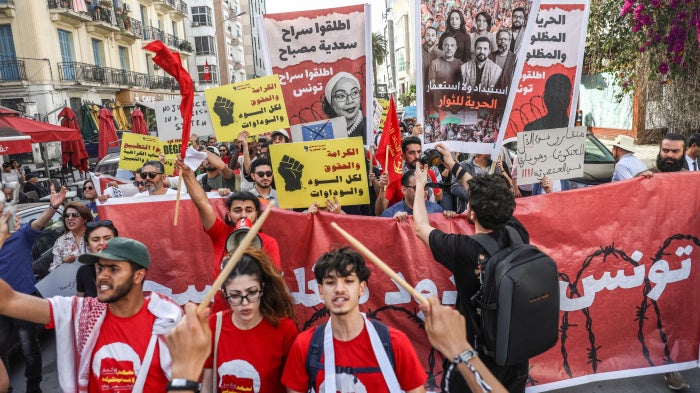
The 49-page report, “‘We Are Living on Borrowed Time’: Repression of Civil Society in Tunisia” documents the Tunisian authorities’ escalating repression of local and international civil society groups, workers, members, and affiliates through the weaponization of abusive prosecutions, arbitrary arrests, detention, financial and criminal investigations, mass suspensions, and threats of dissolution.
Human Rights and Parliamentary Elections in the Islamic Republic of Iran
Iranians voted on March 8, 1996, to elect 270 members of the parliament, or Majles, in an election process that severely limited citizen participation. Parliamentary elections could represent a real contest for power in Iran’s political system—but only if arbitrary bans on candidates and other constraints on political life are lifted.
Since the end of 30 years of military dictatorship and the election in 1992 of the country’s first civilian president in three decades, the Republic of Korea is a more open country with a government that pledges respect for international human rights. Nevertheless, it has not lived up to its pledges.
Letter from Human Rights Watch and the New Cambodian Press Law
Over the last year, the Royal Cambodian Government has waged a campaign to silence its critics, targeting independent newspapers and political figures for prosecution and harassment. On more than a dozen occasions, it has suspended, shut or confiscated newspapers or brought criminal complaints against journalists.
One year after President Clinton unconditionally renewed Most Favored Nation status for China and international pressure on China to improve its human rights practices dropped off dramatically, the Chinese government continues to impose tight controls on dissent and to engage in a pattern of systematic abuse of prisoners.
Forced Resettlement, Suppression of Dissent and Labor Rights Concerns
In April 1992, China’s National People’s Congress (NPC) formally approved the “Resolution on the Construction of the Yangtze River Three Gorges Project,” marking the conclusion of decades of controversy within the Chinese leadership in favor of supporters of the world’s biggest-ever river dam project.
Abuses in East Timor, involving possible extrajudicial executions, torture, disappearances, unlawful arrests and detentions and denials of freedom of association, assembly and expression, continue unabated. The perpetrators are the police and army, as well as a group operating in civilian dress, locally known as “ninjas,” who operate as masked gangs reportedly organized by the military.
Revisited Threats to Freedom of Expression Continue in Miami’s Cuban Exile Community
In 1992, we released a report (see B407) documenting instances of harassment and intimidation against members of the Miami Cuban exile community who expressed moderate political views regarding the government of Fidel Castro or relations with Cuba. In addition to intimidation by private actors, the report found significant responsibility by the U.S. government at all levels.
Continuing Rural Violence and Restrictions on Freedom of Speech and Assembly
After winning the first multiparty election since 1963 in December of 1993, the government of Daniel arap Moi has increased its harassment of the political opposition, bringing spurious criminal charges against opposition politicians, forcing unwarranted restrictions on their freedom of association, and arresting them without charge.
Despite the considerable progress that has been made to ensure an independent press both in practice and in law, there is troubling evidence of official harassment of journalists whose views are critical of the ruling powers, ranging from selective denial of press credentials to the imprisonment of a journalist who wrote an allegory considered defamatory of the President of Romania.
Heightened political tension has been characterized by physical attacks on journalists critical of the former Meciar government. HRW/Helsinki urges the interim government to give special consideration to the concerns outlined in this report and to disassociate itself from the media policies of its predecessor in order to create an environment in which the independent press can flourish.
Freedom of expression on campus in Indonesia became a major issue in mid-1993 with national attention focused on three court cases and the banning of a student newspaper. All of the cases illustrate the tight limits that the Indonesian government places on written and spoken criticism.
Citing violations of core political rights in Mexico — freedom of expression, freedom of association, freedom of assembly, and the right to vote — this report calls for the Clinton administration to address these and other human rights issues as it engages the Mexican government in trade negotiations.
One Party State in KwaZulu Homeland Threatens Transition to Democracy
In examining the human rights record of the government of the KwaZulu homeland in Natal province of South Africa, we found that it does not support Chief Buthelezi’s claim that he is a democrat. KwaZulu is a one-party state, in which the institutions of Inkatha and those of the homeland administration are virtually indistinguishable.
The apparent intensity of public debate, variety of publications and the wealth of artistic achievements in the Islamic Republic of Iran create an illusion of unrestricted discourse. The limits on expression are defined, however, in complex and often arbitrary ways by a government beset by internal power struggles and intolerance.